Department of Medicine and.
Columbia Center for Translational Immunology, College of Physicians and Surgeons, Columbia University, New York, NY; and.
Blood. 2021 Apr 1;137(13):1754-1764. doi: 10.1182/blood.2020006334.
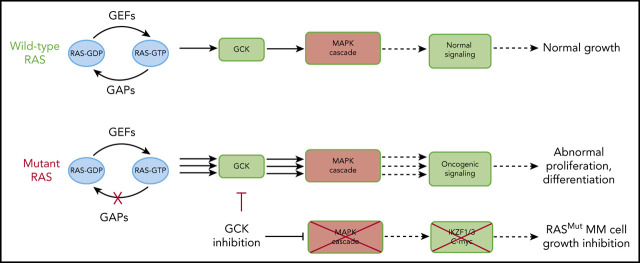
In multiple myeloma (MM), frequent mutations of NRAS, KRAS, or BRAF are found in up to 50% of newly diagnosed patients. The majority of the NRAS, KRAS, and BRAF mutations occur in hotspots causing constitutive activation of the corresponding proteins. Thus, targeting RAS mutation in MM will increase therapeutic efficiency and potentially overcome drug resistance. We identified germinal center kinase (GCK) as a novel therapeutic target in MM with RAS mutation. GCK knockdown (KD) in MM cells demonstrated in vitro and in vivo that silencing of GCK induces MM cell growth inhibition, associated with blocked MKK4/7-JNK phosphorylation and impaired degradation of IKZF1/3, BCL-6, and c-MYC. These effects were rescued by overexpression of a short hairpin RNA (shRNA)-resistant GCK, thereby excluding the potential off-target effects of GCK KD. In contrast, overexpression of shRNA-resistant GCK kinase-dead mutant (K45A) inhibited MM cell proliferation and failed to rescue the effects of GCK KD on MM growth inhibition, indicating that GCK kinase activity is critical for regulating MM cell proliferation and survival. Importantly, the higher sensitivity to GCK KD in RASMut cells suggests that targeting GCK is effective in MM, which harbors RAS mutations. In accordance with the effects of GCK KD, the GCK inhibitor TL4-12 dose-dependently downregulated IKZF1 and BCL-6 and led to MM cell proliferation inhibition accompanied by induction of apoptosis. Here, our data identify GCK as a novel target in RASMut MM cells, providing a rationale to treat RAS mutations in MM. Furthermore, GCK inhibitors might represent an alternative therapy to overcome immunomodulatory drug resistance in MM.
在多发性骨髓瘤(MM)中,多达 50%的新诊断患者中存在NRAS、KRAS 或 BRAF 的频繁突变。大多数NRAS、KRAS 和 BRAF 突变发生在导致相应蛋白组成性激活的热点。因此,针对 MM 中的 RAS 突变将提高治疗效率并有可能克服耐药性。我们发现,生发中心激酶(GCK)是一种新的 RAS 突变 MM 治疗靶点。在 MM 细胞中敲低 GCK(KD),体外和体内研究表明,沉默 GCK 可诱导 MM 细胞生长抑制,与 MKK4/7-JNK 磷酸化受阻和 IKZF1/3、BCL-6 和 c-MYC 降解受损相关。过表达短发夹 RNA(shRNA)抗性 GCK 可挽救这些效应,从而排除 GCK KD 的潜在脱靶效应。相比之下,过表达 shRNA 抗性 GCK 激酶失活突变体(K45A)抑制 MM 细胞增殖,且不能挽救 GCK KD 对 MM 生长抑制的作用,表明 GCK 激酶活性对于调节 MM 细胞增殖和存活至关重要。重要的是,RASMut 细胞对 GCK KD 的更高敏感性表明,针对 GCK 是有效的,这在 MM 中,携带有 RAS 突变。与 GCK KD 的作用一致,GCK 抑制剂 TL4-12 剂量依赖性地下调 IKZF1 和 BCL-6,并导致 MM 细胞增殖抑制,同时诱导凋亡。在这里,我们的数据确定 GCK 是 RASMut MM 细胞中的一个新靶点,为治疗 MM 中的 RAS 突变提供了一个合理的依据。此外,GCK 抑制剂可能代表一种替代疗法,以克服 MM 中的免疫调节药物耐药性。