Division of Hematology, Department of Internal Medicine, Aichi Medical University, 1 Karimata, Yazako, Nagakute, Aichi, 480-1195, Japan.
Int J Hematol. 2022 Jun;115(6):762-777. doi: 10.1007/s12185-022-03353-5. Epub 2022 May 9.
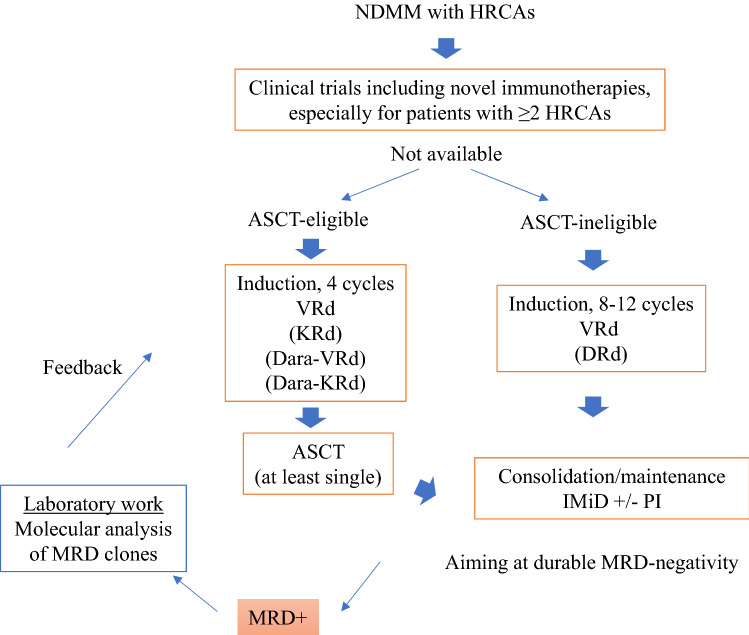
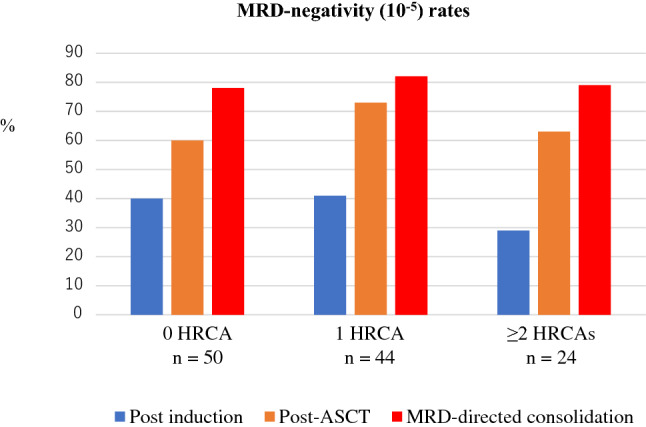
Despite substantial advances in anti-myeloma treatments, early recurrence and death remain an issue in certain subpopulations. Cytogenetic abnormalities (CAs) are the most widely accepted predictors for poor prognosis in multiple myeloma (MM), such as t(4;14), t(14;16), t(14;20), gain/amp(1q21), del(1p), and del(17p). Co-existing high-risk CAs (HRCAs) tend to be associated with an even worse prognosis. Achievement of sustained minimal residual disease (MRD)-negativity has recently emerged as a surrogate for longer survival, regardless of cytogenetic risk. Information from newer clinical trials suggests that extended intensified treatment can help achieve MRD-negativity in patients with HRCAs, which may lead to improved outcomes. Therapy should be considered to include a 3- or 4-drug induction regimen (PI/IMiD/Dex or PI/IMiD/Dex/anti-CD38 antibody), auto-transplantation, and consolidation/maintenance with lenalidomide ± a PI. Results from ongoing clinical trials for enriched high-risk populations will reveal the precise efficacy of the investigated regimens. Genetic abnormalities of MM cells are intrinsic critical factors determining tumor characteristics, which reflect the natural course and drug sensitivity of the disease. This paper reviews the clinicopathological features of genomic abnormalities related to adverse prognosis, focusing on HRCAs that are the most relevant in clinical practice, and outline current optimal therapeutic approaches for newly diagnosed MM with HRCAs.
尽管在抗骨髓瘤治疗方面取得了重大进展,但在某些亚人群中,早期复发和死亡仍然是一个问题。细胞遗传学异常(CAs)是多发性骨髓瘤(MM)预后不良的最广泛接受的预测因素,例如 t(4;14)、t(14;16)、t(14;20)、gain/amp(1q21)、del(1p) 和 del(17p)。同时存在的高危 CA(HRCAs)往往与更差的预后相关。最近,持续的微小残留疾病(MRD)阴性的实现已成为生存时间更长的替代指标,而与细胞遗传学风险无关。来自新临床试验的信息表明,强化治疗可以帮助 HRCAs 患者实现 MRD 阴性,这可能会改善结果。应考虑采用 3 或 4 种药物诱导方案(PI/IMiD/Dex 或 PI/IMiD/Dex/抗 CD38 抗体)、自动移植以及来那度胺联合/不联合 PI 进行巩固/维持治疗。正在进行的高风险人群富集临床试验的结果将揭示所研究方案的确切疗效。MM 细胞的遗传异常是决定肿瘤特征的内在关键因素,反映了疾病的自然病程和药物敏感性。本文综述了与不良预后相关的基因组异常的临床病理特征,重点介绍了在临床实践中最相关的 HRCAs,并概述了新诊断的 HRCAs 多发性骨髓瘤的当前最佳治疗方法。