Department of Geriatric Medicine and Memory Clinic, Research Center on Autonomy and Longevity, University Hospital, Angers, France; UPRES EA 4638, University of Angers, Angers, France.
Department of Geriatric Medicine and Memory Clinic, Research Center on Autonomy and Longevity, University Hospital, Angers, France; Pôle Recherche Clinique et Programmes Thérapeutiques, LNA santé, Vertou, France.
Maturitas. 2020 Nov;141:46-52. doi: 10.1016/j.maturitas.2020.06.023. Epub 2020 Jun 26.
BACKGROUND/OBJECTIVE: The COVID-19 epidemic is particularly serious in older adults. The symptomatology and epidemic profile remain little known in this population, especially in disabled oldest-old people with chronic diseases living in nursing homes. The objective of the present study was to comprehensively describe symptoms and chronological aspects of the diffusion of the SARS-CoV-2 virus in a nursing home, among both residents and caregivers.
Five-week retrospective cohort study.
A middle-sized nursing home in Maine-et-Loire, west of France.
Eighty-seven frail older residents (87.9 ± 7.2years; 71 % female) and 92 staff members (38.3 ± 11.7years; 89 % female) were included.
Mass screening for SARS-CoV-2 was performed in both residents and staff. Attack rate, mortality rate, and symptoms among residents and staff infected with SARS-CoV-2 were recorded.
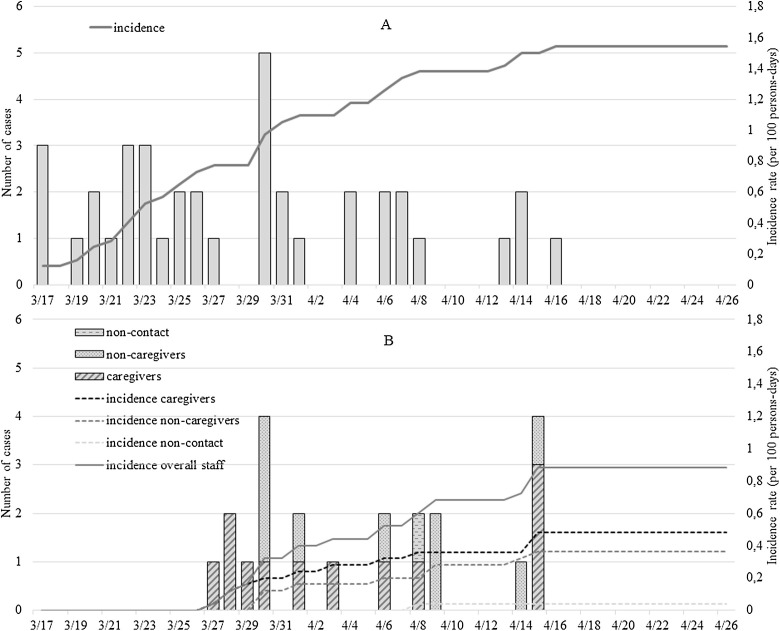
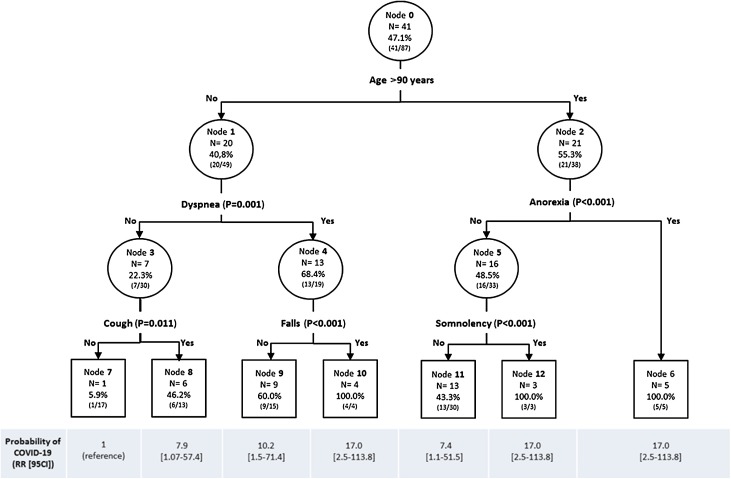
The attack rate of COVID-19 was 47 % in residents (case fatality rate, 27 %), and 24 % in staff. Epidemic curves revealed that the epidemic started in residents before spreading to caregivers. Residents exhibited both general and respiratory signs (59 % hyperthermia, 49 % cough, 42 % polypnea) together with geriatric syndromes (15 % falls, 10 % altered consciousness). The classification tree revealed 100 % COVID-19 probability in the following groups: i) residents younger than 90 with dyspnea and falls; ii) residents older than 90 with anorexia; iii) residents older than 90 without anorexia but with altered consciousness. Finally, 41 % of staff members diagnosed with COVID-19 were asymptomatic.
The pauci-symptomatic expression of COVID-19 in older residents, together with the high prevalence of asymptomatic forms in caregivers, justifies mass screening in nursing homes, possibly prioritizing residents with suggestive combinations of clinical signs including dyspnea, falls, anorexia and/or altered consciousness.
背景/目的:COVID-19 疫情在老年人中尤为严重。在这一人群中,其症状和流行特征仍知之甚少,尤其是在患有慢性病且身体虚弱的居住在养老院中的最年长老年人中。本研究的目的是全面描述养老院中 SARS-CoV-2 病毒在居民和护理人员中的传播症状和时间方面。
回顾性队列研究,持续五周。
法国西部曼恩-卢瓦尔省的一家中型养老院。
87 名身体虚弱的老年居民(87.9 ± 7.2 岁;71%为女性)和 92 名工作人员(38.3 ± 11.7 岁;89%为女性)。
对居民和工作人员进行 SARS-CoV-2 大规模筛查。记录居民和感染 SARS-CoV-2 的工作人员的发病率、死亡率和症状。
COVID-19 的发病率在居民中为 47%(病死率为 27%),在工作人员中为 24%。疫情曲线显示,疫情先在居民中开始,然后传播到护理人员。居民既有一般症状,也有呼吸道症状(59%发热,49%咳嗽,42%呼吸急促),还有老年综合征(15%跌倒,10%意识改变)。分类树显示以下组别的 COVID-19 概率为 100%:i)有呼吸困难和跌倒的 90 岁以下居民;ii)90 岁以上有厌食症的居民;iii)90 岁以上无厌食症但有意识改变的居民。最后,41%被诊断患有 COVID-19 的工作人员无症状。
COVID-19 在老年居民中的症状表现不明显,加上护理人员中有大量无症状病例,因此有理由对养老院进行大规模筛查,可能优先对有提示性临床症状组合的居民进行筛查,包括呼吸困难、跌倒、厌食症和/或意识改变。