Faculty of Health Sciences and Social Care, Molde University College, Molde, Norway.
The Research Centre for Age-Related Functional Decline and Disease, Innlandet Hospital Trust, Ottestad, Norway.
BMC Geriatr. 2023 Feb 17;23(1):101. doi: 10.1186/s12877-023-03826-0.
The coronavirus 2019 (COVID-19) pandemic has led to a high rate of infections, frequent outbreaks, and high mortality rates in nursing homes (NH) worldwide. To protect and improve the treatment and care of the vulnerable NH population, it is pivotal to systematise and synthesise data from cases of COVID-19 among NH residents. In our systematic review, we therefore aimed to describe the clinical expressions, characteristics, and treatments of NH residents confirmed to have COVID-19.
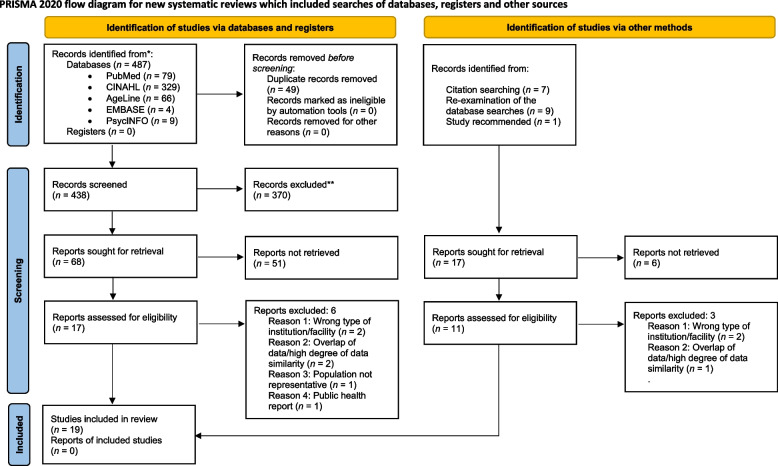
We conducted two comprehensive literature searches in several electronic databases: (1) PubMed, (2) CINAHL, (3) AgeLine, (4) Embase, and (5) PsycINFO in April and July 2021. Of the 438 articles screened, 19 were included in our sample, and we used the Newcastle-Ottawa Assessment Scale to assess the quality of the reported studies. A weighted mean (M), was calculated to account for the large variation in sample sizes of the studies, and due to heterogeneity among the studies, we report our findings in a narrative synthesis.
According to the mean weights (M), common symptoms and signs in NH residents confirmed to have COVID-19 were fever (53.7%), cough (56.5%), hypoxia (32.3%), and delirium or confusion (31.2%). Common comorbidities were hypertension (78.6%), dementia or cognitive impairment (55.3%), and cardiovascular diseases (52.0%). Six studies presented data concerning medical and pharmacological treatments, such as inhalers, oxygen supplementation, anticoagulation, and parenteral/enteral fluids or nutrition. The treatments were used to improve outcomes, as part of palliative care, or as end-of-life treatment. Transfers to hospital for NH residents with confirmed COVID-19 were reported in six of the included studies, and the rate of hospital transfers ranged from 6.9% to 50% in this population. In the 17 studies reporting mortality, 40.2% of the NH residents died during the studies' observation periods.
Our systematic review allowed us to summarise important clinical findings about COVID-19 among NH residents and to identify the population's risk factors for serious illness and death caused by the disease. However, the treatment and care of NH residents with severe COVID-19 warrant further investigation.
2019 年冠状病毒病(COVID-19)大流行导致全球疗养院(NH)的感染率高、频繁爆发和高死亡率。为了保护和改善脆弱的 NH 人群的治疗和护理,系统地综合 COVID-19 疗养院居民病例的数据至关重要。在我们的系统评价中,我们旨在描述确诊为 COVID-19 的 NH 居民的临床表现、特征和治疗方法。
我们在 2021 年 4 月和 7 月在多个电子数据库中进行了两次全面的文献检索:(1)PubMed,(2)CINAHL,(3)AgeLine,(4)Embase 和(5)PsycINFO。在筛选出的 438 篇文章中,有 19 篇被纳入我们的样本,我们使用纽卡斯尔-渥太华评估量表来评估报告研究的质量。由于研究样本量差异很大,且研究之间存在异质性,我们以叙述性综合的方式报告我们的发现。
根据平均权重(M),确诊为 COVID-19 的 NH 居民的常见症状和体征为发热(53.7%)、咳嗽(56.5%)、低氧血症(32.3%)和谵妄或意识混乱(31.2%)。常见的合并症有高血压(78.6%)、痴呆或认知障碍(55.3%)和心血管疾病(52.0%)。有 6 项研究介绍了医疗和药物治疗的数据,如吸入器、氧补充、抗凝治疗以及肠内或肠外补液或营养治疗。这些治疗方法被用于改善结局、姑息治疗或临终治疗。在纳入的 6 项研究中,有 6 项研究报告了确诊 COVID-19 的 NH 居民转院的情况,该人群的转院率在 6.9%至 50%之间。在报告死亡率的 17 项研究中,有 40.2%的 NH 居民在研究观察期间死亡。
我们的系统评价使我们能够总结 NH 居民 COVID-19 的重要临床发现,并确定该人群因疾病而患重病和死亡的风险因素。然而,严重 COVID-19 的 NH 居民的治疗和护理需要进一步研究。