Department of Human Movement Sciences, Faculty of Behavioural and Movement Sciences, Vrije Universiteit Amsterdam, Amsterdam Movement Sciences, Amsterdam, The Netherlands.
Auckland Bioengineering Institute, University of Auckland, Auckland, New Zealand.
Scand J Med Sci Sports. 2021 Feb;31(2):358-370. doi: 10.1111/sms.13851. Epub 2020 Dec 7.
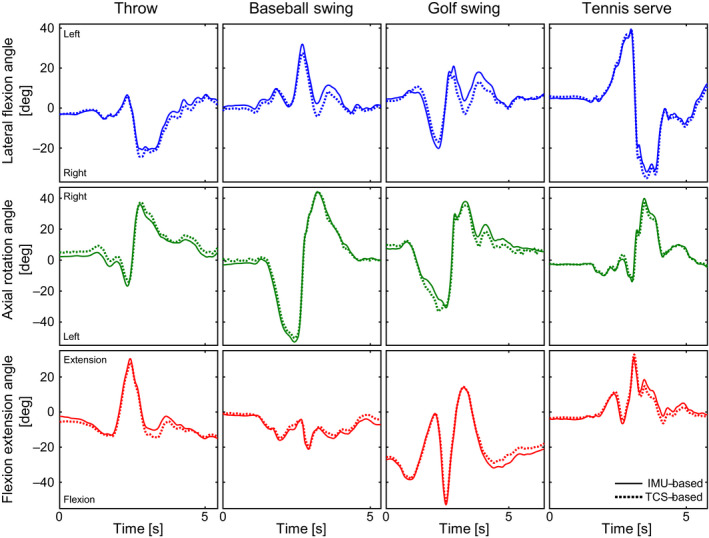
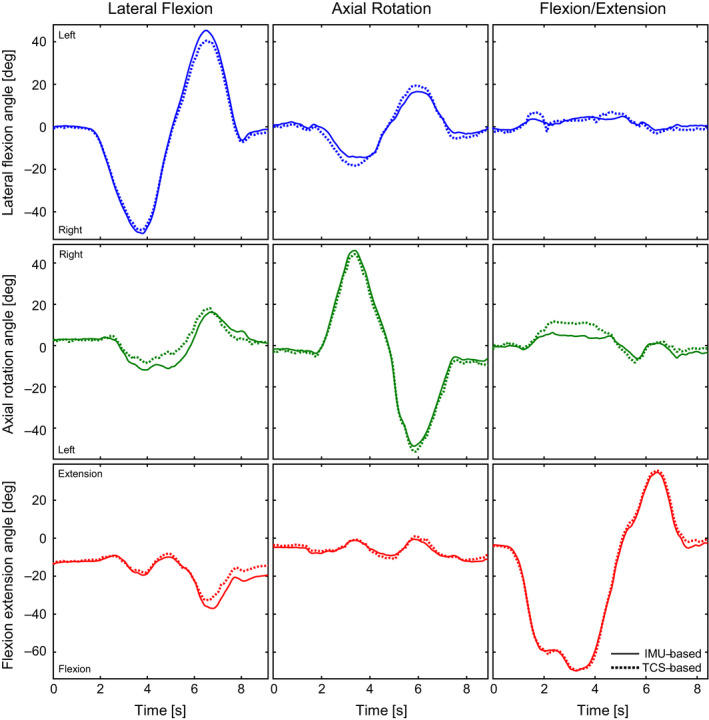
Trunk motion is related to the performance and risk of injuries during dynamic sports motions. Optical motion capture is traditionally used to measure trunk motion during dynamic sports motions, but these systems are typically constrained to a laboratory environment. Inertial measurement units (IMUs) might provide a suitable alternative for measuring the trunk orientation during dynamic sports motions. The objective of the present study was to assess the accuracy of the three-dimensional trunk orientation measured using IMUs during dynamic sports motions and isolated anatomical trunk motions. The motions were recorded with two IMUs and an optical motion capture system (gold standard). Ten participants performed a total of 71 sports motions (19 golf swings, 15 one-handed ball throws, 19 tennis serves, and 18 baseball swings) and 125 anatomical trunk motions (42, 41, and 42 trials of lateral flexion, axial rotation, and flexion/extension, respectively). The root-mean-square differences between the IMU- and optical motion capture-based trunk angles were less than 5 degrees, and the similarity between the methods was on average across all trials "very good" to "excellent" (R ≥ 0.85; R ≥ 0.80). Across the dynamic sports motions, even higher measures of similarity were found (R ≥ 0.90; R ≥ 0.82). When aligned to the relevant segment, the current IMUs are a promising alternative to optical motion capture and previous presented IMU-based systems for the field-based measurement of the three-dimensional trunk orientation during dynamic sports motions and the anatomical trunk motions.
躯干运动与动态运动中的表现和受伤风险有关。传统上,光学运动捕捉系统用于测量动态运动中的躯干运动,但这些系统通常局限于实验室环境。惯性测量单元(IMU)可能是测量动态运动中躯干方向的合适替代方法。本研究的目的是评估在动态运动和解剖学躯干运动中使用 IMU 测量的三维躯干方向的准确性。使用两个 IMU 和一个光学运动捕捉系统(黄金标准)记录了这些运动。10 名参与者总共完成了 71 项运动(19 次高尔夫挥杆、15 次单手投球、19 次网球发球和 18 次棒球挥棒)和 125 次解剖学躯干运动(分别为 42、41 和 42 次侧向弯曲、轴向旋转和屈伸运动)。基于 IMU 和光学运动捕捉的躯干角度之间的均方根差小于 5 度,并且两种方法之间的相似性平均在所有试验中都为“非常好”到“极好”(R≥0.85;R≥0.80)。在动态运动中,发现了更高的相似性度量(R≥0.90;R≥0.82)。当与相关节段对齐时,当前的 IMU 是一种有前途的替代光学运动捕捉和以前基于 IMU 的系统的方法,可用于在动态运动中和解剖学躯干运动中现场测量三维躯干方向。