Baudet Audrey, Morisset Claire, d'Athis Philippe, Maillefert Jean-Francis, Casillas Jean-Marie, Ornetti Paul, Laroche Davy
Centre d'Investigation Clinique INSERM 1432, Plateforme d'Investigation Technologique, Dijon University Hospital, Dijon, France.
Centre d'Investigation Clinique INSERM 1432, Plateforme d'Investigation Technologique, Dijon University Hospital, Dijon, France; INSERM U1093, Dijon, France.
PLoS One. 2014 Jul 8;9(7):e102098. doi: 10.1371/journal.pone.0102098. eCollection 2014.
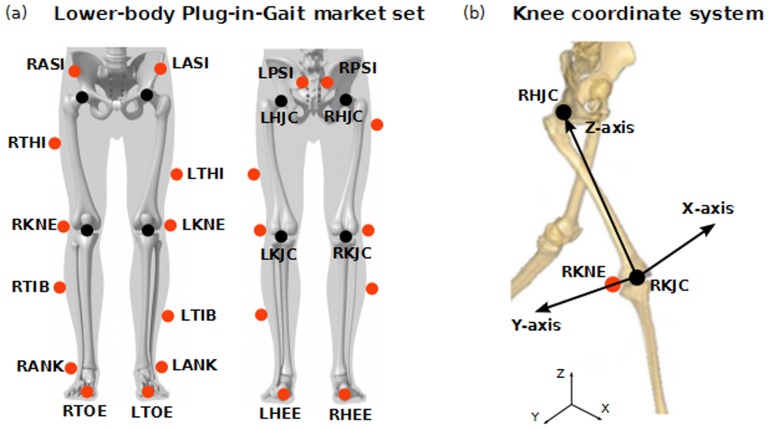
In 3D gait analysis, the knee joint is usually described by the Eulerian way. It consists in breaking down the motion between the articulating bones of the knee into three rotations around three axes: flexion/extension, abduction/adduction and internal/external rotation. However, the definition of these axes is prone to error, such as the "cross-talk" effect, due to difficult positioning of anatomical landmarks. This paper proposes a correction method, principal component analysis (PCA), based on an objective kinematic criterion for standardization, in order to improve knee joint kinematic analysis.
The method was applied to the 3D gait data of two different groups (twenty healthy subjects and four with knee osteoarthritis). Then, this method was evaluated with respect to three main criteria: (1) the deletion of knee joint angle cross-talk (2) the reduction of variance in the varus/valgus kinematic profile (3) the posture trial varus/valgus deformation matching the X-ray value for patients with knee osteoarthritis. The effect of the correction method was tested statistically on variabilities and cross-talk during gait.
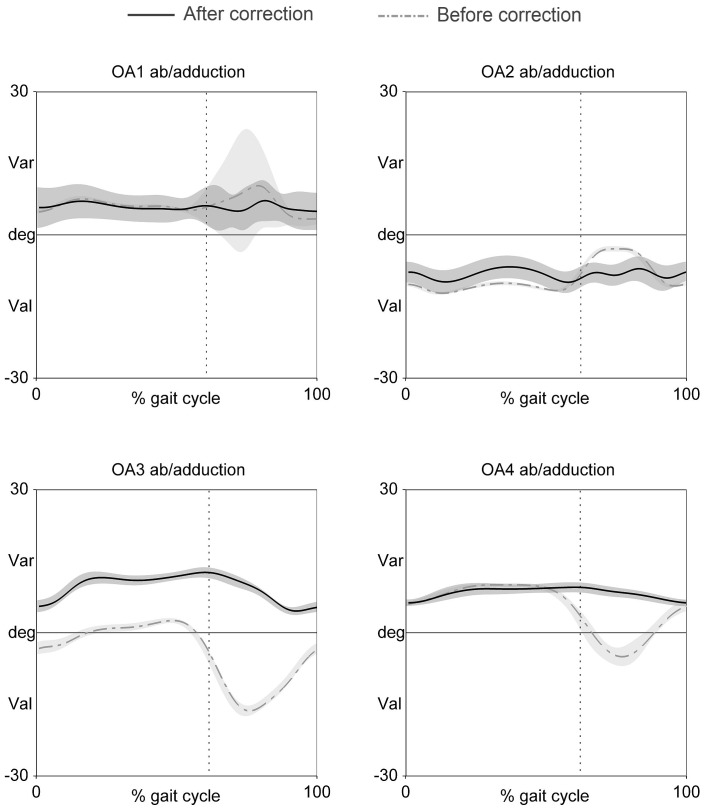
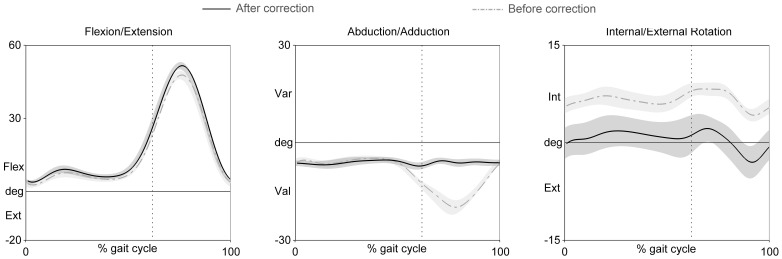
Cross-talk was lower (p<0.05) after correction (the correlation between the flexion-extension and varus-valgus kinematic profiles being annihilated). Additionally, the variance in the kinematic profile for knee varus/valgus and knee flexion/extension was found to be lower and higher (p<0.05), respectively, after correction for both the left and right side. Moreover, after correction, the posture trial varus/valgus angles were much closer to x-ray grading.
The results show that the PCA correction applied to the knee joint eliminates the cross-talk effect, and does not alter the radiological varus/valgus deformation for patients with knee osteoarthritis. These findings suggest that the proposed correction method produces new rotational axes that better fit true knee motion.
在三维步态分析中,膝关节通常采用欧拉角的方式进行描述。这包括将膝关节的关节骨之间的运动分解为围绕三个轴的三种旋转:屈伸、内收外展和内外旋转。然而,由于解剖标志定位困难,这些轴的定义容易出错,例如“串扰”效应。本文提出了一种基于客观运动学标准进行标准化的校正方法——主成分分析(PCA),以改善膝关节运动学分析。
该方法应用于两组不同的三维步态数据(20名健康受试者和4名膝关节骨关节炎患者)。然后,根据三个主要标准对该方法进行评估:(1)消除膝关节角度串扰;(2)减少内翻/外翻运动学曲线的方差;(3)膝关节骨关节炎患者的姿势试验内翻/外翻变形与X射线值匹配。在校正方法的效果在步态期间的变异性和串扰方面进行了统计学测试。
校正后串扰较低(p<0.05)(屈伸和内翻-外翻运动学曲线之间的相关性消失)。此外,校正后发现左右两侧膝关节内翻/外翻和膝关节屈伸运动学曲线的方差分别较低和较高(p<0.05)。此外,校正后,姿势试验内翻/外翻角度更接近X射线分级。
结果表明,应用于膝关节的PCA校正消除了串扰效应,并且不会改变膝关节骨关节炎患者的放射学内翻/外翻变形。这些发现表明,所提出的校正方法产生了更符合真实膝关节运动的新旋转轴。