• 文献检索
  • 文档翻译
  • 深度研究
  • 学术资讯
  • Suppr Zotero 插件Zotero 插件
  • 邀请有礼
  • 套餐&价格
  • 历史记录
应用&插件
Suppr Zotero 插件Zotero 插件浏览器插件Mac 客户端Windows 客户端微信小程序
定价
高级版会员购买积分包购买API积分包
服务
文献检索文档翻译深度研究API 文档MCP 服务
关于我们
关于 Suppr公司介绍联系我们用户协议隐私条款
关注我们

Suppr 超能文献

核心技术专利:CN118964589B侵权必究
粤ICP备2023148730 号-1Suppr @ 2026

文献检索

告别复杂PubMed语法,用中文像聊天一样搜索,搜遍4000万医学文献。AI智能推荐,让科研检索更轻松。

立即免费搜索

文件翻译

保留排版,准确专业,支持PDF/Word/PPT等文件格式,支持 12+语言互译。

免费翻译文档

深度研究

AI帮你快速写综述,25分钟生成高质量综述,智能提取关键信息,辅助科研写作。

立即免费体验

使用胸部计算机断层扫描和实验室测量预测COVID-19严重程度:基于机器学习方法的评估

Prediction of COVID-19 Severity Using Chest Computed Tomography and Laboratory Measurements: Evaluation Using a Machine Learning Approach.

作者信息

Li Daowei, Zhang Qiang, Tan Yue, Feng Xinghuo, Yue Yuanyi, Bai Yuhan, Li Jimeng, Li Jiahang, Xu Youjun, Chen Shiyu, Xiao Si-Yu, Sun Muyan, Li Xiaona, Zhu Fang

机构信息

Department of Radiology, The People's Hospital of China Medical University & The People's Hospital of Liaoning Province, Shenyang, China.

Department of Pulmonary and Critical Care Medicine, Shengjing Hospital of China Medical University, Shenyang, China.

出版信息

JMIR Med Inform. 2020 Nov 17;8(11):e21604. doi: 10.2196/21604.

DOI:10.2196/21604
PMID:33038076
原文链接:https://pmc.ncbi.nlm.nih.gov/articles/PMC7674140/
Abstract

BACKGROUND

Most of the mortality resulting from COVID-19 has been associated with severe disease. Effective treatment of severe cases remains a challenge due to the lack of early detection of the infection.

OBJECTIVE

This study aimed to develop an effective prediction model for COVID-19 severity by combining radiological outcome with clinical biochemical indexes.

METHODS

A total of 46 patients with COVID-19 (10 severe, 36 nonsevere) were examined. To build the prediction model, a set of 27 severe and 151 nonsevere clinical laboratory records and computerized tomography (CT) records were collected from these patients. We managed to extract specific features from the patients' CT images by using a recently published convolutional neural network. We also trained a machine learning model combining these features with clinical laboratory results.

RESULTS

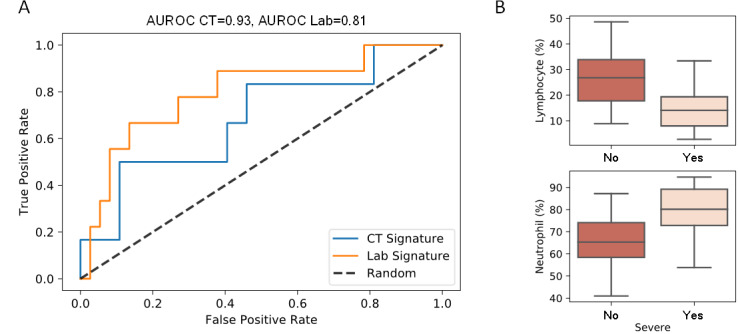
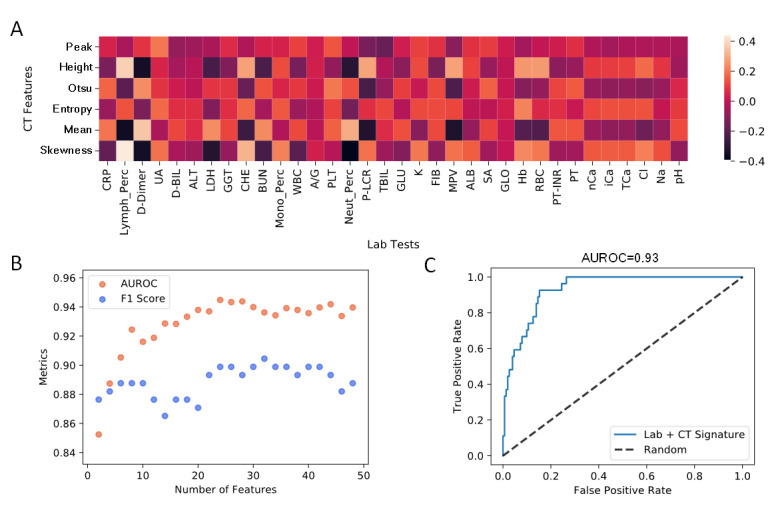
We present a prediction model combining patients' radiological outcomes with their clinical biochemical indexes to identify severe COVID-19 cases. The prediction model yielded a cross-validated area under the receiver operating characteristic (AUROC) score of 0.93 and an F score of 0.89, which showed a 6% and 15% improvement, respectively, compared to the models based on laboratory test features only. In addition, we developed a statistical model for forecasting COVID-19 severity based on the results of patients' laboratory tests performed before they were classified as severe cases; this model yielded an AUROC score of 0.81.

CONCLUSIONS

To our knowledge, this is the first report predicting the clinical progression of COVID-19, as well as forecasting severity, based on a combined analysis using laboratory tests and CT images.

摘要

背景

2019年冠状病毒病(COVID-19)导致的死亡大多与重症相关。由于缺乏对感染的早期检测,重症病例的有效治疗仍然是一项挑战。

目的

本研究旨在通过将影像学结果与临床生化指标相结合,开发一种用于预测COVID-19严重程度的有效模型。

方法

共检查了46例COVID-19患者(10例重症,36例非重症)。为构建预测模型,从这些患者中收集了27例重症和151例非重症的临床实验室记录及计算机断层扫描(CT)记录。我们利用最近发表的卷积神经网络从患者的CT图像中提取特定特征。我们还训练了一个将这些特征与临床实验室结果相结合的机器学习模型。

结果

我们提出了一种将患者影像学结果与临床生化指标相结合的预测模型,以识别重症COVID-19病例。该预测模型在受试者工作特征曲线下面积(AUROC)的交叉验证得分是0.93,F得分是0.89,与仅基于实验室检测特征的模型相比,分别提高了6%和15%。此外,我们基于患者在被分类为重症病例之前进行的实验室检测结果,开发了一种预测COVID-19严重程度的统计模型;该模型的AUROC得分为0.81。

结论

据我们所知,这是第一份基于实验室检测和CT图像的综合分析来预测COVID-19临床进展以及严重程度的报告。

https://cdn.ncbi.nlm.nih.gov/pmc/blobs/99c5/7674140/343f6dab94d2/medinform_v8i11e21604_fig5.jpg
https://cdn.ncbi.nlm.nih.gov/pmc/blobs/99c5/7674140/d2b51346353d/medinform_v8i11e21604_fig1.jpg
https://cdn.ncbi.nlm.nih.gov/pmc/blobs/99c5/7674140/b98a2a62067d/medinform_v8i11e21604_fig2.jpg
https://cdn.ncbi.nlm.nih.gov/pmc/blobs/99c5/7674140/2f358c04871e/medinform_v8i11e21604_fig3.jpg
https://cdn.ncbi.nlm.nih.gov/pmc/blobs/99c5/7674140/aa40e1214e00/medinform_v8i11e21604_fig4.jpg
https://cdn.ncbi.nlm.nih.gov/pmc/blobs/99c5/7674140/343f6dab94d2/medinform_v8i11e21604_fig5.jpg
https://cdn.ncbi.nlm.nih.gov/pmc/blobs/99c5/7674140/d2b51346353d/medinform_v8i11e21604_fig1.jpg
https://cdn.ncbi.nlm.nih.gov/pmc/blobs/99c5/7674140/b98a2a62067d/medinform_v8i11e21604_fig2.jpg
https://cdn.ncbi.nlm.nih.gov/pmc/blobs/99c5/7674140/2f358c04871e/medinform_v8i11e21604_fig3.jpg
https://cdn.ncbi.nlm.nih.gov/pmc/blobs/99c5/7674140/aa40e1214e00/medinform_v8i11e21604_fig4.jpg
https://cdn.ncbi.nlm.nih.gov/pmc/blobs/99c5/7674140/343f6dab94d2/medinform_v8i11e21604_fig5.jpg

相似文献

1
Prediction of COVID-19 Severity Using Chest Computed Tomography and Laboratory Measurements: Evaluation Using a Machine Learning Approach.使用胸部计算机断层扫描和实验室测量预测COVID-19严重程度:基于机器学习方法的评估
JMIR Med Inform. 2020 Nov 17;8(11):e21604. doi: 10.2196/21604.
2
Prediction of COVID Criticality Score with Laboratory, Clinical and CT Images using Hybrid Regression Models.基于混合回归模型的实验室、临床和 CT 图像对 COVID 危重评分的预测。
Comput Methods Programs Biomed. 2021 Sep;209:106336. doi: 10.1016/j.cmpb.2021.106336. Epub 2021 Aug 10.
3
Fine-Grained Assessment of COVID-19 Severity Based on Clinico-Radiological Data Using Machine Learning.基于临床和影像学数据的机器学习对 COVID-19 严重程度的精细评估。
Int J Environ Res Public Health. 2022 Aug 26;19(17):10665. doi: 10.3390/ijerph191710665.
4
Severe/critical COVID-19 early warning system based on machine learning algorithms using novel imaging scores.基于使用新型影像评分的机器学习算法的重症/危重症新型冠状病毒肺炎预警系统
World J Clin Cases. 2023 Apr 26;11(12):2716-2728. doi: 10.12998/wjcc.v11.i12.2716.
5
Predicting survival of Iranian COVID-19 patients infected by various variants including omicron from CT Scan images and clinical data using deep neural networks.利用深度神经网络,通过CT扫描图像和临床数据预测包括奥密克戎在内的各种变异毒株感染的伊朗新冠肺炎患者的生存率。
Heliyon. 2023 Nov 8;9(11):e21965. doi: 10.1016/j.heliyon.2023.e21965. eCollection 2023 Nov.
6
Machine Learning Approach to Predicting COVID-19 Disease Severity Based on Clinical Blood Test Data: Statistical Analysis and Model Development.基于临床血液检测数据预测COVID-19疾病严重程度的机器学习方法:统计分析与模型开发
JMIR Med Inform. 2021 Apr 13;9(4):e25884. doi: 10.2196/25884.
7
Deep Learning Models for Predicting Severe Progression in COVID-19-Infected Patients: Retrospective Study.用于预测新冠病毒感染患者严重病情进展的深度学习模型:回顾性研究
JMIR Med Inform. 2021 Jan 28;9(1):e24973. doi: 10.2196/24973.
8
Development of an unsupervised machine learning algorithm for the prognostication of walking ability in spinal cord injury patients.开发一种用于预测脊髓损伤患者行走能力的无监督机器学习算法。
Spine J. 2020 Feb;20(2):213-224. doi: 10.1016/j.spinee.2019.09.007. Epub 2019 Sep 13.
9
Artificial Intelligence-Based Multimodal Risk Assessment Model for Surgical Site Infection (AMRAMS): Development and Validation Study.基于人工智能的手术部位感染多模态风险评估模型(AMRAMS):开发与验证研究
JMIR Med Inform. 2020 Jun 15;8(6):e18186. doi: 10.2196/18186.
10
Development and Performance of the Pulmonary Embolism Result Forecast Model (PERFORM) for Computed Tomography Clinical Decision Support.用于计算机断层扫描临床决策支持的肺栓塞结果预测模型 (PERFORM) 的开发和性能。
JAMA Netw Open. 2019 Aug 2;2(8):e198719. doi: 10.1001/jamanetworkopen.2019.8719.

引用本文的文献

1
A hybrid inception-dilated-ResNet architecture for deep learning-based prediction of COVID-19 severity.一种用于基于深度学习预测COVID-19严重程度的混合Inception-扩张式ResNet架构。
Sci Rep. 2025 Feb 22;15(1):6490. doi: 10.1038/s41598-025-91322-3.
2
COVID-19 mortality prediction in Hungarian ICU settings implementing random forest algorithm.在实施随机森林算法的匈牙利 ICU 环境中预测 COVID-19 死亡率。
Sci Rep. 2024 May 24;14(1):11941. doi: 10.1038/s41598-024-62791-9.
3
Severe/critical COVID-19 early warning system based on machine learning algorithms using novel imaging scores.

本文引用的文献

1
Automatic lung segmentation in routine imaging is primarily a data diversity problem, not a methodology problem.常规影像中的自动肺分割主要是一个数据多样性问题,而不是方法学问题。
Eur Radiol Exp. 2020 Aug 20;4(1):50. doi: 10.1186/s41747-020-00173-2.
2
COVID-19 Pneumonia Diagnosis Using a Simple 2D Deep Learning Framework With a Single Chest CT Image: Model Development and Validation.使用具有单张胸部CT图像的简单二维深度学习框架诊断COVID-19肺炎:模型开发与验证
J Med Internet Res. 2020 Jun 29;22(6):e19569. doi: 10.2196/19569.
3
Automated detection of COVID-19 cases using deep neural networks with X-ray images.
基于使用新型影像评分的机器学习算法的重症/危重症新型冠状病毒肺炎预警系统
World J Clin Cases. 2023 Apr 26;11(12):2716-2728. doi: 10.12998/wjcc.v11.i12.2716.
4
Predicting the Disease Severity of Virus Infection.预测病毒感染的疾病严重程度。
Adv Exp Med Biol. 2022;1368:111-139. doi: 10.1007/978-981-16-8969-7_6.
5
A novel reliability-based regression model to analyze and forecast the severity of COVID-19 patients.一种新颖的基于可靠性的回归模型,用于分析和预测 COVID-19 患者的严重程度。
BMC Med Inform Decis Mak. 2022 May 5;22(1):123. doi: 10.1186/s12911-022-01861-2.
6
Determination of the Severity and Percentage of COVID-19 Infection through a Hierarchical Deep Learning System.通过分层深度学习系统确定新冠病毒感染的严重程度和百分比
J Pers Med. 2022 Mar 28;12(4):535. doi: 10.3390/jpm12040535.
7
Prognostic findings for ICU admission in patients with COVID-19 pneumonia: baseline and follow-up chest CT and the added value of artificial intelligence.COVID-19 肺炎患者 ICU 入院的预后发现:基线和随访胸部 CT 以及人工智能的附加值。
Emerg Radiol. 2022 Apr;29(2):243-262. doi: 10.1007/s10140-021-02008-y. Epub 2022 Jan 20.
8
A deep learning approach for predicting severity of COVID-19 patients using a parsimonious set of laboratory markers.一种使用简约实验室指标集预测新冠肺炎患者严重程度的深度学习方法。
iScience. 2021 Dec 17;24(12):103523. doi: 10.1016/j.isci.2021.103523. Epub 2021 Nov 27.
9
The Applications of Artificial Intelligence in Chest Imaging of COVID-19 Patients: A Literature Review.人工智能在COVID-19患者胸部成像中的应用:文献综述
Diagnostics (Basel). 2021 Jul 22;11(8):1317. doi: 10.3390/diagnostics11081317.
10
A State-of-the-Art Survey on Artificial Intelligence to Fight COVID-19.关于抗击新冠疫情的人工智能技术的最新进展综述
J Clin Med. 2021 May 2;10(9):1961. doi: 10.3390/jcm10091961.
使用 X 射线图像的深度学习神经网络自动检测 COVID-19 病例。
Comput Biol Med. 2020 Jun;121:103792. doi: 10.1016/j.compbiomed.2020.103792. Epub 2020 Apr 28.
4
Identification of Symptoms Prognostic of COVID-19 Severity: Multivariate Data Analysis of a Case Series in Henan Province.新冠病毒病严重程度的症状预后识别:河南省一组病例的多变量数据分析
J Med Internet Res. 2020 Jun 30;22(6):e19636. doi: 10.2196/19636.
5
Chest CT features of coronavirus disease 2019 (COVID-19) pneumonia: key points for radiologists.COVID-19 肺炎的胸部 CT 特征:放射科医生的关键点。
Radiol Med. 2020 Jul;125(7):636-646. doi: 10.1007/s11547-020-01237-4. Epub 2020 Jun 4.
6
COVID-19 identification in chest X-ray images on flat and hierarchical classification scenarios.基于平面和分层分类场景的胸部 X 射线图像中的 COVID-19 识别。
Comput Methods Programs Biomed. 2020 Oct;194:105532. doi: 10.1016/j.cmpb.2020.105532. Epub 2020 May 8.
7
Comorbid Chronic Diseases and Acute Organ Injuries Are Strongly Correlated with Disease Severity and Mortality among COVID-19 Patients: A Systemic Review and Meta-Analysis.合并慢性疾病和急性器官损伤与COVID-19患者的疾病严重程度和死亡率密切相关:一项系统评价和荟萃分析。
Research (Wash D C). 2020 Apr 19;2020:2402961. doi: 10.34133/2020/2402961. eCollection 2020.
8
Multicenter cohort study demonstrates more consolidation in upper lungs on initial CT increases the risk of adverse clinical outcome in COVID-19 patients.多中心队列研究表明,COVID-19 患者初始 CT 上肺部上叶实变程度增加与不良临床结局风险增加相关。
Theranostics. 2020 Apr 27;10(12):5641-5648. doi: 10.7150/thno.46465. eCollection 2020.
9
CT quantification of pneumonia lesions in early days predicts progression to severe illness in a cohort of COVID-19 patients.CT 量化评估新冠肺炎患者早期肺炎病变可预测疾病进展为重症。
Theranostics. 2020 Apr 27;10(12):5613-5622. doi: 10.7150/thno.45985. eCollection 2020.
10
Prognostic value of interleukin-6, C-reactive protein, and procalcitonin in patients with COVID-19.白细胞介素-6、C 反应蛋白和降钙素原对 COVID-19 患者的预后价值。
J Clin Virol. 2020 Jun;127:104370. doi: 10.1016/j.jcv.2020.104370. Epub 2020 Apr 14.