Department of Immunology, Aggeu Magalhães Institute (IAM), Oswaldo Cruz Foundation (FIOCRUZ), 50670-420 Recife, PE, Brazil; Graduate Program in Applied Cellular and Molecular Biology, University of Pernambuco (UPE), 50100-130 Recife, PE, Brazil.
Department of Chemistry, University of Miami, 1301 Memorial Drive, Coral Gables, FL 33146, USA.
J Control Release. 2021 Jan 10;329:758-761. doi: 10.1016/j.jconrel.2020.10.009. Epub 2020 Oct 7.
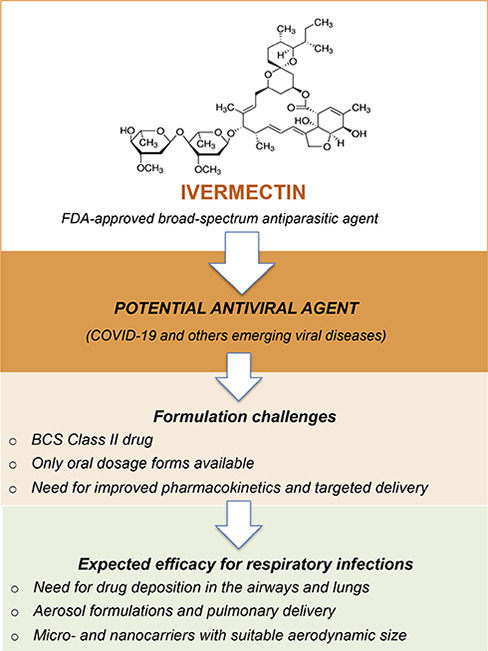
Ivermectin is an FDA-approved broad-spectrum antiparasitic agent with demonstrated antiviral activity against a number of DNA and RNA viruses, including severe acute respiratory syndrome coronavirus 2 (SARS-CoV-2). Despite this promise, the antiviral activity of ivermectin has not been consistently proven in vivo. While ivermectin's activity against SARS-CoV-2 is currently under investigation in patients, insufficient emphasis has been placed on formulation challenges. Here, we discuss challenges surrounding the use of ivermectin in the context of coronavirus disease-19 (COVID-19) and how novel formulations employing micro- and nanotechnologies may address these concerns.
伊维菌素是一种获得美国食品药品监督管理局批准的广谱抗寄生虫药物,已证明其具有针对多种 DNA 和 RNA 病毒的抗病毒活性,包括严重急性呼吸综合征冠状病毒 2(SARS-CoV-2)。尽管有这样的前景,但伊维菌素在体内的抗病毒活性尚未得到一致证实。虽然伊维菌素对 SARS-CoV-2 的活性目前正在患者中进行研究,但对配方挑战的重视程度还不够。在这里,我们讨论了在冠状病毒病-19(COVID-19)背景下使用伊维菌素所面临的挑战,以及采用微纳技术的新型制剂如何解决这些问题。