Santas Enrique, Miñana Gema, Cardells Ingrid, Palau Patricia, Llàcer Pau, Fácila Lorenzo, Almenar Luis, López-Lereu Maria P, Monmeneu Jose V, Sanchis Juan, Maceira Alicia M, Bayés-Genís Antoni, Núñez Julio
Cardiology Department, Hospital Clínico Universitario de Valencia, Universidad de Valencia, INCLIVA, Valencia, Spain.
CIBER Cardiovascular, Madrid, Spain.
ESC Heart Fail. 2020 Dec;7(6):4222-4230. doi: 10.1002/ehf2.13053. Epub 2020 Oct 11.
The mechanisms underlying the beneficial effect of ferric carboxymaltose (FCM) in patients with heart failure (HF) and iron deficiency (ID) have not been completely characterized. The Myocardial-IRON trial was a double-blind, randomized trial that evaluated myocardial iron repletion following FCM vs. placebo in 53 patients with HF and ID. In this post hoc analysis, we evaluated whether treatment with FCM was associated with cardiac magnetic resonance changes in left and right ventricular function (LVEF and RVEF, respectively) at different points of systolic dysfunction.
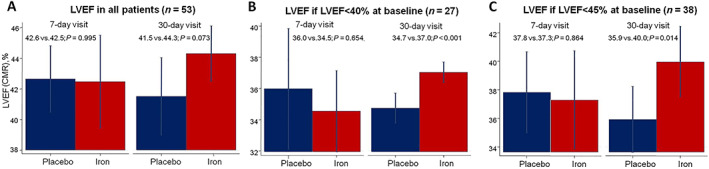
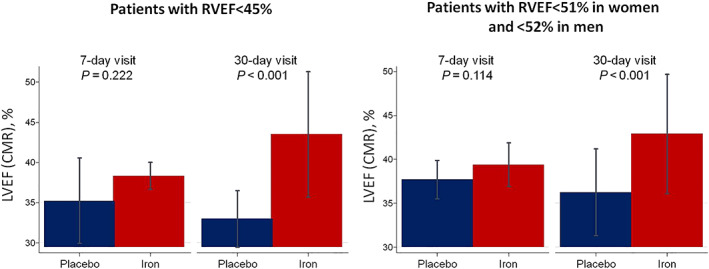
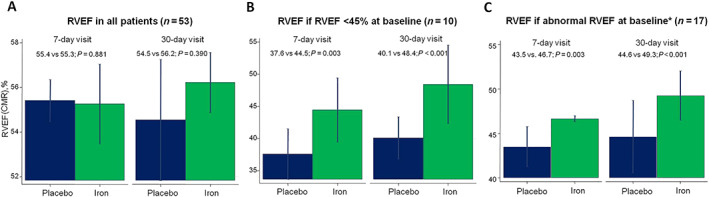
We included patients from the Myocardial-IRON trial with left and right ventricular systolic dysfunction (LVSD and RVSD, respectively) at enrolment. Linear mixed regression models were used to evaluate changes at 7 and 30 days on LVEF and RVEF at cardiac magnetic resonance. At enrolment, 27 (50.9%) and 38 (71.7%) patients had LVEF < 40% (LVSD ) or <45% (LVSD ), respectively, and 10 (18.9%) and 17 (32.1%) patients had RVEF < 45% (RVSD ) or <51% in women and <52% in men (RVSD , respectively. Treatment with FCM was associated with a significant improvement in LVEF at 30 days (LVSD : Δ2.3%, P < 0.001; LVSD : Δ4.1, P = 0.014). FCM was also associated with a significant and early improvement in RVEF at 7 days (RVSD : Δ6.9%, P = 0.003; RVSD : Δ3.2%, P = 0.003) that persisted at 30 days (RVSD : Δ8.1%, P < 0.001; RVSD : Δ4.7%, P < 0.001).
In patients with HF and systolic dysfunction with ID, FCM was associated with short-term improvement in LVEF and, especially, in RVEF.
羧基麦芽糖铁(FCM)对心力衰竭(HF)合并缺铁(ID)患者有益作用的潜在机制尚未完全明确。心肌铁试验是一项双盲随机试验,评估了53例HF合并ID患者接受FCM与安慰剂治疗后心肌铁的补充情况。在这项事后分析中,我们评估了FCM治疗是否与不同收缩功能障碍阶段左、右心室功能(分别为左心室射血分数[LVEF]和右心室射血分数[RVEF])的心脏磁共振变化相关。
我们纳入了心肌铁试验中入组时存在左、右心室收缩功能障碍(分别为LVSD和RVSD)的患者。采用线性混合回归模型评估心脏磁共振检查时第7天和第30天LVEF和RVEF的变化。入组时,分别有27例(50.9%)和38例(71.7%)患者LVEF<40%(LVSD)或<45%(LVSD),10例(18.9%)和17例(32.1%)患者RVEF<45%(RVSD)或女性<51%、男性<52%(分别为RVSD)。FCM治疗与第30天LVEF的显著改善相关(LVSD:Δ2.3%,P<0.001;LVSD:Δ4.1,P=0.014)。FCM还与第7天RVEF的显著早期改善相关(RVSD:Δ6.9%,P=0.003;RVSD:Δ3.2%,P=0.003),并持续至第30天(RVSD:Δ8.1%,P<0.001;RVSD:Δ4.7%,P<0.001)。
在HF合并ID且存在收缩功能障碍的患者中,FCM与LVEF尤其是RVEF的短期改善相关。