Immunobiology Department, Carlos III Health Institute, Madrid, Spain.
Chronic Disease Programme, Carlos III Health Institute, Madrid, Spain.
Front Immunol. 2020 Sep 16;11:2120. doi: 10.3389/fimmu.2020.02120. eCollection 2020.
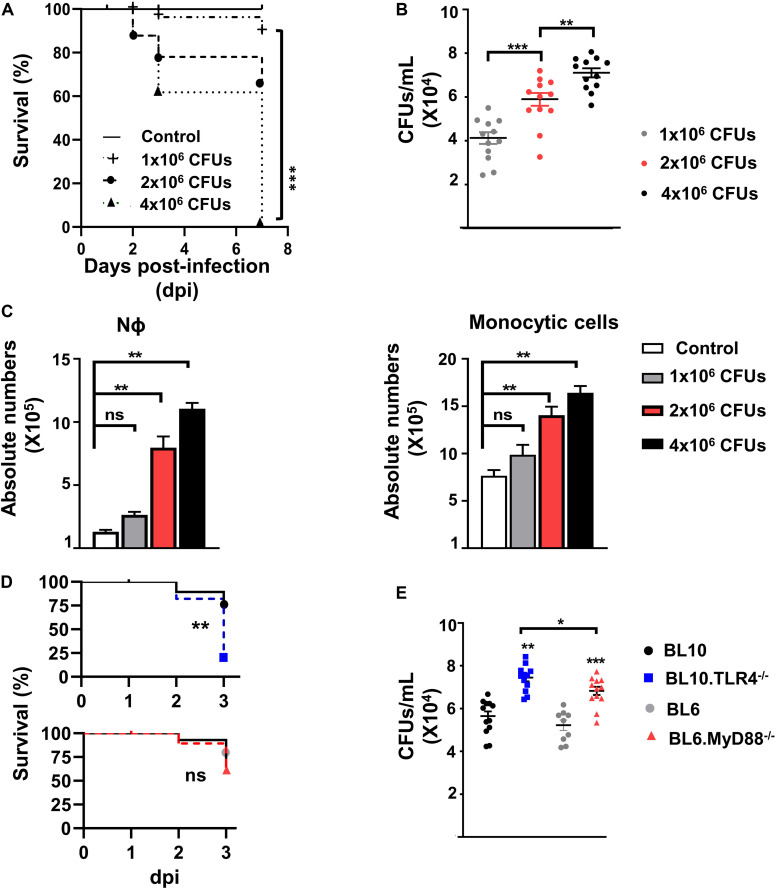
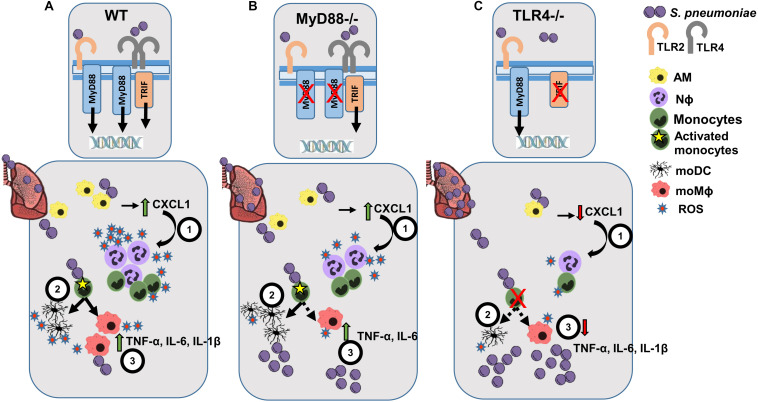
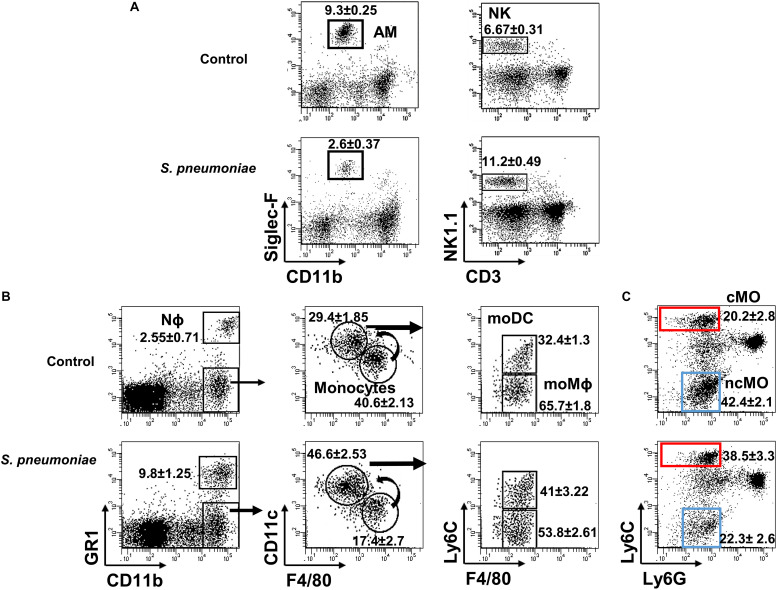
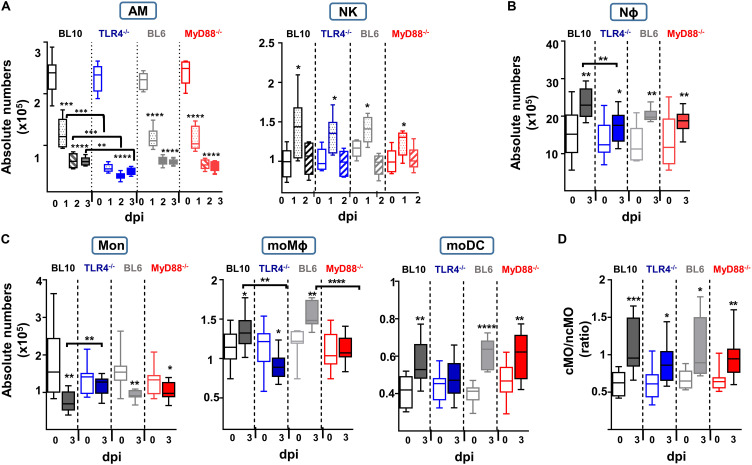
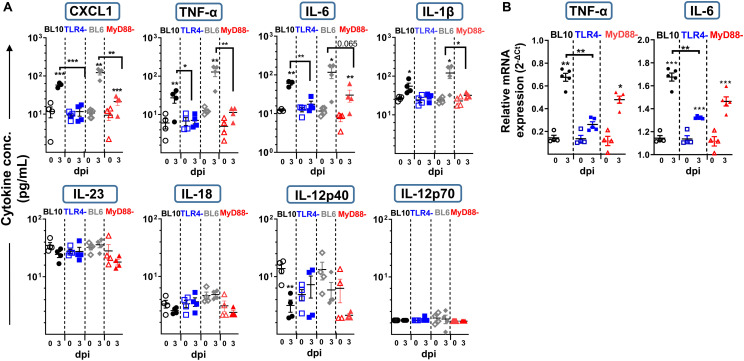
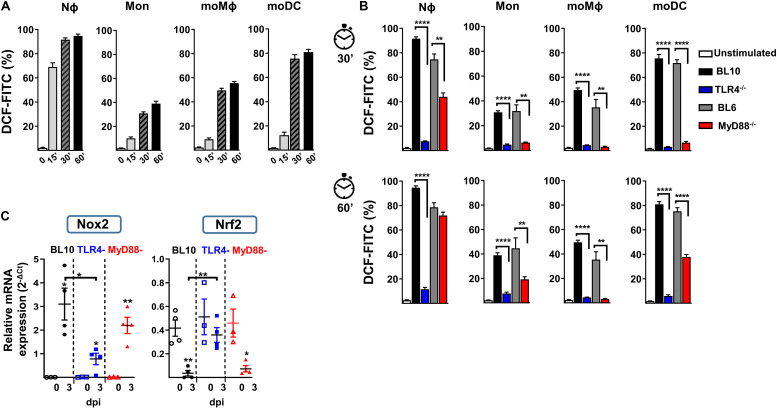
is the main cause of bacterial pneumonia, a condition that currently produces significant global morbidity and mortality. The initial immune response to this bacterium occurs when the innate system recognizes common motifs expressed by many pathogens, events driven by pattern recognition receptors like the Toll-like family receptors (TLRs). In this study, lung myeloid-cell populations responsible for the innate immune response (IIR) against , and their dependence on the TLR4-signaling axis, were analyzed in TLR4 and Myeloid-Differentiation factor-88 deficient (MyD88) mice. Neutrophils and monocyte-derived cells were recruited in infected mice 3-days post-infection. Compared to wild-type mice, there was an increased bacterial load in both these deficient mouse strains and an altered IIR, although TLR4 mice were more susceptible to bacterial infection. These mice also developed fewer alveolar macrophages, weaker neutrophil infiltration, less Ly6C monocyte differentiation and a disrupted classical and non-classical monocyte profile. The pro-inflammatory cytokine profile (CXCL1, TNF-α, IL-6, and IL-1β) was also severely affected by the lack of TLR4 and no induction of Th1 was observed in these mice. The respiratory burst (ROS production) after infection was profoundly dampened in TLR4 and MyD88 mice. These data demonstrate the complex dynamics of myeloid populations and a key role of the TLR4-signaling axis in the IIR to , which involves both the MyD88 and TRIF (Toll/IL-1R domain-containing adaptor-inducing IFN-β) dependent pathways.
是细菌性肺炎的主要病因,这种疾病目前在全球范围内造成了很高的发病率和死亡率。当先天免疫系统识别许多病原体表达的共同基序时,就会发生对这种细菌的初始免疫反应,这些事件是由模式识别受体(如 Toll 样家族受体(TLRs))驱动的。在这项研究中,分析了负责针对 的先天免疫反应(IIR)的肺髓样细胞群体,以及它们对 TLR4 信号轴的依赖性,在 TLR4 和 Myeloid-Differentiation factor-88 缺陷(MyD88)小鼠中进行了分析。在感染后 3 天,中性粒细胞和单核细胞衍生细胞被招募到感染的小鼠中。与野生型小鼠相比,这两种缺陷小鼠株的细菌负荷增加,并且 IIR 发生改变,尽管 TLR4 小鼠对细菌感染更敏感。这些小鼠还产生较少的肺泡巨噬细胞,较弱的中性粒细胞浸润,较少的 Ly6C 单核细胞分化以及经典和非经典单核细胞谱的破坏。缺乏 TLR4 和未诱导 Th1 也严重影响了促炎细胞因子谱(CXCL1、TNF-α、IL-6 和 IL-1β)。TLR4 和 MyD88 小鼠感染后呼吸爆发(ROS 产生)也受到严重抑制。这些数据表明髓样细胞群体的复杂动态以及 TLR4 信号轴在针对 的 IIR 中的关键作用,这涉及 MyD88 和 TRIF(Toll/IL-1R 域包含衔接子诱导 IFN-β)依赖性途径。