Department of Medicine II, Rheumatology and Clinical Immunology, University of Würzburg, Würzburg, Germany.
Department Medicine/Rheumatology and Clinical Immunology, Charité- Universitätsmedizin Berlin, DRFZ Berlin, Berlin, Germany.
Front Immunol. 2020 Sep 11;11:572475. doi: 10.3389/fimmu.2020.572475. eCollection 2020.
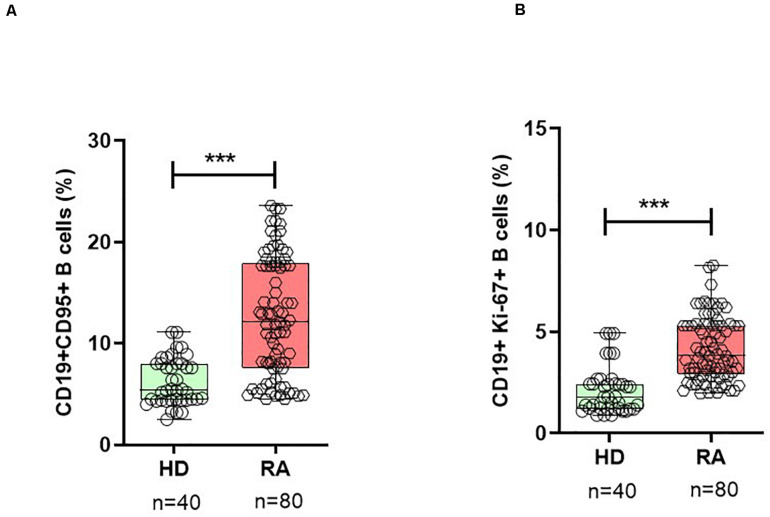
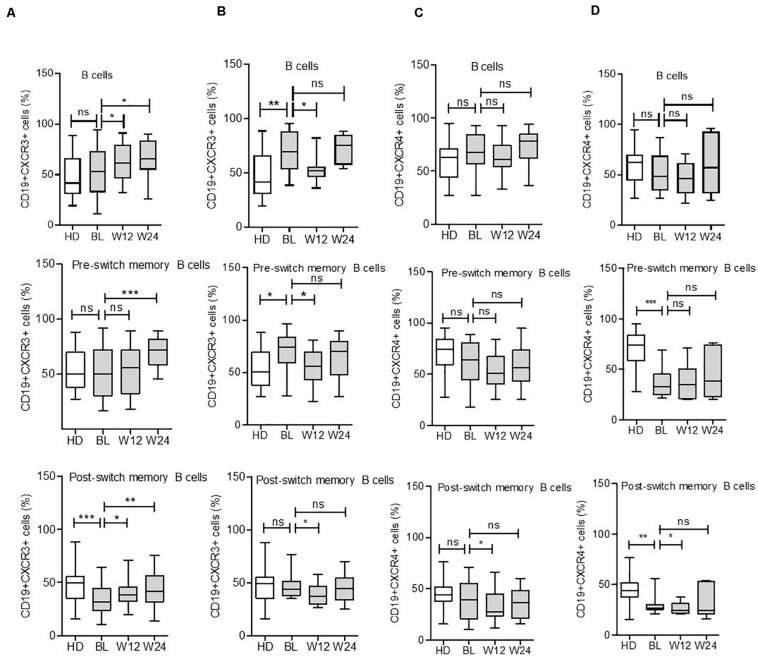
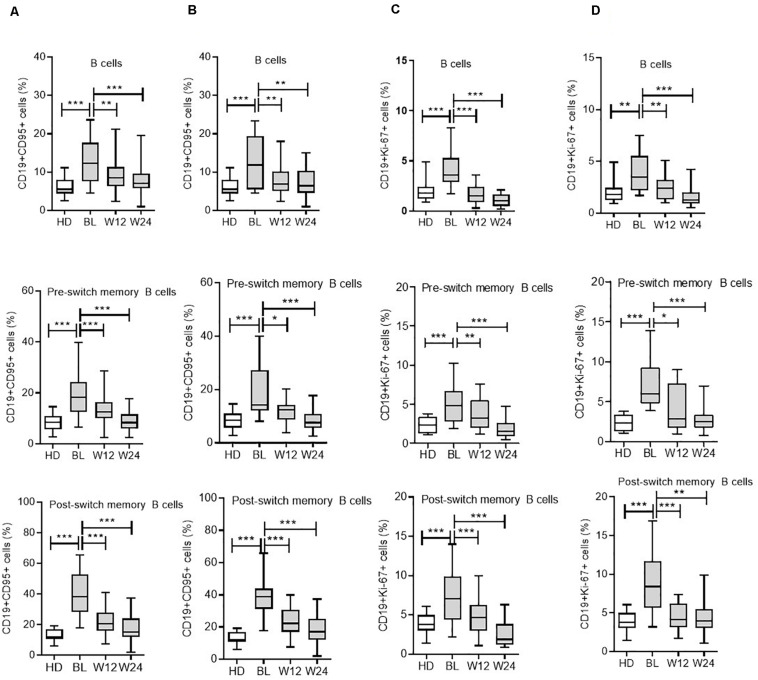
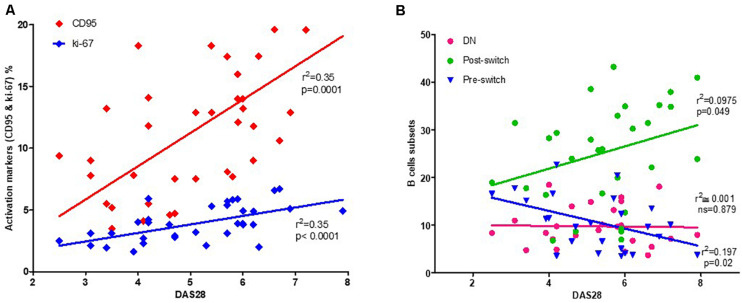
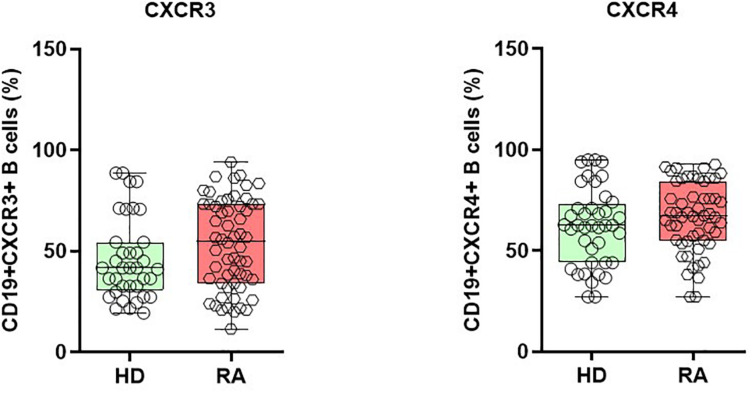
Memory B cells have known to play an important role in the pathogenesis of rheumatoid arthritis (RA). With the emergence of B cell-targeted therapies, the modulation of memory B cells appears to be a key therapeutic target. Human peripheral memory B cells can be distinguished based on the phenotypic expression of CD27 and IgD, characterizing the three major B cell subpopulations: CD27+IgD+ pre-switch, CD27+IgD- post-switch, and CD27-IgD- double-negative memory B cells. We evaluated different memory cell populations for activation markers (CD95 and Ki-67) and chemokine receptors (CXCR3 and 4) expressing B cells in active RA, as well as under IL6-R blockade by tocilizumab (TCZ) and TNF-α blockade by adalimumab (ADA). Memory B cells were phenotypically analyzed from RA patients at baseline, week 12, and week 24 under TCZ or ADA treatment, respectively. Using flow cytometry, surface expression of CD95, intracellular Ki-67, and surface expressions of CXCR3 and CXCR4 were determined. Compared with healthy donors ( = 40), the phenotypic analysis of RA patients ( = 80) demonstrated that all three types of memory B cells were activated in RA patients. Surface and intracellular staining of B cells showed a significantly higher percentage of CD95+ ( < 0.0001) and Ki-67+ ( < 0.0001) cells, with numerically altered CXCR3+ and CXCR4+ cells in RA. CD95 and Ki-67 expressions were highest in post-switch memory B cells, whereas CD19+CXCR3+ and CD19+CXCR4+ expressing cells were substantially higher in the pre-switch compartment. In all subsets of the memory B cells, IL-6R, and TNF-α blockade significantly reduced the enhanced expressions of CD95 and Ki-67. Based on our findings, we conclude that the three major peripheral memory B cell populations, pre-, post-switch, and double-negative B cells, are activated in RA, demonstrating enhanced CD95 and Ki-67 expressions, and varied expression of CXCR3 and CXCR4 chemokine receptors when compared with healthy individuals. This activation can be efficaciously modulated under cytokine inhibition .
记忆 B 细胞在类风湿关节炎(RA)的发病机制中起着重要作用。随着针对 B 细胞的治疗方法的出现,调节记忆 B 细胞似乎成为了一个关键的治疗靶点。根据 CD27 和 IgD 的表型表达,可将人外周记忆 B 细胞区分开来,将其分为三大 B 细胞亚群:CD27+IgD+前切换、CD27+IgD-后切换和 CD27-IgD-双阴性记忆 B 细胞。我们评估了在 RA 活动期以及托珠单抗(TCZ)阻断白细胞介素 6 受体(IL6-R)和阿达木单抗(ADA)阻断肿瘤坏死因子-α(TNF-α)下,不同记忆细胞群体中表达激活标志物(CD95 和 Ki-67)和趋化因子受体(CXCR3 和 CXCR4)的 B 细胞。从分别接受 TCZ 或 ADA 治疗的 RA 患者的基线、第 12 周和第 24 周,对记忆 B 细胞进行表型分析。采用流式细胞术测定 CD95 表面表达、Ki-67 细胞内染色和 CXCR3 和 CXCR4 表面表达。与健康供体(n=40)相比,RA 患者(n=80)的表型分析表明,RA 患者的所有三种类型的记忆 B 细胞均被激活。B 细胞的表面和细胞内染色显示,CD95+(<0.0001)和 Ki-67+(<0.0001)细胞的比例显著升高,RA 患者的 CXCR3+和 CXCR4+细胞数值发生改变。在后切换记忆 B 细胞中,CD95 和 Ki-67 的表达最高,而在前切换区中,CD19+CXCR3+和 CD19+CXCR4+表达细胞的数量明显更高。在记忆 B 细胞的所有亚群中,IL-6R 和 TNF-α 阻断均可显著降低 CD95 和 Ki-67 的增强表达。基于我们的发现,我们得出结论,与健康个体相比,三种主要的外周记忆 B 细胞群体,前切换、后切换和双阴性 B 细胞,在 RA 中被激活,表现出增强的 CD95 和 Ki-67 表达以及不同的 CXCR3 和 CXCR4 趋化因子受体表达。这种激活可以通过细胞因子抑制得到有效调节。