Zhang Shuping, Sun Li, Zhang Jie, Liu Sijin, Han Jinxiang, Liu Yajun
The First Affiliated Hospital of Shandong First Medical University Jinan Shandong 250014 China.
Biomedical Sciences College & Shandong Medicinal Biotechnology Centre Shandong First Medical University & Shandong Academy of Medical Sciences Jinan Shandong 250062 China.
Adv Sci (Weinh). 2020 Aug 4;7(19):2000383. doi: 10.1002/advs.202000383. eCollection 2020 Oct.
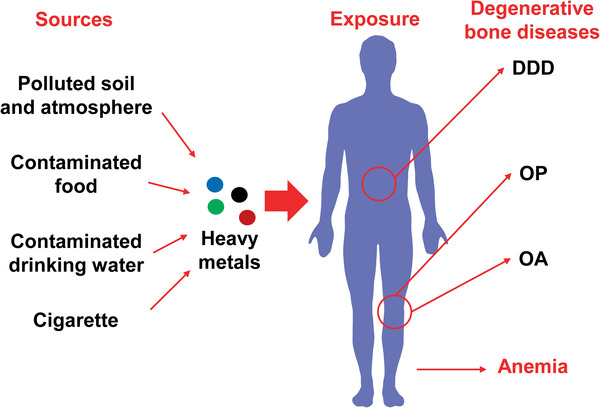
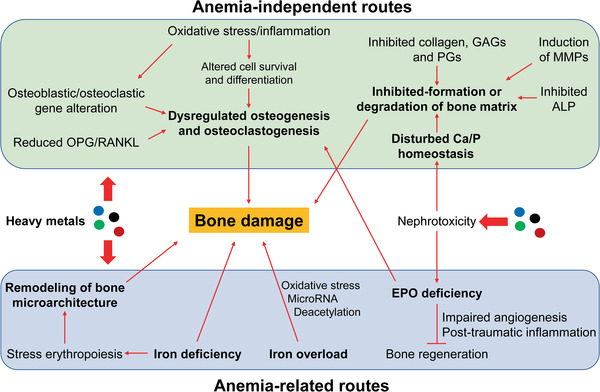
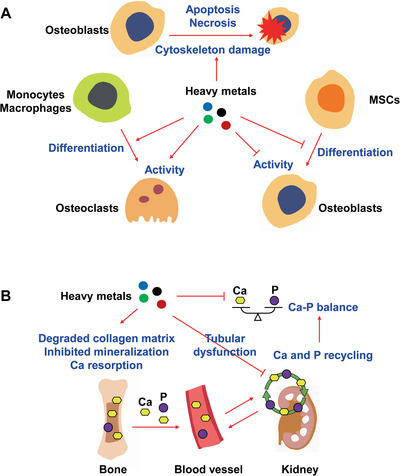
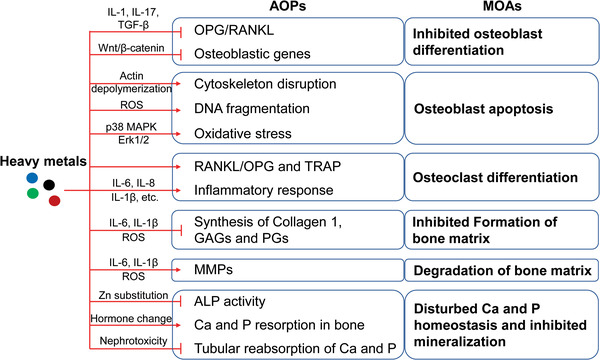
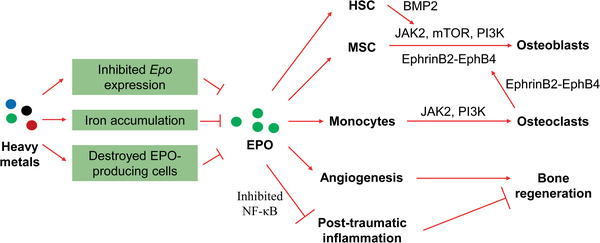
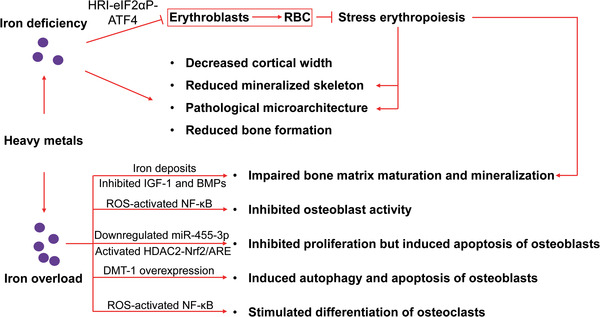
Mounting evidence is revealing that heavy metals can incur disordered bone homeostasis, leading to the development of degenerative bone diseases, including osteoporosis, osteoarthritis, degenerative disk disease, and osteomalacia. Meanwhile, heavy metal-induced anemia has been found to be intertwined with degenerative bone diseases. However, the relationship and interplay among these adverse outcomes remain elusive. Thus, it is of importance to shed light on the modes of action (MOAs) and adverse outcome pathways (AOPs) responsible for degenerative bone diseases and anemia under exposure to heavy metals. In the current Review, the epidemiological and experimental findings are recapitulated to interrogate the contributions of heavy metals to degenerative bone disease development which may be attributable dependently and independently to anemia. A few likely mechanisms are postulated for anemia-independent degenerative bone diseases, including dysregulated osteogenesis and osteoblastogenesis, imbalanced bone formation and resorption, and disturbed homeostasis of essential trace elements. By contrast, remodeled bone microarchitecture, inhibited erythropoietin production, and disordered iron homeostasis are speculated to account for anemia-associated degenerative bone disorders upon heavy metal exposure. Together, this Review aims to elaborate available literature to fill in the knowledge gaps in understanding the detrimental effects of heavy metals on bone cells and bone homeostasis through different perspectives.
越来越多的证据表明,重金属会破坏骨骼稳态,导致包括骨质疏松症、骨关节炎、椎间盘退变疾病和骨软化症在内的退行性骨病的发生。与此同时,已发现重金属诱导的贫血与退行性骨病相互关联。然而,这些不良后果之间的关系和相互作用仍不明确。因此,阐明重金属暴露下导致退行性骨病和贫血的作用模式(MOA)和不良结局途径(AOP)具有重要意义。在本综述中,我们总结了流行病学和实验研究结果,以探讨重金属对退行性骨病发展的影响,这些影响可能独立或依赖于贫血。对于与贫血无关的退行性骨病,我们提出了一些可能的机制,包括成骨和骨细胞生成失调、骨形成与吸收失衡以及必需微量元素的内环境稳态紊乱。相比之下,推测重金属暴露后,重塑的骨微结构、促红细胞生成素产生受抑制以及铁稳态紊乱是导致与贫血相关的退行性骨病的原因。总之,本综述旨在详细阐述现有文献,从不同角度填补在理解重金属对骨细胞和骨稳态的有害影响方面的知识空白。