Lai Agnes Y K, Lam Eliza Y W, Fabrizo Cecilia, Lee Dickson P K, Wan Alice N T, Tsang Jessica S Y, Ho Lai-Ming, Stewart Sunita M, Lam Tai-Hing
School of Nursing, The University of Hong Kong, Hong Kong, Hong Kong.
Caritas-Hong Kong, Hong Kong, Hong Kong.
Front Public Health. 2020 Sep 15;8:434. doi: 10.3389/fpubh.2020.00434. eCollection 2020.
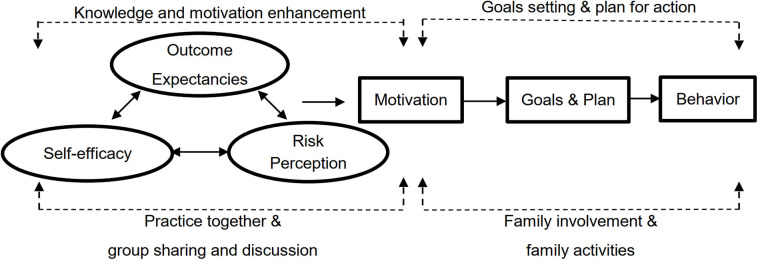
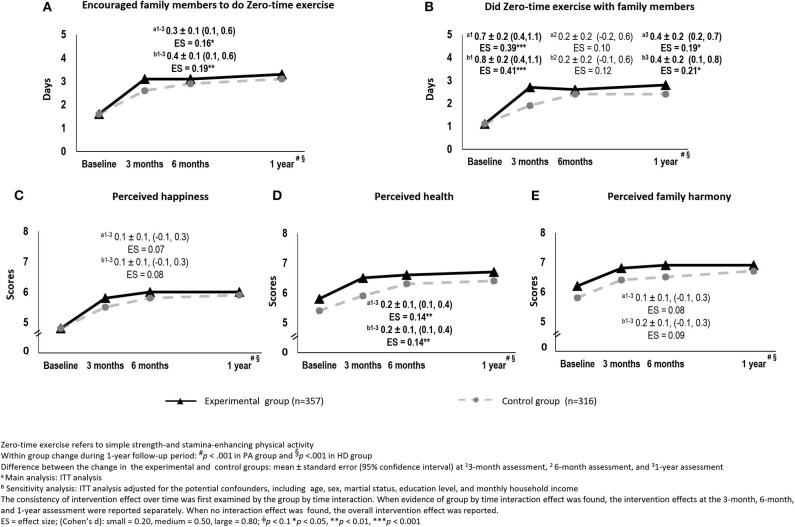
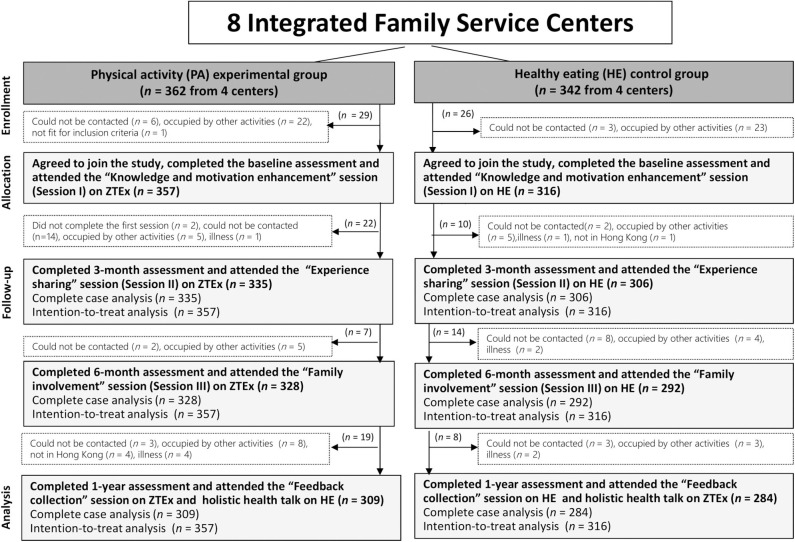
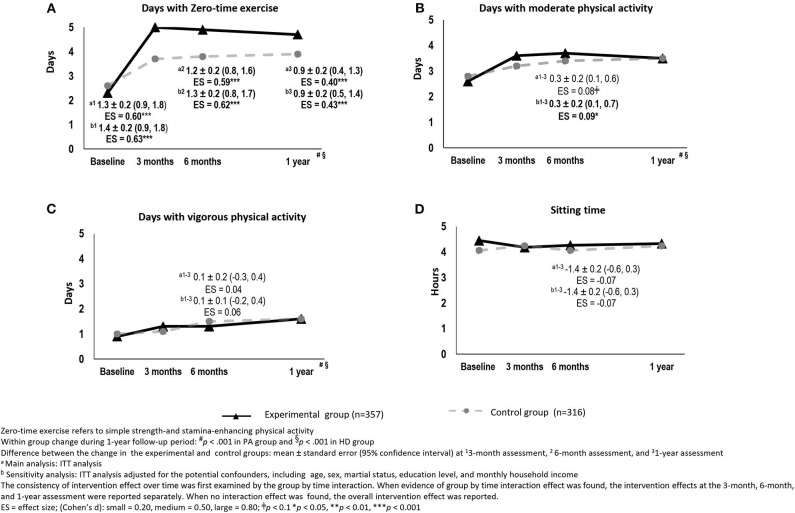
Zero-time exercise (ZTEx) is an approach integrating simple strength- and stamina-enhancing physical activity into daily life. The study evaluated the effectiveness of a community-based lifestyle-integrated physical activity intervention using ZTEx to enhance participants' physical activity, family communication, perceived health and happiness, and family harmony. A parallel group, cluster randomized controlled trial was conducted in a sample of 673 participants from eight Integrated Family Service Centers in Hong Kong. The experimental group ( = 316) received a physical activity intervention. The control group ( = 357) received information on healthy eating. Both groups received three face-to-face intervention sessions (totalling 6 h and 30 min) and 16 text messages. The primary outcome was the change in days spent engaged in ZTEx. Secondary outcomes included changes in sitting time, days engaged in moderate or vigorous physical activities, family communication (encouraging and engaging family members in ZTEx), dietary habits, perceived health and happiness, and family harmony. Self-administered questionnaires were used at baseline and at 3, 6, and 12 months. Mixed effects models with intention-to-treat analysis was used. Compared with the control group at 3 months, the experimental group showed significantly greater increases of 1.3 days spent doing ZTEx (Cohen's : 0.60), 0.3 days spent doing moderate physical activity (Cohen's : 0.08), 0.3 days encouraging family members to do ZTEx (Cohen's : 0.16), and 0.7 days doing ZTEx with family members (Cohen's : 0.39) during the 7 days prior. At 3 months, the experimental group also showed a significantly greater improvement in perceived health, by a score of 0.2 (Cohen's : 0.14). The effect sizes ranged from small to medium, with similar intervention effects at the 6-month and 1-year assessments. Compared with the experimental group, the control group showed a significantly greater reduction of 0.4 days on which sweetened beverages were consumed (95% CI: 0.01, 0.9, < 0.05, Cohen's : 0.28). The qualitative results supported the quantitative findings. Our findings show that a community-based lifestyle-integrated physical activity (PA) intervention can enhance physical activity, family communication, and perceived health in deprived families in Hong Kong. The research protocol was retrospectively registered at the National Institutes of Health (identifier number: NCT02601534) on November 10, 2015.
零时运动(ZTEx)是一种将简单的增强力量和耐力的体育活动融入日常生活的方法。该研究评估了一项基于社区的、将体育活动与生活方式相结合的干预措施(使用零时运动)在增强参与者体育活动、家庭沟通、感知到的健康与幸福以及家庭和睦方面的有效性。在来自香港八个综合家庭服务中心的673名参与者样本中进行了一项平行组整群随机对照试验。实验组(n = 316)接受了体育活动干预。对照组(n = 357)收到了关于健康饮食的信息。两组均接受了三次面对面干预课程(共计6小时30分钟)以及16条短信。主要结局是参与零时运动的天数变化。次要结局包括久坐时间的变化、参与中等强度或剧烈体育活动的天数、家庭沟通(鼓励家庭成员参与零时运动并使其融入其中)、饮食习惯、感知到的健康与幸福以及家庭和睦。在基线以及3个月、6个月和12个月时使用了自填式问卷。采用了意向性分析的混合效应模型。与3个月时的对照组相比,实验组在之前7天里参与零时运动的天数显著增加了1.3天(科恩d值:0.60),参与中等强度体育活动的天数增加了0.3天(科恩d值:0.08),鼓励家庭成员参与零时运动的天数增加了0.3天(科恩d值:0.16),与家庭成员一起参与零时运动的天数增加了0.7天(科恩d值:0.39)。在3个月时,实验组在感知到的健康方面也有显著更大的改善,得分提高了0.2(科恩d值:0.14)。效应大小范围从小到中,在6个月和1年评估时具有相似的干预效果。与实验组相比,对照组饮用甜味饮料的天数显著减少了0.4天(95%置信区间:0.01,0.9,P < 0.05,科恩d值:0.28)。定性结果支持了定量研究结果。我们的研究结果表明,一项基于社区的、将体育活动与生活方式相结合的干预措施可以增强香港贫困家庭的体育活动、家庭沟通以及感知到的健康。该研究方案于2015年11月10日在国立卫生研究院进行了回顾性注册(标识符编号:NCT02601534)。