Holdsworth Michelle, Nicolaou Mary, Langøien Lars Jørun, Osei-Kwasi Hibbah Araba, Chastin Sebastien F M, Stok F Marijn, Capranica Laura, Lien Nanna, Terragni Laura, Monsivais Pablo, Mazzocchi Mario, Maes Lea, Roos Gun, Mejean Caroline, Powell Katie, Stronks Karien
Public Health Section, School of Health and Related Research-ScHARR, The University of Sheffield, Sheffield, UK.
Academic Medical Centre, University of Amsterdam, Department of Public Health, Amsterdam Public Health research Institute, Amsterdam, The Netherlands.
Int J Behav Nutr Phys Act. 2017 Nov 7;14(1):154. doi: 10.1186/s12966-017-0608-6.
Some ethnic minority populations have a higher risk of non-communicable diseases than the majority European population. Diet and physical activity behaviours contribute to this risk, shaped by a system of inter-related factors. This study mapped a systems-based framework of the factors influencing dietary and physical activity behaviours in ethnic minority populations living in Europe, to inform research prioritisation and intervention development.
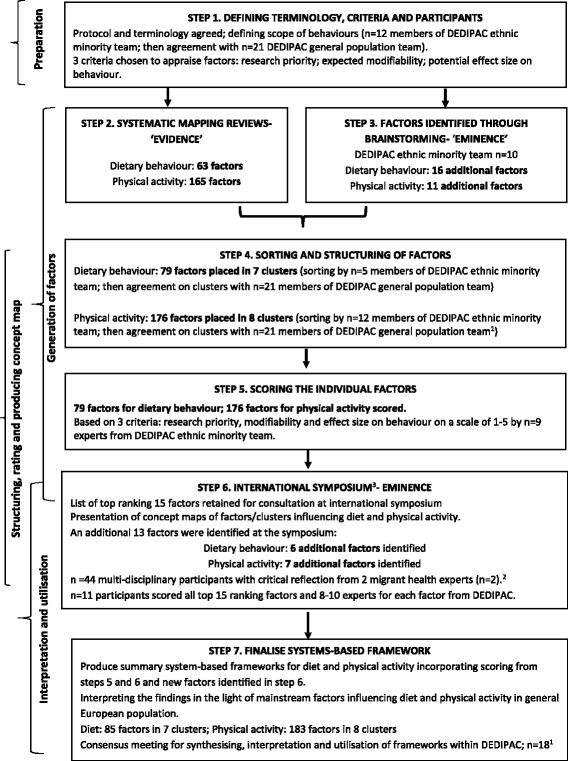
A concept mapping approach guided by systems thinking was used: i. Preparation (protocol and terminology); ii. Generating a list of factors influencing dietary and physical activity behaviours in ethnic minority populations living in Europe from evidence (systematic mapping reviews) and 'eminence' (89 participants from 24 academic disciplines via brainstorming, an international symposium and expert review) and; iii. Seeking consensus on structuring, rating and clustering factors, based on how they relate to each other; and iv. Interpreting/utilising the framework for research and interventions. Similar steps were undertaken for frameworks developed for the majority European population.
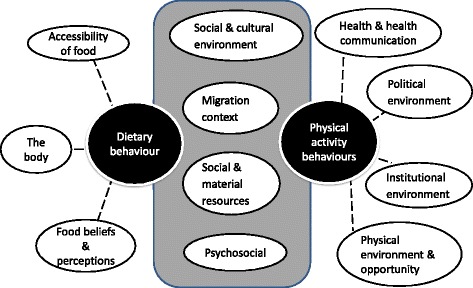
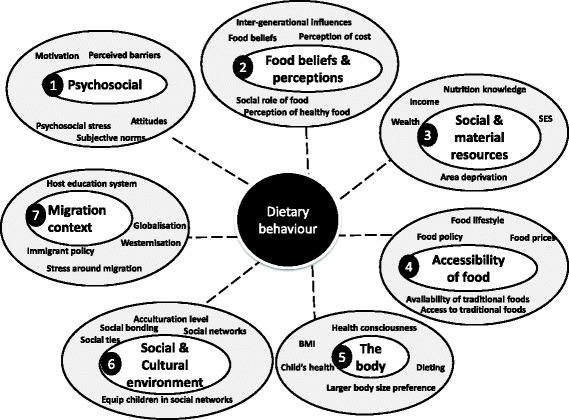
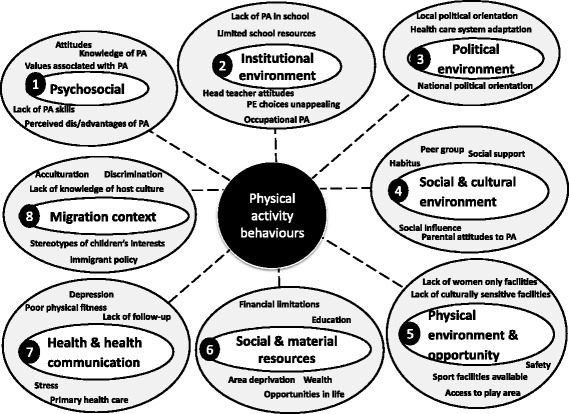
Seven distinct clusters emerged for dietary behaviour (containing 85 factors) and 8 for physical activity behaviours (containing 183 factors). Four clusters were similar across behaviours: Social and cultural environment; Social and material resources; Psychosocial; and Migration context. Similar clusters of factors emerged in the frameworks for diet and physical activity behaviours of the majority European population, except for 'migration context'. The importance of factors across all clusters was acknowledged, but their relative importance differed for ethnic minority populations compared with the majority population.
This systems-based framework integrates evidence from both expert opinion and published literature, to map the factors influencing dietary and physical activity behaviours in ethnic minority groups. Our findings illustrate that innovative research and complex interventions need to be developed that are sensitive to the needs of ethnic minority populations. A systems approach that encompasses the complexity of the inter-related factors that drive behaviours may inform a more holistic public health paradigm to more effectively reach ethnic minorities living in Europe, as well as the majority host population.
一些少数民族人群患非传染性疾病的风险高于欧洲多数人群。饮食和身体活动行为导致了这种风险,而这又受到一系列相互关联因素的影响。本研究绘制了一个基于系统的框架,以说明影响居住在欧洲的少数民族人群饮食和身体活动行为的因素,为研究重点的确定和干预措施的制定提供依据。
采用以系统思维为指导的概念图方法:i. 准备(方案和术语);ii. 根据证据(系统映射综述)和“卓越见解”(通过头脑风暴、国际研讨会和专家评审,来自24个学科的89名参与者)生成影响居住在欧洲的少数民族人群饮食和身体活动行为的因素列表;iii. 根据因素之间的相互关系,就因素的结构、评级和聚类达成共识;iv. 解释/利用该框架进行研究和干预。为欧洲多数人群制定的框架也采取了类似步骤。
饮食行为出现了7个不同的聚类(包含85个因素),身体活动行为出现了8个聚类(包含183个因素)。有4个聚类在两种行为中是相似的:社会和文化环境;社会和物质资源;心理社会;以及移民背景。在欧洲多数人群的饮食和身体活动行为框架中也出现了类似的因素聚类,但“移民背景”除外。所有聚类中因素的重要性都得到了认可,但与多数人群相比,少数民族人群中各因素的相对重要性有所不同。
这个基于系统的框架整合了专家意见和已发表文献中的证据,以描绘影响少数民族群体饮食和身体活动行为的因素。我们的研究结果表明,需要开展创新研究和复杂干预措施,以满足少数民族人群的需求。一种涵盖驱动行为的相互关联因素复杂性的系统方法,可能为更全面的公共卫生范式提供信息,从而更有效地惠及居住在欧洲的少数民族以及多数东道国人口。