Xiao Shiyu, Zhou Liya
Department of Gastroenterology, Peking University Third Hospital, Beijing, China.
Beijing Key Laboratory of Helicobacter Pylori Infection and Upper Gastrointestinal Diseases, Peking University Third Hospital, Beijing, China.
Front Cell Dev Biol. 2020 Sep 17;8:571536. doi: 10.3389/fcell.2020.571536. eCollection 2020.
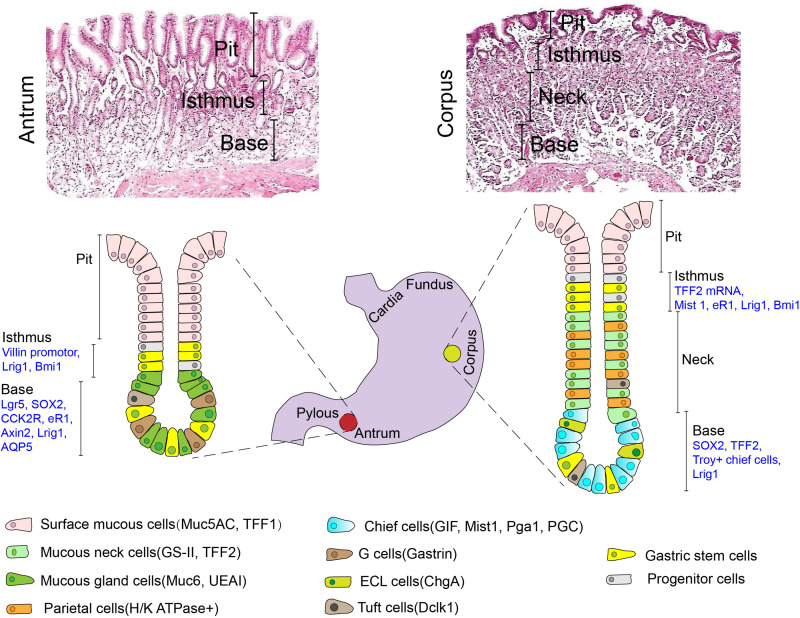
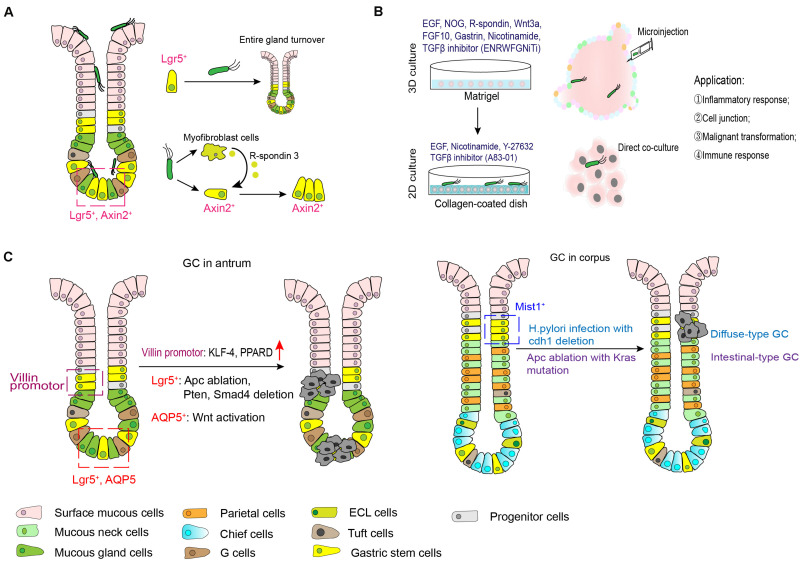
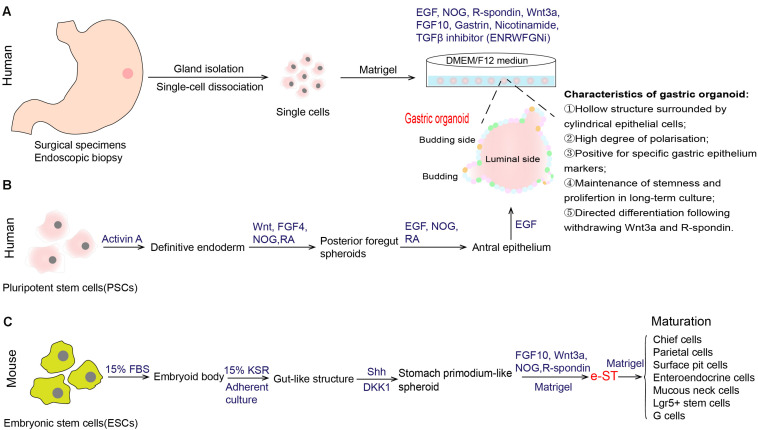
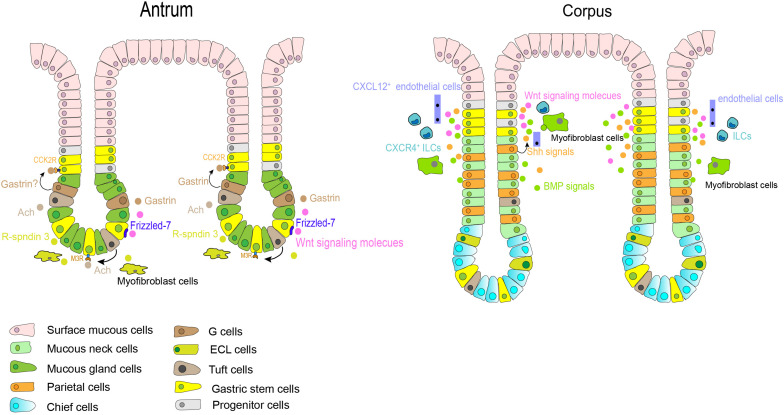
Gastric epithelium operates in a hazardous environment that curtails the lifespan of the constituent cells, imposing a requirement for continuous epithelial renewal. Stem cells that reside in the stomach are thus essential for regulating physiological tissue renewal and injury repair because of their self-renewal, high proliferation capacity and multiple differentiation potentials. Recent investigations using lineage tracing models have identified diverse populations of gastric stem cells and even fully differentiated cells that can regain stem cell capacity, so enriching our understanding on the identity and plasticity of gastric stem cells. These cell populations include the Villin promotor, Lgr5, CCKR2, Axin2 and AQP5 stem cells in the antrum, TFF2 mRNA, Mist1 cells and Troy mature chief cells in the corpus, as well as Sox2, eR1, Lrig1, Bmi1-marked cell in both the antrum and the corpus. Establishment of gastric organoids derived from primary gastric tissues and pluripotent stem cells or embryonic stem cells characterizes niche factors required by the gastric stem cell populations, and further provides new insights into stomach development, host-Helicobacter pylori interactions and malignant transformation. Furthermore, focus on the gastric stem cells and their niches uncovers the initiation of stomach precancerous lesions and origin of gastric cancer, providing options for cancer prevention and intervention. In summary, with the development of stem cell research, gastric stem cells give us more opportunities to prevent and treat stomach diseases.
胃上皮细胞在一个危险的环境中运作,这种环境会缩短组成细胞的寿命,因此需要持续的上皮更新。由于其自我更新、高增殖能力和多种分化潜能,胃中的干细胞对于调节生理组织更新和损伤修复至关重要。最近使用谱系追踪模型的研究已经确定了不同类型的胃干细胞群体,甚至还有能够恢复干细胞能力的完全分化细胞,这丰富了我们对胃干细胞的特性和可塑性的理解。这些细胞群体包括胃窦中的维林启动子、Lgr5、CCKR2、Axin2和AQP5干细胞,胃体中的TFF2 mRNA、Mist1细胞和Troy成熟主细胞,以及胃窦和胃体中由Sox2、eR1、Lrig1、Bmi1标记的细胞。从原发性胃组织以及多能干细胞或胚胎干细胞中衍生出胃类器官,这明确了胃干细胞群体所需的生态位因子,并进一步为胃的发育、宿主与幽门螺杆菌的相互作用以及恶性转化提供了新的见解。此外,对胃干细胞及其生态位的关注揭示了胃癌前病变的起始和胃癌的起源,为癌症预防和干预提供了选择。总之,随着干细胞研究的发展,胃干细胞为我们预防和治疗胃部疾病提供了更多机会。