Centre for Vaccinology, Department of Pathology and Immunology, University of Geneva, Geneva, Switzerland.
Centre for Infectious Disease Control, WHO COVID-19 reference laboratory, RIVM, Bilthoven, Netherlands.
Emerg Microbes Infect. 2020 Dec;9(1):2394-2403. doi: 10.1080/22221751.2020.1835448.
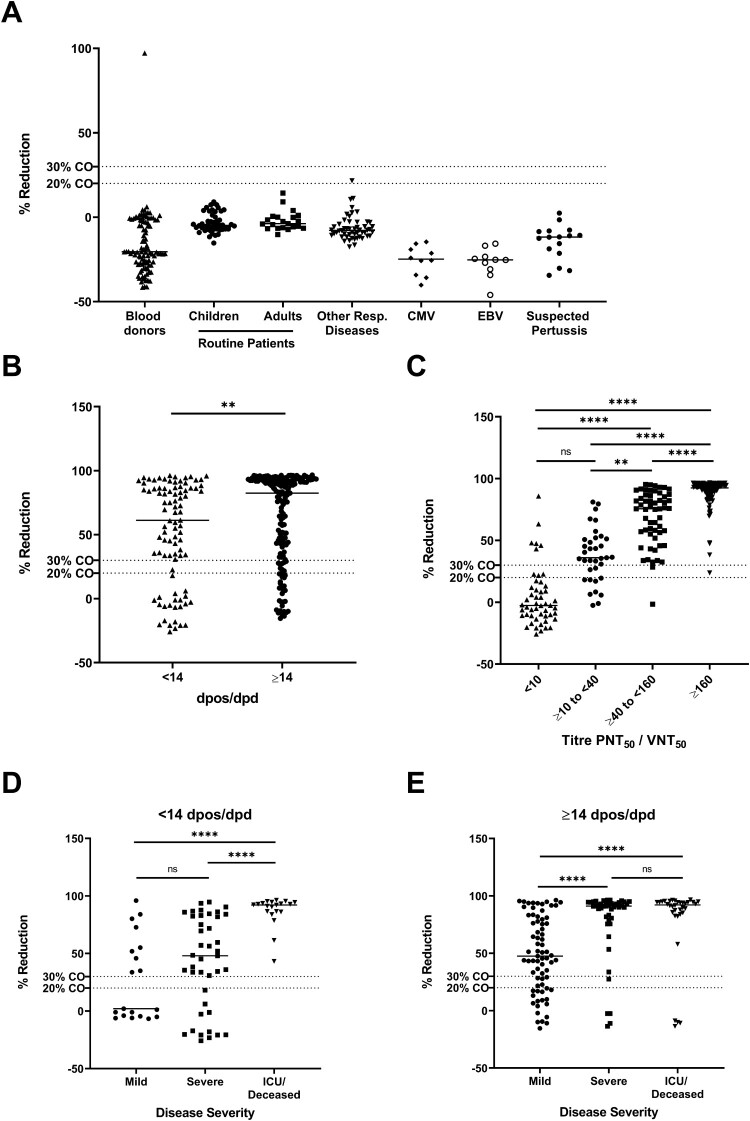
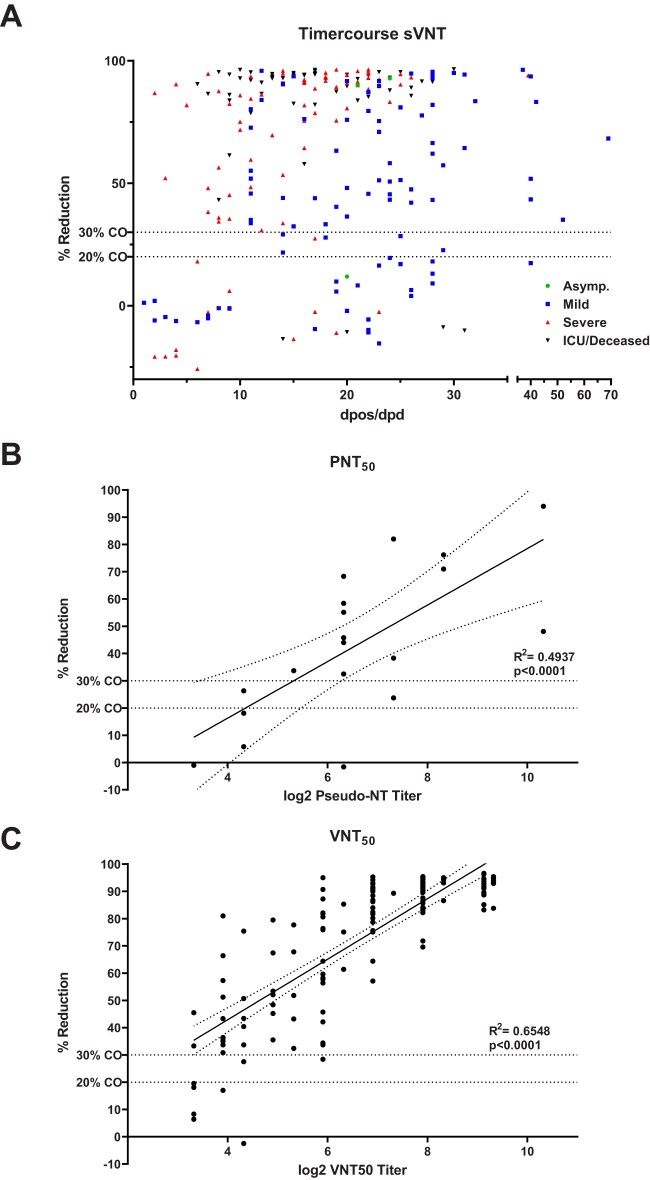
To understand SARS-CoV-2 immunity after natural infection or vaccination, functional assays such as virus neutralising assays are needed. So far, assays to detect SARS-CoV-2 neutralising antibodies rely on cell-culture based infection assays either using wild type SARS-CoV-2 or pseudotyped viruses. Such assays are labour-intensive, require appropriate biosafety facilities and are difficult to standardize. Recently, a new surrogate virus neutralisation test (sVNT) was described that uses the principle of an ELISA to measure the neutralisation capacity of anti-SARS-CoV-2 antibodies directed against the receptor binding domain. Here, we performed an independent evaluation of the robustness, specificity and sensitivity on an extensive panel of sera from 269 PCR-confirmed COVID-19 cases and 259 unmatched samples collected before 2020 and compared it to cell-based neutralisation assays. We found a high specificity of 99.2 (95%CI: 96.9-99.9) and overall sensitivity of 80.3 (95%CI: 74.9-84.8) for the sVNT. Clinical sensitivity increased between early (<14 days post symptom onset or post diagnosis, dpos/dpd) and late sera (>14 dpos/dpd) from 75.0 (64.7-83.2) to 83.1 (76.5-88.1). Also, higher severity was associated with an increase in clinical sensitivity. Upon comparison with cell-based neutralisation assays we determined an analytical sensitivity of 74.3 (56.4-86.9) and 98.2 (89.4-99.9) for titres ≥10 to <40 and ≥40 to <160, respectively. Only samples with a titre ≥160 were always positive in the sVNT. In conclusion, the sVNT can be used as an additional assay to determine the immune status of COVID-19 infected of vaccinated individuals but its value needs to be assessed for each specific context.
为了了解自然感染或接种疫苗后的 SARS-CoV-2 免疫情况,需要进行功能性检测,如病毒中和检测。到目前为止,用于检测 SARS-CoV-2 中和抗体的检测方法依赖于基于细胞培养的感染检测,使用野生型 SARS-CoV-2 或假型病毒。此类检测方法劳动强度大,需要适当的生物安全设施,且难以标准化。最近,描述了一种新的替代病毒中和检测(sVNT),该检测使用 ELISA 的原理来测量针对受体结合域的抗 SARS-CoV-2 抗体的中和能力。在这里,我们对来自 269 例经 PCR 确诊的 COVID-19 病例和 259 例 2020 年前采集的未匹配样本的广泛血清样本进行了独立评估,并将其与基于细胞的中和检测进行了比较。我们发现 sVNT 的特异性为 99.2(95%CI:96.9-99.9),总敏感性为 80.3(95%CI:74.9-84.8)。sVNT 的临床敏感性在早期(症状出现后<14 天或诊断后,dpos/dpd)和晚期血清(>14 dpos/dpd)之间有所增加,从 75.0(64.7-83.2)增加到 83.1(76.5-88.1)。此外,严重程度的增加与临床敏感性的增加相关。与基于细胞的中和检测相比,我们确定 sVNT 的分析敏感性分别为 74.3(56.4-86.9)和 98.2(89.4-99.9),用于滴度≥10 至<40 和≥40 至<160。只有滴度≥160 的样本在 sVNT 中始终为阳性。总之,sVNT 可作为确定 COVID-19 感染或接种疫苗个体免疫状态的附加检测方法,但需要针对每个特定情况评估其价值。