
新冠病毒感染轻症与重症患者的系统性及黏膜性抗体对 SARS-CoV-2 的应答特征。
Systemic and mucosal antibody responses specific to SARS-CoV-2 during mild versus severe COVID-19.
机构信息
Department of Immunology, University Hospital Zurich, Zurich, Switzerland.
Department of Infectious Diseases and Hospital Epidemiology, University Hospital Zurich, Zurich, Switzerland.
出版信息
J Allergy Clin Immunol. 2021 Feb;147(2):545-557.e9. doi: 10.1016/j.jaci.2020.10.040. Epub 2020 Nov 20.
BACKGROUND
Whereas severe acute respiratory syndrome coronavirus 2 (SARS-CoV-2)-specific antibody tests are increasingly being used to estimate the prevalence of SARS-CoV-2 infection, the determinants of these antibody responses remain unclear.
OBJECTIVES
Our aim was to evaluate systemic and mucosal antibody responses toward SARS-CoV-2 in mild versus severe coronavirus disease 2019 (COVID-19) cases.
METHODS
Using immunoassays specific for SARS-CoV-2 spike proteins, we determined SARS-CoV-2-specific IgA and IgG in sera and mucosal fluids of 2 cohorts, including SARS-CoV-2 PCR-positive patients (n = 64) and PCR-positive and PCR-negtive health care workers (n = 109).
RESULTS
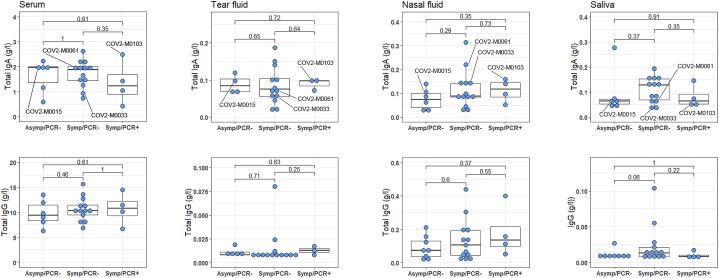
SARS-CoV-2-specific serum IgA titers in patients with mild COVID-19 were often transiently positive, whereas serum IgG titers remained negative or became positive 12 to 14 days after symptom onset. Conversely, patients with severe COVID-19 showed a highly significant increase of SARS-CoV-2-specific serum IgA and IgG titers after symptom onset. Very high titers of SARS-CoV-2-specific serum IgA were correlated with severe acute respiratory distress syndrome. Interestingly, some health care workers with negative SARS-CoV-2-specific serum antibody titers showed SARS-CoV-2-specific IgA in mucosal fluids with virus-neutralizing capacity in some cases. SARS-CoV-2-specific IgA titers in nasal fluids were inversely correlated with age.
CONCLUSIONS
Systemic antibody production against SARS-CoV-2 develops mainly in patients with severe COVID-19, with very high IgA titers seen in patients with severe acute respiratory distress syndrome, whereas mild disease may be associated with transient production of SARS-CoV-2-specific antibodies but may stimulate mucosal SARS-CoV-2-specific IgA secretion.
背景
严重急性呼吸综合征冠状病毒 2(SARS-CoV-2)特异性抗体检测越来越多地用于估计 SARS-CoV-2 感染的流行率,但这些抗体反应的决定因素尚不清楚。
目的
我们旨在评估轻度与重度 2019 年冠状病毒病(COVID-19)病例中针对 SARS-CoV-2 的全身和黏膜抗体反应。
方法
使用针对 SARS-CoV-2 刺突蛋白的免疫测定法,我们确定了 2 个队列中 SARS-CoV-2 特异性 IgA 和 IgG,包括 SARS-CoV-2 PCR 阳性患者(n=64)和 PCR 阳性和 PCR 阴性医护人员(n=109)。
结果
轻度 COVID-19 患者的 SARS-CoV-2 特异性血清 IgA 滴度通常是短暂阳性的,而血清 IgG 滴度仍为阴性或在症状出现后 12 至 14 天转为阳性。相反,重度 COVID-19 患者在症状出现后 SARS-CoV-2 特异性血清 IgA 和 IgG 滴度显著升高。非常高的 SARS-CoV-2 特异性血清 IgA 滴度与急性呼吸窘迫综合征相关。有趣的是,一些 SARS-CoV-2 特异性血清抗体滴度阴性的医护人员在某些情况下具有黏膜液中的 SARS-CoV-2 特异性 IgA 且具有中和病毒的能力。鼻液中的 SARS-CoV-2 特异性 IgA 滴度与年龄呈负相关。
结论
针对 SARS-CoV-2 的全身抗体产生主要发生在重度 COVID-19 患者中,严重急性呼吸窘迫综合征患者中可见非常高的 IgA 滴度,而轻度疾病可能与 SARS-CoV-2 特异性抗体的短暂产生相关,但可能刺激黏膜 SARS-CoV-2 特异性 IgA 分泌。



 Zotero 插件