Department of Life Sciences, Imperial College London , London, UK.
Department of Entomology, Virginia Polytechnic Institute and State University , Blacksburg, VA, USA.
Pathog Glob Health. 2020 Oct;114(7):370-378. doi: 10.1080/20477724.2020.1803628.
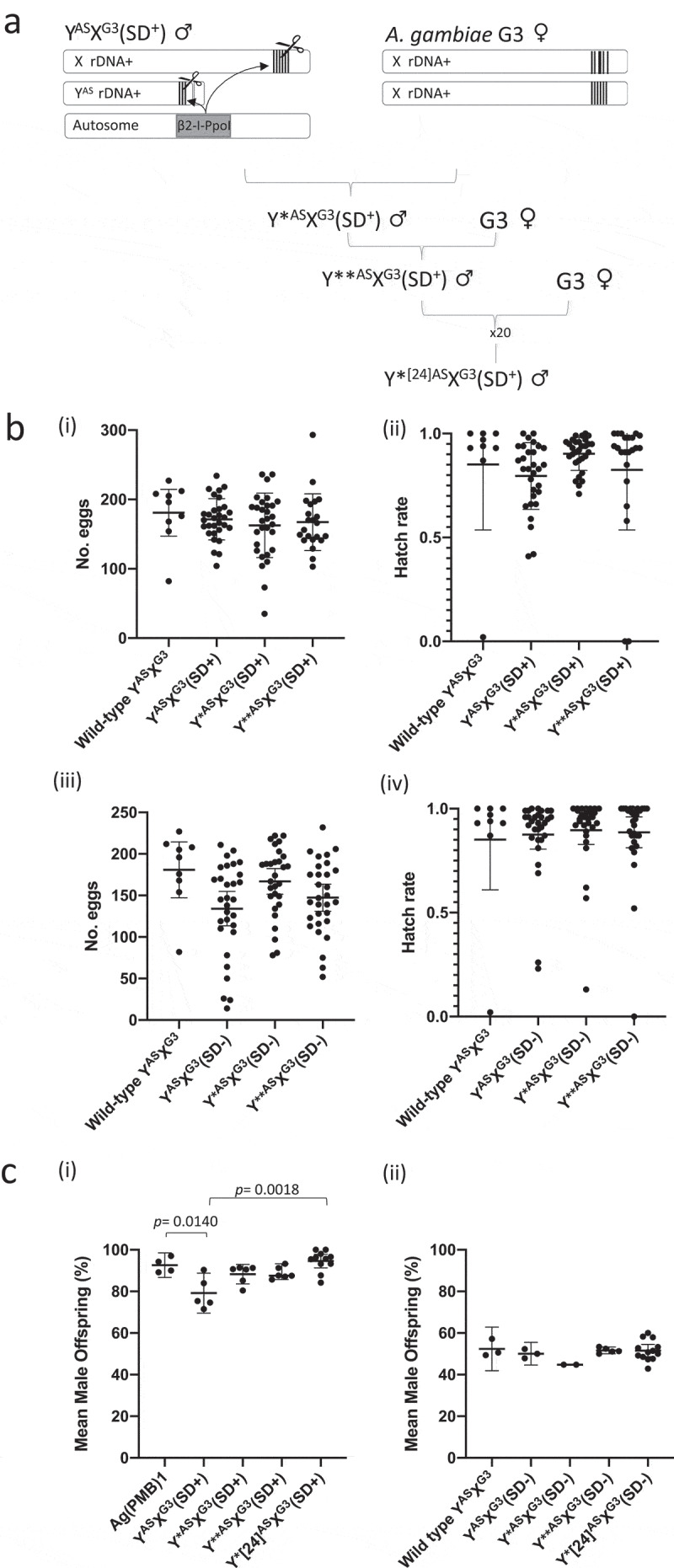
Genetic control strategies aimed to bias the sex of progenies towards males present a promising new paradigm to eliminate malaria-transmitting mosquitoes. A synthetic sex-ratio distortion (SD) system was successfully engineered in by exploiting the meiotic activity of the I-PpoI endonuclease targeting ribosomal DNA (rDNA) repeats, exclusively located on the X chromosome. Males carrying the SD construct produce highly male-biased progenies without evident reduction in fertility. In this study, we investigated the fate of X and Y chromosomes in these SD males and found that ratios of mature X:Y-bearing sperm were comparable to wild-type insects, indicating absence of selection mechanisms during sperm maturation. We therefore tested the effect of meiotic cleavage of both X and Y chromosomes in a lab-generated SD strain carrying rDNA on both sex chromosomes, showing fertility comparable to wild-type and a reduced male-bias compared to SD males in which only the X is targeted. Exposure of Y-linked rDNA to I-PpoI cleavage for consecutive generations rapidly restored the male-bias to typical high frequencies, indicating a correlation between the number of cleavable targets in each sex chromosome and the sex-ratios found in the progeny. Altogether our results indicate that meiotic cleavage of rDNA repeats, located in the sex chromosomes of SD males, affects the competitiveness of mature sperm to fertilize the female oocyte, thereby generating sex-biased progenies. We also show that the presence of rDNA copies on the Y chromosome does not impair the effectiveness of engineered synthetic SD systems for the control of human malaria mosquitoes.
旨在使后代性别偏向雄性的遗传控制策略为消除传播疟疾的蚊子提供了一个有前途的新范例。 通过利用靶向核糖体 DNA(rDNA)重复序列的减数分裂活性的 I-PpoI 内切酶,成功地在 中设计了一种合成性别比例扭曲(SD)系统,该重复序列仅位于 X 染色体上。携带 SD 构建体的雄性产生高度雄性偏倚的后代,而生育力没有明显降低。在这项研究中,我们研究了这些 SD 雄性中 X 和 Y 染色体的命运,发现成熟的 X:Y 携带精子的比例与野生型昆虫相当,表明在精子成熟过程中没有选择机制。因此,我们测试了在携带 rDNA 的实验室生成的 SD 菌株中对 X 和 Y 染色体进行减数分裂切割的效果,该 rDNA 位于两条性染色体上,结果显示其与野生型昆虫的生育能力相当,与仅靶向 X 的 SD 雄性相比,雄性偏倚降低。连续几代将 Y 染色体上的 rDNA 暴露于 I-PpoI 切割中,迅速将雄性偏倚恢复到典型的高频率,这表明每个性染色体上可切割靶标的数量与后代中发现的性别比例之间存在相关性。总的来说,我们的结果表明,rDNA 重复序列的减数分裂切割位于 SD 雄性的性染色体中,会影响成熟精子使雌性卵受精的竞争力,从而产生性别偏倚的后代。我们还表明,Y 染色体上存在 rDNA 拷贝不会损害工程合成 SD 系统对控制人类疟疾蚊子的有效性。