Department of Clinical, Special and Dental Sciences, University Politecnica delle Marche, Ancona, Italy.
Department of Radiology, Division of Special and Pediatric Radiology, University Hospital "Umberto I - Lancisi - Salesi", Via Conca 71, 60126, Ancona, AN, Italy.
Radiol Med. 2021 Mar;126(3):388-398. doi: 10.1007/s11547-020-01298-5. Epub 2020 Oct 12.
To investigate the role of third-generation iterative reconstruction (ADMIRE) in dual-source, high-pitch chest CT protocol with spectral shaping at 100 kVp in Coronavirus disease 2019 (COVID-19).
Confirmed COVID-19 inpatients undergoing to unenhanced chest CT were scanned with a dual-energy acquisition (DECT, 90/150Sn kV) and a dual-source, high-pitch acquisition with tin-filtered 100 kVp (LDCT). On the DECT with ADMIRE 3 (DECT3) were evaluated the pulmonary findings and their extension (25-point score). Two radiologists in consensus evaluated with 5-point scales the overall image quality, the anatomical structures, and the elementary findings on LDCT reconstructed with filtered backprojection (LDCT0), with ADMIRE 3 (LDCT3) and 5 (LDCT5), and on DECT3. The signal-to-noise ratio (SNR), the body mass index, the exposure times, and the radiation doses were recorded.
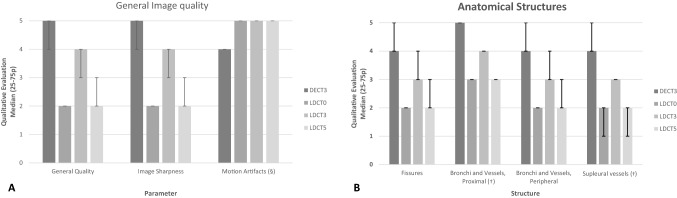
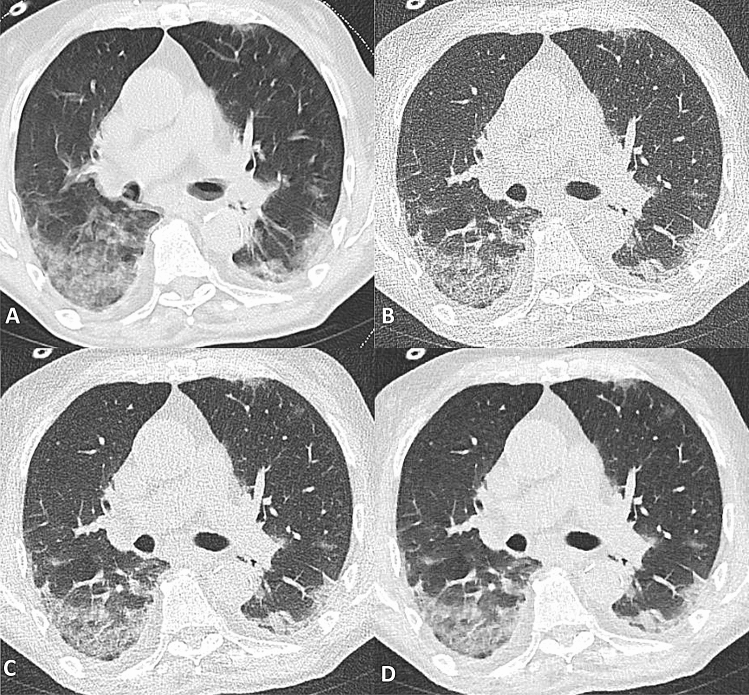
Seventy-five patients (57 M/18F; median age: 63 y.o.) were included, with median pulmonary extension of 13/25 points. The imaging findings were detected in proportion comparable to the available literature. The ADMIRE significantly improved the SNR in LDCT (p < 0.00001) with almost no significant differences in overweight patients. The LDCT had median effective dose of 0.39 mSv and acquisition time of 0.71 s with significantly less motion artifacts than DECT (p < 0.00001). The DECT3 and LDCT3 provided the best image quality and depiction of pulmonary anatomy and imaging findings, with significant differences among all the series (p < 0.00001).
The LDCT with spectral shaping and ADMIRE3 provided acceptable image quality in the evaluation of patients with COVID-19, with significantly reduced radiation dose and motion artifacts.
探讨第三代迭代重建(ADMIRE)在双源、高螺距 100kVp 能谱成像胸部 CT 方案(spectral shaping at 100 kVp)在 2019 年冠状病毒病(COVID-19)中的作用。
对接受双能采集(DECT,90/150Sn kV)和带有锡滤器的 100kVp(LDCT)双源、高螺距采集的确诊 COVID-19 住院患者进行胸部 CT 平扫。在具有 ADMIRE 3(DECT3)的 DECT 上评估肺部表现及其扩展(25 分评分)。两位放射科医生在共识的基础上,使用 5 分制评估总体图像质量、解剖结构和 LDCT 上的基本表现(LDCT0),使用 ADMIRE 3(LDCT3)和 5(LDCT5),以及 DECT3。记录信噪比(SNR)、体重指数、曝光时间和辐射剂量。
共纳入 75 例患者(57 例男性/18 例女性;中位年龄:63 岁),肺部扩展中位数为 13/25 分。成像结果与现有文献的检测比例相当。ADMIRE 显著提高了 LDCT 的 SNR(p < 0.00001),而超重患者的差异无统计学意义。LDCT 的有效剂量中位数为 0.39mSv,采集时间为 0.71s,与 DECT 相比,运动伪影显著减少(p < 0.00001)。DECT3 和 LDCT3 提供了最佳的图像质量和肺部解剖结构和影像学表现的描述,所有系列之间均有显著差异(p < 0.00001)。
带有光谱成形和 ADMIRE3 的 LDCT 可在评估 COVID-19 患者时提供可接受的图像质量,同时显著降低辐射剂量和运动伪影。