Department of Laboratory Medicine and Pathology, University of Washington, Seattle, WA.
Department of Pathology, Cedars-Sinai Medical Center, Los Angeles, CA.
Am J Kidney Dis. 2021 Jan;77(1):82-93.e1. doi: 10.1053/j.ajkd.2020.10.001. Epub 2020 Oct 10.
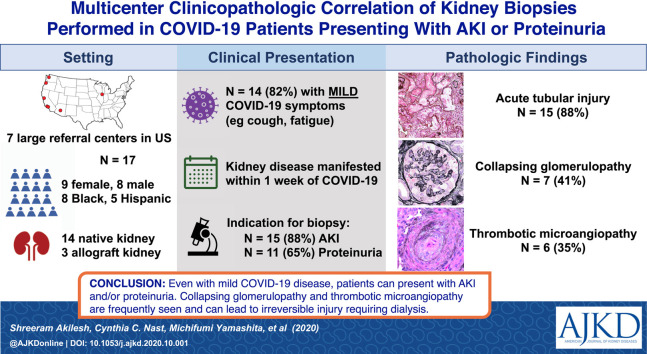
RATIONALE & OBJECTIVE: Kidney biopsy data inform us about pathologic processes associated with infection with severe acute respiratory syndrome coronavirus 2 (SARS-CoV-2). We conducted a multicenter evaluation of kidney biopsy findings in living patients to identify various kidney disease pathology findings in patients with coronavirus disease 2019 (COVID-19) and their association with SARS-CoV-2 infection.
Case series.
SETTING & PARTICIPANTS: We identified 14 native and 3 transplant kidney biopsies performed for cause in patients with documented recent or concurrent SARS-CoV-2 infection treated at 7 large hospital systems in the United States.
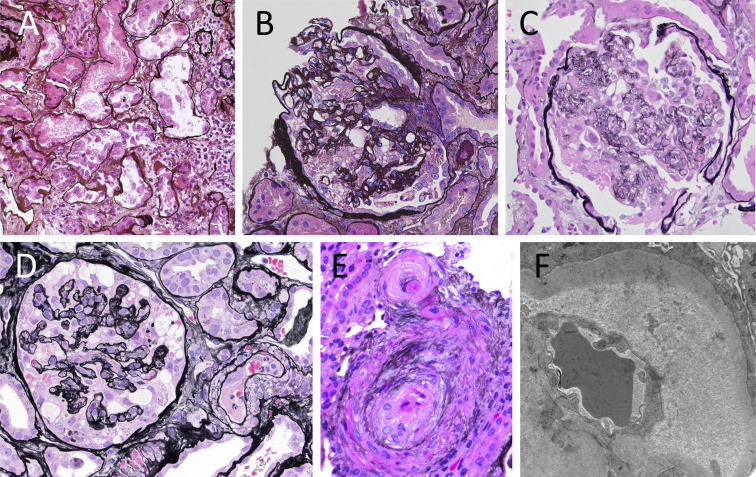
Men and women were equally represented in this case series, with a higher proportion of Black (n=8) and Hispanic (n=5) patients. All 17 patients had SARS-CoV-2 infection confirmed by reverse transcriptase-polymerase chain reaction, but only 3 presented with severe COVID-19 symptoms. Acute kidney injury (n=15) and proteinuria (n=11) were the most common indications for biopsy and these symptoms developed concurrently or within 1 week of COVID-19 symptoms in all patients. Acute tubular injury (n=14), collapsing glomerulopathy (n=7), and endothelial injury/thrombotic microangiopathy (n=6) were the most common histologic findings. 2 of the 3 transplant recipients developed active antibody-mediated rejection weeks after COVID-19. 8 patients required dialysis, but others improved with conservative management.
Small study size and short clinical follow-up.
Cases of even symptomatically mild COVID-19 were accompanied by acute kidney injury and/or heavy proteinuria that prompted a diagnostic kidney biopsy. Although acute tubular injury was seen among most of them, uncommon pathology such as collapsing glomerulopathy and acute endothelial injury were detected, and most of these patients progressed to irreversible kidney injury and dialysis.
肾活检数据可让我们了解与严重急性呼吸综合征冠状病毒 2(SARS-CoV-2)感染相关的病理过程。我们对活体患者的肾活检结果进行了多中心评估,以确定 COVID-19 患者中各种肾脏疾病的病理发现及其与 SARS-CoV-2 感染的关系。
病例系列研究。
我们在 7 家美国大型医院系统中发现了 14 例原发性和 3 例移植肾活检,这些活检是针对近期或同时发生 SARS-CoV-2 感染的患者进行的。
本病例系列中男女比例相当,黑人(n=8)和西班牙裔(n=5)患者比例较高。所有 17 例患者的 SARS-CoV-2 感染均通过逆转录-聚合酶链反应(RT-PCR)证实,但只有 3 例出现严重 COVID-19 症状。急性肾损伤(n=15)和蛋白尿(n=11)是最常见的活检指征,所有患者的这些症状均与 COVID-19 症状同时或在 COVID-19 症状出现后 1 周内出现。急性肾小管损伤(n=14)、塌陷性肾小球病(n=7)和内皮损伤/血栓性微血管病(n=6)是最常见的组织学发现。3 例移植受者中的 2 例在 COVID-19 后数周出现活动性抗体介导的排斥反应。8 例患者需要透析,但其他患者经保守治疗后病情好转。
研究规模小,临床随访时间短。
即使 COVID-19 症状轻微,也会伴有急性肾损伤和/或大量蛋白尿,促使进行诊断性肾活检。尽管大多数患者都出现了急性肾小管损伤,但也发现了不常见的病理改变,如塌陷性肾小球病和急性内皮损伤,大多数患者进展为不可逆的肾损伤和透析。