Department of Molecular Gastroenterology and Hepatology, Graduate School of Medical Science, Kyoto Prefectural University of Medicine, Kyoto, Japan.
Department of Surgical Pathology, Graduate School of Medical Science, Kyoto Prefectural University of Medicine, Kyoto, Japan.
United European Gastroenterol J. 2021 Apr;9(3):370-377. doi: 10.1177/2050640620964641. Epub 2021 Feb 10.
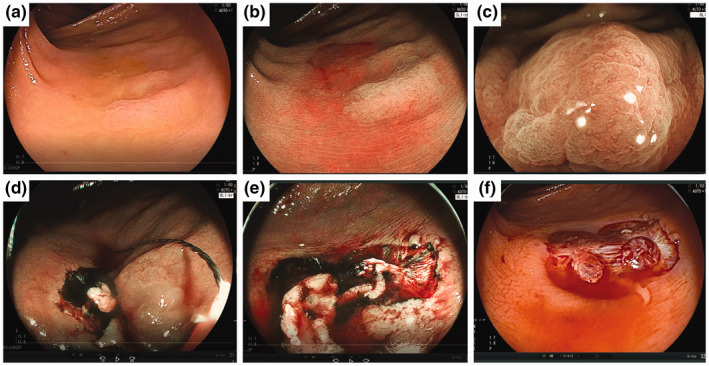
Cold snare polypectomy (CSP) is growing in popularity due to its safety and convenience. Its indication is benign tumours such as adenoma and sessile serrated lesions (SSLs) <10 mm in size. CSP for SSLs ≥10 mm in size has not been well examined. In this study, we aimed the feasibility of this treatment regarding therapeutic results and local recurrence.
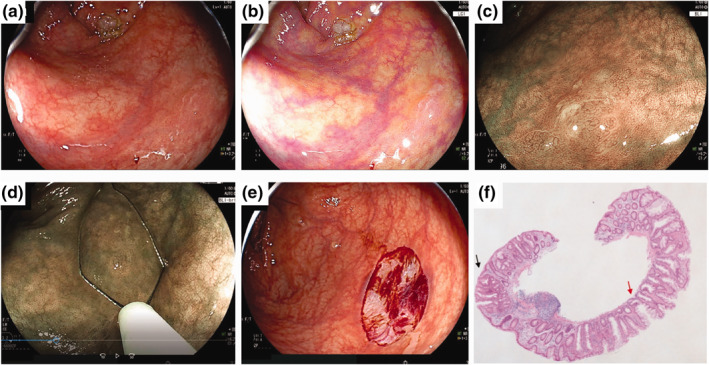
This was a single-centre retrospective cohort study. We reviewed SSLs with or without dysplasia of 10-20 mm that were resected by CSP from 2014 to 2020. All tumours were diagnosed endoscopically as SSLs without dysplasia before CSP with the help of magnifying narrow band imaging or blue laser imaging. We analysed the lesion characteristics, en bloc resection, histopathological diagnosis, adverse events and local recurrence. We analysed risk factors for recurrence, comparing recurrent lesions to non-recurrent lesions. We also compared risk factors for lesions 10-14 mm in size to those for lesions 15-20 mm in size.
We analysed 160 lesions in 100 patients (M ± SD = 67.7 ± 10.1 years). The polyp size (M ± SD) was 11.8 ± 2.8 mm, and the en bloc resection rate was 60.0% (96 cases). The rates of massive perioperative haemorrhage, postoperative haemorrhage and perforation were 1.3%, 0% and 0%, respectively. Regarding histopathological diagnosis, two (1.2%) cases showed SSLs with high-grade dysplasia. The recurrence rate in 101 lesions with a median follow-up period of 18 months (interquartile range 12-24 months) was 5.0%. There were no significant risk factors such as tumour size, location, morphology and so on in terms of recurrence. All recurrent cases could be resected by repeat CSP. The recurrence rates of lesions 10-14 mm in size and 15-20 mm in size were 4.7% and 6.3%, respectively (p = 0.713).
CSP of SSLs ≥10 mm in size according to magnifying endoscopic diagnosis was safe and promising, but the rate of recurrence was slightly high, meaning that close follow-up is required.
冷圈套息肉切除术(CSP)因其安全性和便利性而越来越受欢迎。其适应证为直径<10mm 的良性肿瘤,如腺瘤和无蒂锯齿状病变(SSLs)。对于直径≥10mm 的 SSLs 进行 CSP 的效果尚未得到很好的评估。在本研究中,我们旨在探讨该治疗方法在治疗效果和局部复发方面的可行性。
这是一项单中心回顾性队列研究。我们回顾了 2014 年至 2020 年间通过 CSP 切除的直径为 10-20mm、伴或不伴异型增生的 SSLs。所有肿瘤均在 CSP 前通过放大窄带成像或蓝激光成像诊断为无异型增生的 SSLs。我们分析了病变特征、整块切除、组织病理学诊断、不良事件和局部复发情况。我们分析了复发的危险因素,比较了复发病变与非复发病变。我们还比较了直径 10-14mm 病变与直径 15-20mm 病变的危险因素。
我们分析了 100 例患者的 160 个病变(M ± SD=67.7±10.1 岁)。息肉大小(M ± SD)为 11.8±2.8mm,整块切除率为 60.0%(96 例)。围手术期大出血、术后出血和穿孔的发生率分别为 1.3%、0%和 0%。组织病理学诊断方面,2 例(1.2%)显示 SSLs 伴高级别异型增生。101 个病变的中位随访时间为 18 个月(四分位距 12-24 个月),复发率为 5.0%。在肿瘤大小、位置、形态等方面,均无明显的复发危险因素。所有复发病例均可以通过重复 CSP 切除。直径 10-14mm 和 15-20mm 病变的复发率分别为 4.7%和 6.3%(p=0.713)。
根据放大内镜诊断对直径≥10mm 的 SSLs 进行 CSP 是安全且有前途的,但复发率略高,需要密切随访。