Department of Public Health and Primary Care, University of Cambridge, Cambridge, UK
Department of Public Health and Primary Care, University of Cambridge, Cambridge, UK.
BMJ Support Palliat Care. 2021 Mar;11(1):68-74. doi: 10.1136/bmjspcare-2020-002600. Epub 2020 Oct 12.
Clinically assisted hydration (CAH) can be provided in the last days of life as drinking declines. The impact of this practice on quality of life or survival in the last days of life is unclear. Practice varies worldwide concerning this emotive issue.
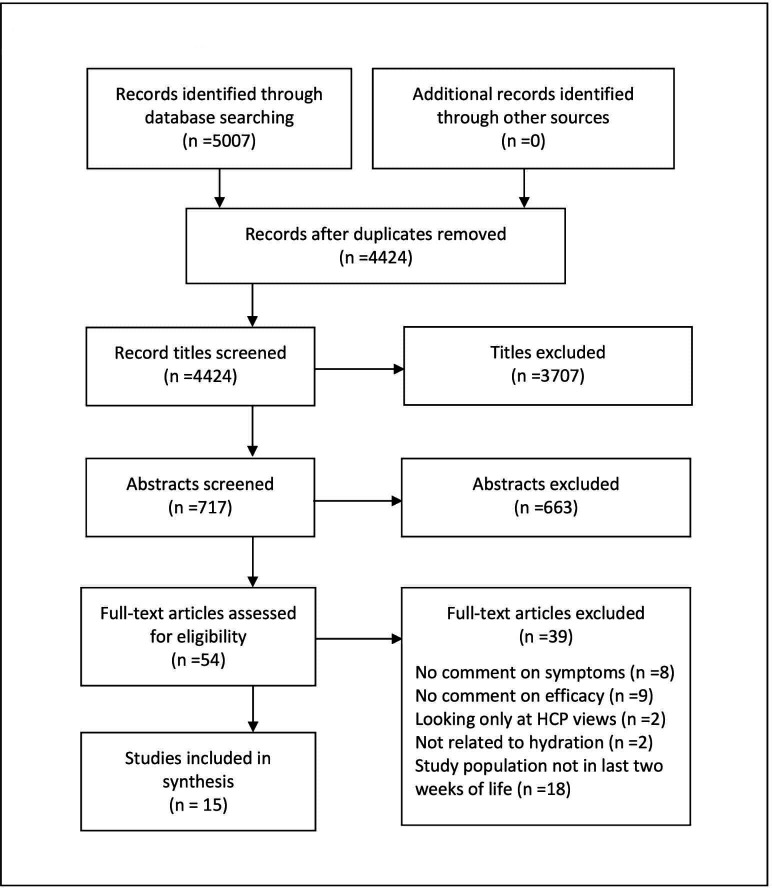
Systematic literature review and narrative synthesis of studies evaluating the impact of, or attitudes toward, CAH in the last days of life. Databases were searched up to December 2019. Studies were included if the majority of participants were in the last 7 days of life, and were evaluated using Gough's 'Weight of Evidence' framework. Review protocol registered with PROSPERO, registration number CRD42019125837.
Fifteen studies were included in the synthesis. None were judged to be both of high quality and relevance. No evidence was found that the provision of CAH has an impact on symptoms or survival. Patient and family carer attitudes toward assisted hydration were diverse.
There is currently insufficient evidence to draw firm conclusions on the impact of CAH in the last days of life. Future research needs to focus on patients specifically in the last days of life, include those with non-malignant diagnoses, and evaluate best ways to communicate effectively about this complex topic with patients and their families.
在生命的最后几天,当患者的饮水能力下降时,可以提供临床辅助水化(CAH)。这种做法对生命最后几天的生活质量或生存的影响尚不清楚。在这个涉及情感的问题上,世界各地的做法存在差异。
系统地回顾和综合评估生命最后几天 CAH 对生活质量或生存影响的研究,检索数据库截至 2019 年 12 月。如果大多数参与者处于生命的最后 7 天,则纳入研究,并使用 Gough 的“证据权重”框架进行评估。综述方案已在 PROSPERO 上注册,注册号为 CRD42019125837。
纳入的综合分析包括 15 项研究。没有一项研究被认为具有高质量和相关性。没有证据表明提供 CAH 会对症状或生存产生影响。患者和家属对辅助水化的态度存在差异。
目前尚无足够的证据来明确 CAH 在生命最后几天的影响。未来的研究需要集中在生命最后几天的患者身上,包括那些非恶性诊断的患者,并评估与患者及其家属就这一复杂问题进行有效沟通的最佳方式。