Kennedy Institute of Ethics, Georgetown University, Washington, DC, USA.
Department of Psychiatry and Behavioral Sciences, Memorial Sloan Kettering Cancer Center, New York, New York, USA.
J Am Geriatr Soc. 2024 Jul;72(7):1964-1972. doi: 10.1111/jgs.18766. Epub 2024 Jan 19.
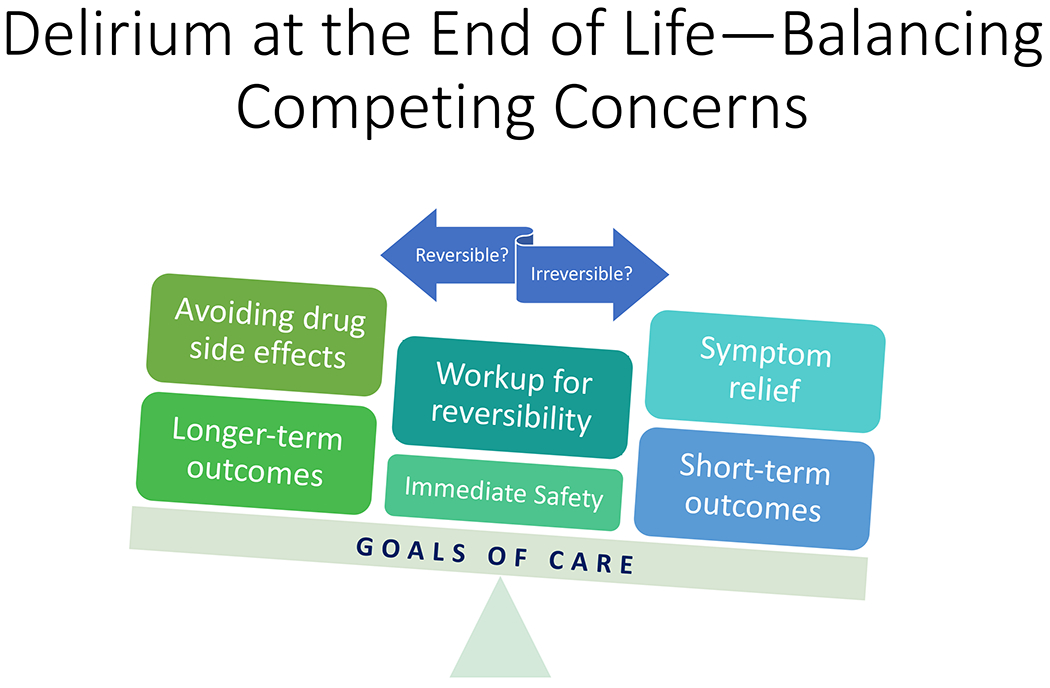
For older persons with delirium at the end of life, treatment involves complex trade-offs and highly value-sensitive decisions. The principles of beneficence, nonmaleficence, respect for autonomy, and justice establish important parameters but lack the structure necessary to guide clinicians in the optimal management of these patients. We propose a set of ethical rules to guide therapeutics-the canons of therapy-as a toolset to help clinicians deliberate about the competing concerns involved in the management of older patients with delirium at the end of life. These canons are standards of judgment that reflect how many experienced clinicians already intuitively practice, but which are helpful to articulate and apply as basic building blocks for a relatively neglected but emerging ethics of therapy. The canons of therapy most pertinent to the care of patients with delirium at the end of life are as follows: (1) restoration, which counsels that the goal of all treatment is to restore the patient, as much as possible, to homeostatic equilibrium; (2) means-end proportionality, which holds that every treatment should be well-fitted to the intended goal or end; (3) discretion, which counsels that an awareness of the limits of medical knowledge and practice should guide all treatment decisions; and (4) parsimony, which maintains that only as much therapeutic force as is necessary should be used to achieve the therapeutic goal. Carefully weighed and applied, these canons of therapy may provide the ethical structure needed to help clinicians optimally navigate complex cases.
对于生命末期患有谵妄的老年人,治疗涉及复杂的权衡和高度敏感的决策。善行、不伤害、尊重自主权和正义的原则确立了重要的参数,但缺乏必要的结构来指导临床医生对这些患者进行最佳管理。我们提出了一套伦理规则来指导治疗——治疗学的准则——作为一个工具集,帮助临床医生在管理生命末期患有谵妄的老年患者时,考虑到涉及的相互竞争的问题。这些准则是判断标准,反映了许多有经验的临床医生已经凭直觉实践的标准,但将其阐明并应用为相对被忽视但新兴的治疗伦理的基本构建块是很有帮助的。与生命末期谵妄患者护理最相关的治疗学准则如下:(1)恢复,即所有治疗的目标都是尽可能地使患者恢复到体内平衡;(2)手段-目的相称性,即每一种治疗都应该与预期的目标或目的相适应;(3)谨慎,即应根据医学知识和实践的局限性来指导所有治疗决策;(4)简约,即只应使用实现治疗目标所需的尽可能少的治疗力量。仔细权衡和应用这些治疗学准则,可以为临床医生提供最佳管理复杂病例所需的伦理结构。