Gastroenterology and Hepatology, Erasmus Medical Center, Rotterdam, The Netherlands
Gastroenterology and Hepatology, Erasmus Medical Center, Rotterdam, The Netherlands.
Gut. 2021 Jul;70(7):1266-1274. doi: 10.1136/gutjnl-2019-319129. Epub 2020 Oct 12.
The aim of this study was to describe the long-term health outcomes of children born to mothers with inflammatory bowel disease (IBD) and to assess the impact of maternal IBD medication use on these outcomes.
We performed a multicentre retrospective study in The Netherlands. Women with IBD who gave birth between 1999 and 2018 were enrolled from 20 participating hospitals. Information regarding disease characteristics, medication use, lifestyle, pregnancy outcomes and long-term health outcomes of children was retrieved from mothers and medical charts. After consent of both parents, outcomes until 5 years were also collected from general practitioners. Our primary aim was to assess infection rate and our secondary aims were to assess adverse reactions to vaccinations, growth, autoimmune diseases and malignancies.
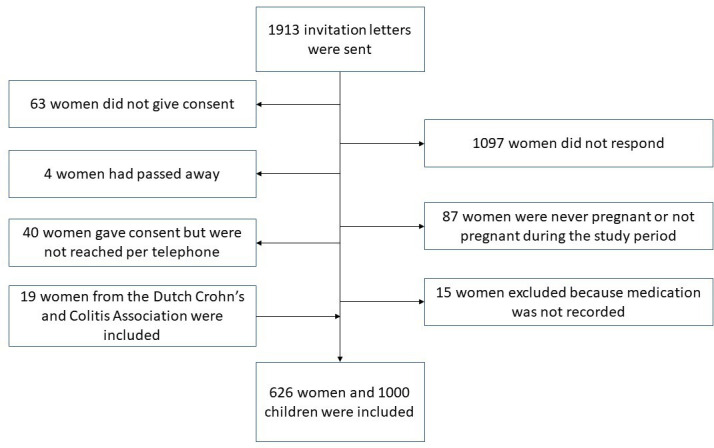
We included 1000 children born to 626 mothers (381 (61%) Crohn's disease, 225 (36%) ulcerative colitis and 20 (3%) IBD unclassified). In total, 196 (20%) had intrauterine exposure to anti-tumour necrosis factor-α (anti-TNF-α) (60 with concomitant thiopurine) and 240 (24%) were exposed to thiopurine monotherapy. The 564 children (56%) not exposed to anti-TNF-α and/or thiopurine served as control group. There was no association between adverse long-term health outcomes and in utero exposure to IBD treatment. We did find an increased rate of intrahepatic cholestasis of pregnancy (ICP) in case thiopurine was used during the pregnancy without affecting birth outcomes and long-term health outcomes of children. All outcomes correspond with the general age-adjusted population.
In our study, we found no association between in utero exposure to anti-TNF-α and/or thiopurine and the long-term outcomes antibiotic-treated infections, severe infections needing hospital admission, adverse reactions to vaccinations, growth failure, autoimmune diseases and malignancies.
本研究旨在描述母亲患有炎症性肠病(IBD)的儿童的长期健康结局,并评估母体 IBD 药物使用对这些结局的影响。
我们在荷兰进行了一项多中心回顾性研究。从 20 家参与医院招募了 1999 年至 2018 年间分娩的患有 IBD 的女性。从母亲和病历中检索了有关疾病特征、药物使用、生活方式、妊娠结局和儿童长期健康结局的信息。在获得父母双方同意后,还从全科医生那里收集了 5 岁以下的结局数据。我们的主要目的是评估感染率,次要目的是评估疫苗接种不良反应、生长、自身免疫性疾病和恶性肿瘤。
我们纳入了 1000 名由 626 名母亲(381 名(61%)克罗恩病、225 名(36%)溃疡性结肠炎和 20 名(3%)未分类的 IBD)所生的儿童。共有 196 名(20%)儿童在宫内接触过抗肿瘤坏死因子-α(anti-TNF-α)(60 名同时接受硫嘌呤治疗),240 名(24%)儿童接受硫嘌呤单药治疗。未暴露于 anti-TNF-α 和/或硫嘌呤的 564 名儿童(56%)作为对照组。母体 IBD 治疗药物暴露与不良长期健康结局之间无关联。我们确实发现,在怀孕期间使用硫嘌呤而不影响妊娠结局和儿童长期健康结局的情况下,妊娠肝内胆汁淤积症(ICP)的发生率增加。所有结局都与一般年龄调整人群相符。
在本研究中,我们发现母体 IBD 药物(anti-TNF-α 和/或硫嘌呤)暴露与儿童抗生素治疗感染、严重需要住院治疗的感染、疫苗接种不良反应、生长障碍、自身免疫性疾病和恶性肿瘤等长期结局之间无关联。