Dik Jan-Willem H, Sinha Bhanu, Friedrich Alex W, Lo-Ten-Foe Jerome R, Hendrix Ron, Köck Robin, Bijker Bert, Postma Maarten J, Freitag Michael H, Glaeske Gerd, Hoffmann Falk
Department of Medical Microbiology, University of Groningen, University Medical Center Groningen, Hanzeplein 1, 9713 GZ, Groningen, The Netherlands.
Certe Laboratories for Infectious Diseases, Groningen, The Netherlands.
Antimicrob Resist Infect Control. 2016 Apr 18;5:14. doi: 10.1186/s13756-016-0113-8. eCollection 2016.
Antibiotic resistance is a worldwide problem and inappropriate prescriptions are a cause. Especially among children, prescriptions tend to be high. It is unclear how they differ in bordering regions. This study therefore examined the antibiotic prescription prevalence among children in primary care between northern Netherlands and north-west of Germany.
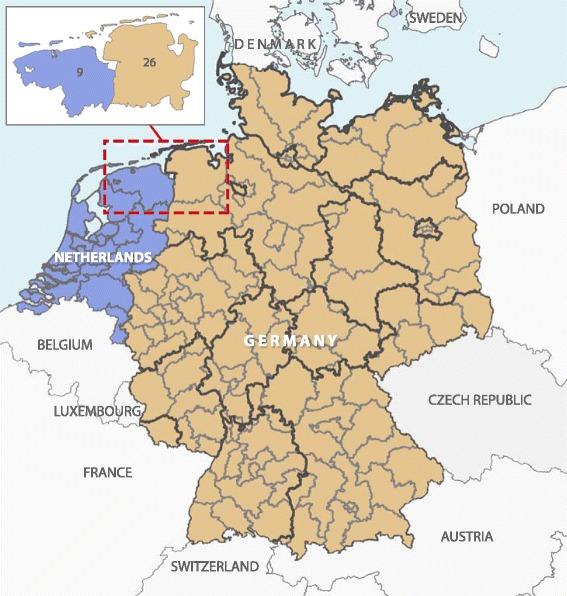
Two datasets were used: The Dutch (IADB) comprises representative data of pharmacists in North Netherland and the German (BARMER GEK) includes nationwide health insurance data. Both were filtered using postal codes to define two comparable bordering regions with patients under 18 years for 2010.
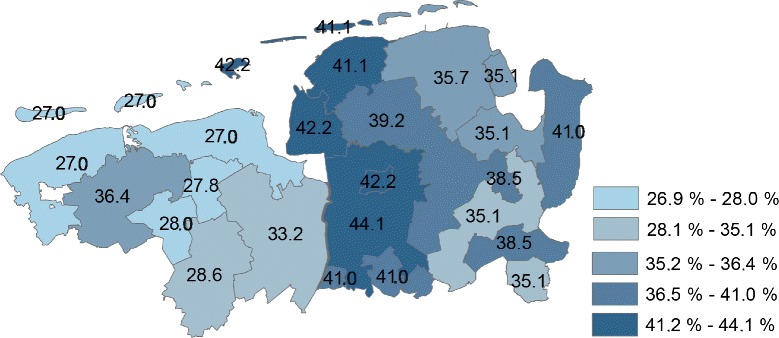
The proportion of primary care patients receiving at least one antibiotic was lower in northern Netherlands (29.8 %; 95 % confidence interval [95 % CI]: 29.3-30.3), compared to north-west Germany (38.9 %; 95 % CI: 38.2-39.6). Within the respective countries, there were variations ranging from 27.0 to 44.1 % between different areas. Most profound was the difference in second-generation cephalosporins: for German children 25 % of the total prescriptions, while for Dutch children it was less than 0.1 %.
This study is the first to compare outpatient antibiotic prescriptions among children in primary care practices in bordering regions of two countries. Large differences were seen within and between the countries, with overall higher prescription prevalence in Germany. Considering increasing cross-border healthcare, these comparisons are highly valuable and help act upon antibiotic resistance in the first line of care in an international approach.
抗生素耐药性是一个全球性问题,不恰当的处方是其成因之一。尤其是在儿童中,处方量往往较高。尚不清楚相邻地区之间的差异情况。因此,本研究调查了荷兰北部和德国西北部初级保健机构中儿童的抗生素处方流行情况。
使用了两个数据集:荷兰的数据集(IADB)包含荷兰北部药剂师的代表性数据,德国的数据集(BARMER GEK)包括全国性医疗保险数据。两者均使用邮政编码进行筛选,以定义两个具有可比性的相邻地区,纳入2010年18岁以下的患者。
与德国西北部(38.9%;95%置信区间[95%CI]:38.2 - 39.6)相比,荷兰北部接受至少一种抗生素治疗的初级保健患者比例较低(29.8%;95%CI:29.3 - 30.3)。在各自国家内,不同地区之间的差异范围为27.0%至44.1%。第二代头孢菌素的差异最为显著:德国儿童的处方量占总处方量的25%,而荷兰儿童的处方量则不到0.1%。
本研究首次比较了两个国家相邻地区初级保健机构中儿童的门诊抗生素处方情况。在国家内部和国家之间均观察到了较大差异,德国的总体处方流行率更高。考虑到跨境医疗保健的增加,这些比较具有很高的价值,有助于以国际方法在一线医疗中应对抗生素耐药性问题。