Godlewska-Żyłkiewicz Beata, Świsłocka Renata, Kalinowska Monika, Golonko Aleksandra, Świderski Grzegorz, Arciszewska Żaneta, Nalewajko-Sieliwoniuk Edyta, Naumowicz Monika, Lewandowski Włodzimierz
Department of Analytical Chemistry, Faculty of Chemistry, University of Bialystok, K. Ciołkowskiego 1K, 15-245 Białystok, Poland.
Department of Chemistry, Biology and Biotechnology, Bialystok University of Technology, Wiejska 45E, 15-351 Białystok, Poland.
Materials (Basel). 2020 Oct 8;13(19):4454. doi: 10.3390/ma13194454.
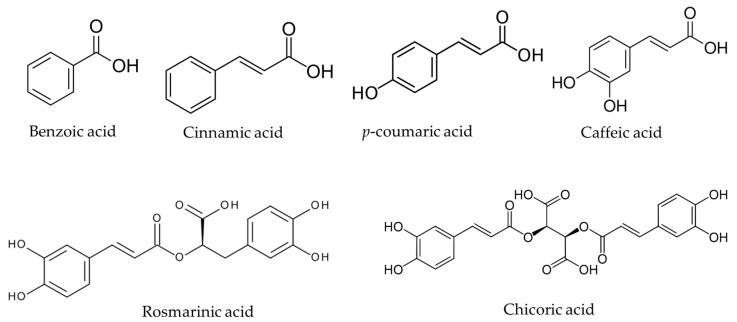
Natural carboxylic acids are plant-derived compounds that are known to possess biological activity. The aim of this review was to compare the effect of structural differences of the selected carboxylic acids (benzoic acid (BA), cinnamic acid (CinA), p-coumaric acid (p-CA), caffeic acid (CFA), rosmarinic acid (RA), and chicoric acid (ChA)) on the antioxidant, antimicrobial, and cytotoxic activity. The studied compounds were arranged in a logic sequence of increasing number of hydroxyl groups and conjugated bonds in order to investigate the correlations between the structure and bioactivity. A review of the literature revealed that RA exhibited the highest antioxidant activity and this property decreased in the following order: RA > CFA ~ ChA > p-CA > CinA > BA. In the case of antimicrobial properties, structure-activity relationships were not easy to observe as they depended on the microbial strain and the experimental conditions. The highest antimicrobial activity was found for CFA and CinA, while the lowest for RA. Taking into account anti-cancer properties of studied NCA, it seems that the presence of hydroxyl groups had an influence on intermolecular interactions and the cytotoxic potential of the molecules, whereas the carboxyl group participated in the chelation of endogenous transition metal ions.
天然羧酸是已知具有生物活性的植物衍生化合物。本综述的目的是比较所选羧酸(苯甲酸(BA)、肉桂酸(CinA)、对香豆酸(p-CA)、咖啡酸(CFA)、迷迭香酸(RA)和菊苣酸(ChA))的结构差异对抗氧化、抗菌和细胞毒性活性的影响。为了研究结构与生物活性之间的相关性,所研究的化合物按照羟基和共轭键数量增加的逻辑顺序排列。文献综述表明,RA表现出最高的抗氧化活性,且该特性按以下顺序降低:RA > CFA ~ ChA > p-CA > CinA > BA。就抗菌特性而言,结构-活性关系不易观察到,因为它们取决于微生物菌株和实验条件。发现CFA和CinA具有最高的抗菌活性,而RA的抗菌活性最低。考虑到所研究的天然羧酸的抗癌特性,似乎羟基的存在对分子间相互作用和细胞毒性潜力有影响,而羧基参与内源性过渡金属离子的螯合。