Meixiong James, Dong Xinzhong, Weng Hao-Jui
Solomon H. Snyder Department of Neuroscience and Medical Scientist Training Program, Johns Hopkins University School of Medicine, Baltimore, MD 21205, USA.
Solomon H. Snyder Department of Neuroscience, Department of Dermatology, and Department of Neurosurgery, Johns Hopkins University School of Medicine, Baltimore, MD 21205, USA.
Cells. 2020 Oct 9;9(10):2263. doi: 10.3390/cells9102263.
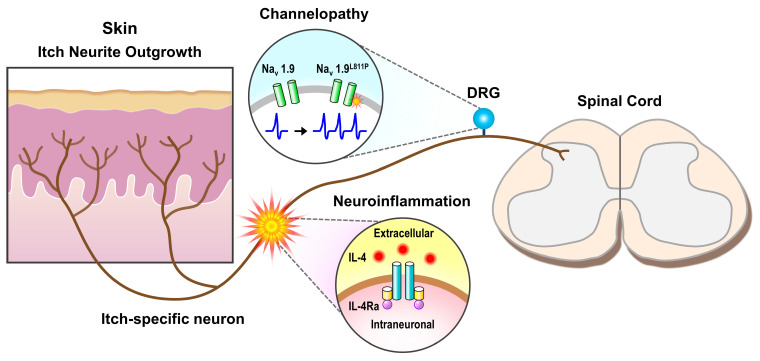
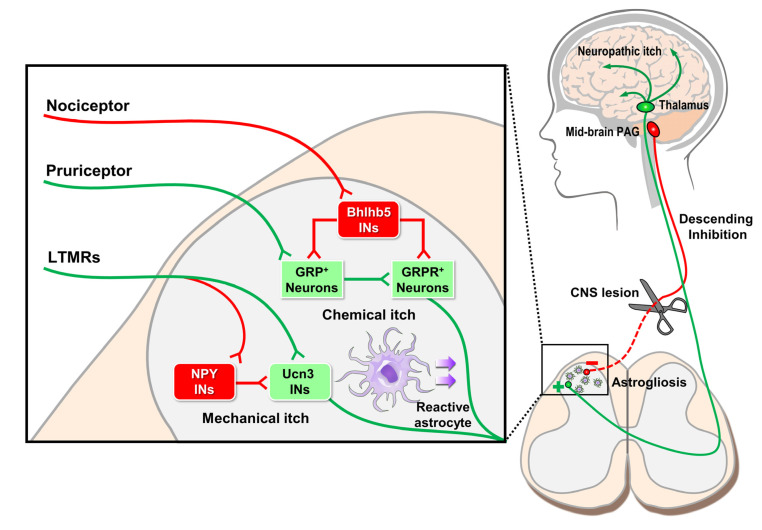
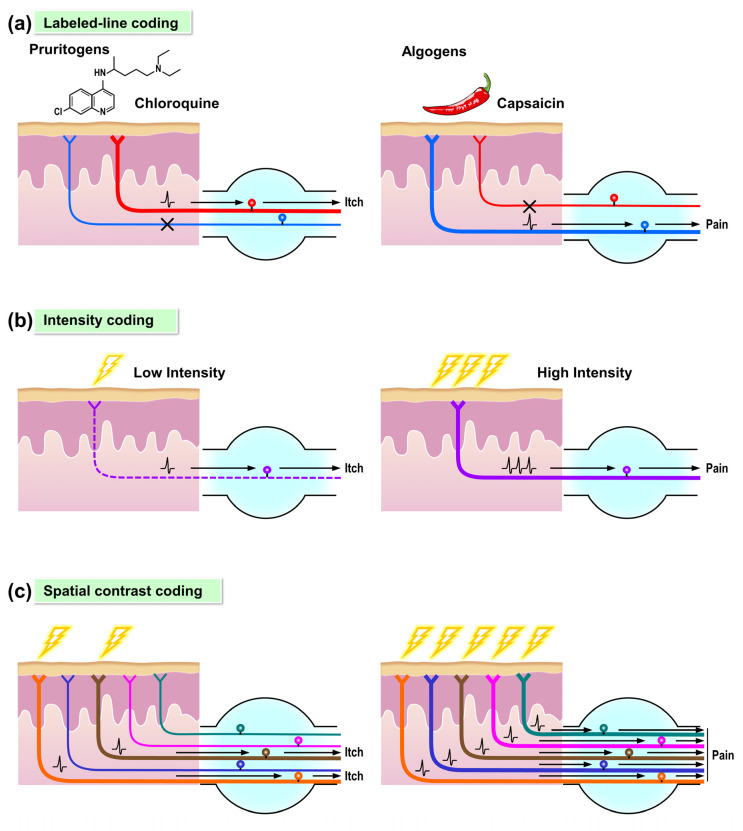
Neurologic insults as varied as inflammation, stroke, and fibromyalgia elicit neuropathic pain and itch. Noxious sensation results when aberrantly increased afferent signaling reaches percept-forming cortical neurons and can occur due to increased sensory signaling, decreased inhibitory signaling, or a combination of both processes. To treat these symptoms, detailed knowledge of sensory transmission, from innervated end organ to cortex, is required. Molecular, genetic, and behavioral dissection of itch in animals and patients has improved understanding of the receptors, cells, and circuits involved. In this review, we will discuss neuropathic itch with a focus on the itch-specific circuit.
诸如炎症、中风和纤维肌痛等各种神经损伤都会引发神经性疼痛和瘙痒。当传入信号异常增加并到达形成感知的皮层神经元时,就会产生有害感觉,这可能是由于感觉信号增加、抑制信号减少或这两个过程共同作用所致。要治疗这些症状,就需要详细了解从受神经支配的终末器官到皮层的感觉传递过程。对动物和患者瘙痒进行分子、遗传和行为剖析,有助于增进对相关受体、细胞和神经回路的理解。在这篇综述中,我们将重点讨论特异性瘙痒神经回路相关的神经性瘙痒。