• 文献检索
  • 文档翻译
  • 深度研究
  • 学术资讯
  • Suppr Zotero 插件Zotero 插件
  • 邀请有礼
  • 套餐&价格
  • 历史记录
应用&插件
Suppr Zotero 插件Zotero 插件浏览器插件Mac 客户端Windows 客户端微信小程序
定价
高级版会员购买积分包购买API积分包
服务
文献检索文档翻译深度研究API 文档MCP 服务
关于我们
关于 Suppr公司介绍联系我们用户协议隐私条款
关注我们

Suppr 超能文献

核心技术专利:CN118964589B侵权必究
粤ICP备2023148730 号-1Suppr @ 2026

文献检索

告别复杂PubMed语法,用中文像聊天一样搜索,搜遍4000万医学文献。AI智能推荐,让科研检索更轻松。

立即免费搜索

文件翻译

保留排版,准确专业,支持PDF/Word/PPT等文件格式,支持 12+语言互译。

免费翻译文档

深度研究

AI帮你快速写综述,25分钟生成高质量综述,智能提取关键信息,辅助科研写作。

立即免费体验

非洲环境下应对 COVID-19 疫情的策略:一项数学建模研究。

Response strategies for COVID-19 epidemics in African settings: a mathematical modelling study.

机构信息

Department of Infectious Disease Epidemiology, Centre for Mathematical Modelling of Infectious Diseases, London School of Hygiene and Tropical Medicine, Keppel Street,, London, WC1E 7HT, UK.

South African Centre for Epidemiological Modelling and Analysis, Stellenbosch University, Stellenbosch, Republic of South Africa.

出版信息

BMC Med. 2020 Oct 14;18(1):324. doi: 10.1186/s12916-020-01789-2.

DOI:10.1186/s12916-020-01789-2
PMID:33050951
原文链接:https://pmc.ncbi.nlm.nih.gov/articles/PMC7553800/
Abstract

BACKGROUND

The health impact of COVID-19 may differ in African settings as compared to countries in Europe or China due to demographic, epidemiological, environmental and socio-economic factors. We evaluated strategies to reduce SARS-CoV-2 burden in African countries, so as to support decisions that balance minimising mortality, protecting health services and safeguarding livelihoods.

METHODS

We used a Susceptible-Exposed-Infectious-Recovered mathematical model, stratified by age, to predict the evolution of COVID-19 epidemics in three countries representing a range of age distributions in Africa (from oldest to youngest average age: Mauritius, Nigeria and Niger), under various effectiveness assumptions for combinations of different non-pharmaceutical interventions: self-isolation of symptomatic people, physical distancing and 'shielding' (physical isolation) of the high-risk population. We adapted model parameters to better represent uncertainty about what might be expected in African populations, in particular by shifting the distribution of severity risk towards younger ages and increasing the case-fatality ratio. We also present sensitivity analyses for key model parameters subject to uncertainty.

RESULTS

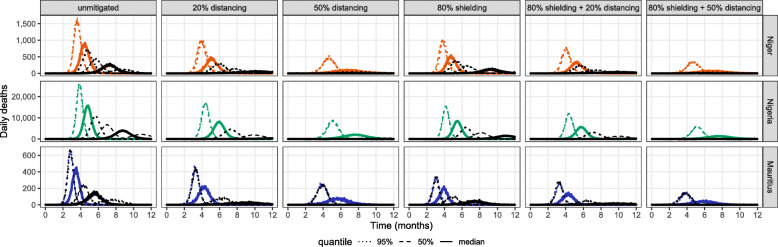
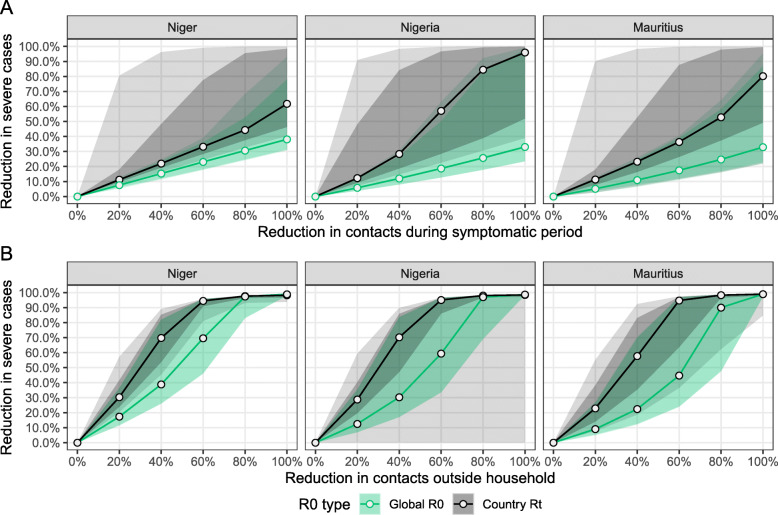
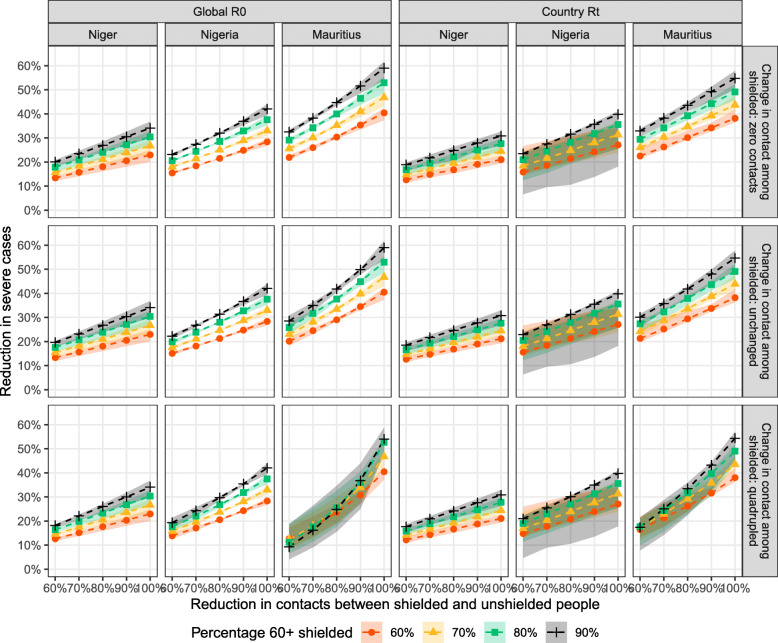
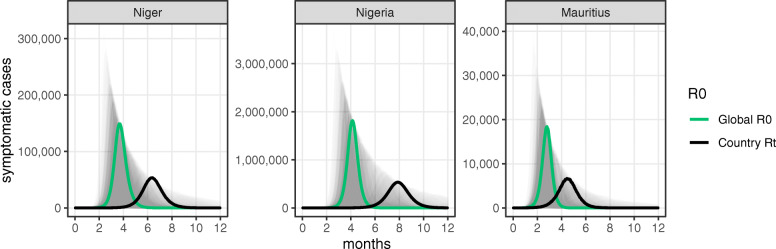
We predicted median symptomatic attack rates over the first 12 months of 23% (Niger) to 42% (Mauritius), peaking at 2-4 months, if epidemics were unmitigated. Self-isolation while symptomatic had a maximum impact of about 30% on reducing severe cases, while the impact of physical distancing varied widely depending on percent contact reduction and R. The effect of shielding high-risk people, e.g. by rehousing them in physical isolation, was sensitive mainly to residual contact with low-risk people, and to a lesser extent to contact among shielded individuals. Mitigation strategies incorporating self-isolation of symptomatic individuals, moderate physical distancing and high uptake of shielding reduced predicted peak bed demand and mortality by around 50%. Lockdowns delayed epidemics by about 3 months. Estimates were sensitive to differences in age-specific social mixing patterns, as published in the literature, and assumptions on transmissibility, infectiousness of asymptomatic cases and risk of severe disease or death by age.

CONCLUSIONS

In African settings, as elsewhere, current evidence suggests large COVID-19 epidemics are expected. However, African countries have fewer means to suppress transmission and manage cases. We found that self-isolation of symptomatic persons and general physical distancing are unlikely to avert very large epidemics, unless distancing takes the form of stringent lockdown measures. However, both interventions help to mitigate the epidemic. Shielding of high-risk individuals can reduce health service demand and, even more markedly, mortality if it features high uptake and low contact of shielded and unshielded people, with no increase in contact among shielded people. Strategies combining self-isolation, moderate physical distancing and shielding could achieve substantial reductions in mortality in African countries. Temporary lockdowns, where socioeconomically acceptable, can help gain crucial time for planning and expanding health service capacity.

摘要

背景

由于人口结构、流行病学、环境和社会经济等因素,新冠疫情对非洲国家的影响可能与欧洲或中国的国家不同。我们评估了在非洲国家减少 SARS-CoV-2 负担的策略,以支持平衡死亡率最小化、保护卫生服务和保障生计的决策。

方法

我们使用了一个易感-暴露-感染-恢复的数学模型,按年龄分层,以预测在三个国家的 COVID-19 疫情演变,这三个国家代表了非洲不同年龄分布的范围(从最年长到最年轻的平均年龄:毛里求斯、尼日利亚和尼日尔),不同非药物干预措施的组合具有不同的有效性假设:有症状者的自我隔离、身体距离和高危人群的“隔离”(身体隔离)。我们调整了模型参数,以更好地代表非洲人群中可能出现的不确定性,特别是通过将严重风险的分布转移到年轻年龄,并增加病死率。我们还对受不确定性影响的关键模型参数进行了敏感性分析。

结果

我们预测,如果疫情不得到缓解,前 12 个月内有症状的攻击率中位数将在 23%(尼日尔)到 42%(毛里求斯)之间,峰值出现在 2-4 个月。有症状时自我隔离的最大影响约为 30%,可减少重症病例,而身体距离的影响则因减少接触的百分比和 R 而异。对高危人群(例如,将他们隔离在物理隔离中)进行隔离的效果主要取决于与低危人群的残留接触,以及在较小程度上取决于隔离人群之间的接触。纳入有症状者自我隔离、适度身体距离和高比例隔离高危人群的缓解策略将预测的峰值床位需求和死亡率降低约 50%。封锁使疫情延迟了约 3 个月。估计值对文献中公布的特定年龄社会混合模式的差异以及对传染性、无症状病例的传染性和年龄相关严重疾病或死亡风险的假设敏感。

结论

在非洲国家,与其他地方一样,目前的证据表明,预计会出现大规模的 COVID-19 疫情。然而,非洲国家在抑制传播和管理病例方面手段较少。我们发现,除非距离采取严格封锁措施的形式,否则自我隔离和普遍的身体距离不太可能避免非常大的疫情。然而,这两种干预措施都有助于减轻疫情。如果高危人群的隔离具有高参与度和低隔离与未隔离人群的接触,且隔离人群之间的接触没有增加,则可以减少卫生服务需求,死亡率降低更为明显。结合自我隔离、适度身体距离和隔离的策略可以在非洲国家实现死亡率的大幅降低。在社会经济上可以接受的情况下,临时封锁可以为规划和扩大卫生服务能力争取宝贵的时间。
https://cdn.ncbi.nlm.nih.gov/pmc/blobs/d5d2/7557033/09308a730fdf/12916_2020_1789_Fig4_HTML.jpg
https://cdn.ncbi.nlm.nih.gov/pmc/blobs/d5d2/7557033/e1b9a5b6f780/12916_2020_1789_Fig1_HTML.jpg
https://cdn.ncbi.nlm.nih.gov/pmc/blobs/d5d2/7557033/f0e96af10e78/12916_2020_1789_Fig2_HTML.jpg
https://cdn.ncbi.nlm.nih.gov/pmc/blobs/d5d2/7557033/5277ba8d0bed/12916_2020_1789_Fig3_HTML.jpg
https://cdn.ncbi.nlm.nih.gov/pmc/blobs/d5d2/7557033/09308a730fdf/12916_2020_1789_Fig4_HTML.jpg
https://cdn.ncbi.nlm.nih.gov/pmc/blobs/d5d2/7557033/e1b9a5b6f780/12916_2020_1789_Fig1_HTML.jpg
https://cdn.ncbi.nlm.nih.gov/pmc/blobs/d5d2/7557033/f0e96af10e78/12916_2020_1789_Fig2_HTML.jpg
https://cdn.ncbi.nlm.nih.gov/pmc/blobs/d5d2/7557033/5277ba8d0bed/12916_2020_1789_Fig3_HTML.jpg
https://cdn.ncbi.nlm.nih.gov/pmc/blobs/d5d2/7557033/09308a730fdf/12916_2020_1789_Fig4_HTML.jpg

相似文献

1
Response strategies for COVID-19 epidemics in African settings: a mathematical modelling study.非洲环境下应对 COVID-19 疫情的策略:一项数学建模研究。
BMC Med. 2020 Oct 14;18(1):324. doi: 10.1186/s12916-020-01789-2.
2
Impact of self-imposed prevention measures and short-term government-imposed social distancing on mitigating and delaying a COVID-19 epidemic: A modelling study.自行采取预防措施和短期政府实施社会隔离对减轻和延缓 COVID-19 疫情的影响:建模研究。
PLoS Med. 2020 Jul 21;17(7):e1003166. doi: 10.1371/journal.pmed.1003166. eCollection 2020 Jul.
3
Effectiveness of isolation, testing, contact tracing, and physical distancing on reducing transmission of SARS-CoV-2 in different settings: a mathematical modelling study.隔离、检测、接触者追踪和保持社交距离在不同环境下减少 SARS-CoV-2 传播的效果:一项数学建模研究。
Lancet Infect Dis. 2020 Oct;20(10):1151-1160. doi: 10.1016/S1473-3099(20)30457-6. Epub 2020 Jun 16.
4
Determining the optimal strategy for reopening schools, the impact of test and trace interventions, and the risk of occurrence of a second COVID-19 epidemic wave in the UK: a modelling study.确定英国学校重新开放的最佳策略、检测和追踪干预措施的影响,以及发生第二波 COVID-19 疫情的风险:一项建模研究。
Lancet Child Adolesc Health. 2020 Nov;4(11):817-827. doi: 10.1016/S2352-4642(20)30250-9. Epub 2020 Aug 3.
5
Effects of non-pharmaceutical interventions on COVID-19 cases, deaths, and demand for hospital services in the UK: a modelling study.非药物干预对英国 COVID-19 病例、死亡和医院服务需求的影响:一项建模研究。
Lancet Public Health. 2020 Jul;5(7):e375-e385. doi: 10.1016/S2468-2667(20)30133-X. Epub 2020 Jun 2.
6
Flexible, Freely Available Stochastic Individual Contact Model for Exploring COVID-19 Intervention and Control Strategies: Development and Simulation.用于探索 COVID-19 干预和控制策略的灵活、免费的随机个体接触模型:开发和模拟。
JMIR Public Health Surveill. 2020 Sep 18;6(3):e18965. doi: 10.2196/18965.
7
The effect of control strategies to reduce social mixing on outcomes of the COVID-19 epidemic in Wuhan, China: a modelling study.控制策略对减少社交接触以控制中国武汉 COVID-19 疫情的效果:建模研究。
Lancet Public Health. 2020 May;5(5):e261-e270. doi: 10.1016/S2468-2667(20)30073-6. Epub 2020 Mar 25.
8
Quantifying the impact of physical distance measures on the transmission of COVID-19 in the UK.量化身体距离措施对英国 COVID-19 传播的影响。
BMC Med. 2020 May 7;18(1):124. doi: 10.1186/s12916-020-01597-8.
9
Evaluating the Effectiveness of Social Distancing Interventions to Delay or Flatten the Epidemic Curve of Coronavirus Disease.评估社交隔离干预措施在延迟或拉平冠状病毒病流行曲线方面的效果。
Emerg Infect Dis. 2020 Aug;26(8):1740-1748. doi: 10.3201/eid2608.201093. Epub 2020 Apr 28.
10
Impact of lockdown on COVID-19 epidemic in Île-de-France and possible exit strategies.封锁对法兰西岛 COVID-19 疫情的影响及可能的退出策略。
BMC Med. 2020 Jul 30;18(1):240. doi: 10.1186/s12916-020-01698-4.

引用本文的文献

1
The Role of Mathematical Modelling in Predicting and Controlling Infectious Disease Outbreaks in Underserved Settings: A Systematic Review and Meta-Analysis.数学建模在预测和控制服务欠缺地区传染病暴发中的作用:一项系统评价与荟萃分析
Public Health Chall. 2025 Sep 13;4(3):e70116. doi: 10.1002/puh2.70116. eCollection 2025 Sep.
2
Exploring affordable and effective pandemic containment measures in lower-income countries with a spatial SEIR model: a case study in South Africa.运用空间SEIR模型探索低收入国家经济适用且有效的疫情防控措施:以南非为例
BMC Public Health. 2025 Jul 23;25(1):2526. doi: 10.1186/s12889-025-23686-0.
3

本文引用的文献

1
Projecting contact matrices in 177 geographical regions: An update and comparison with empirical data for the COVID-19 era.预测 177 个地理区域的接触矩阵:对 COVID-19 时代的经验数据的更新和比较。
PLoS Comput Biol. 2021 Jul 26;17(7):e1009098. doi: 10.1371/journal.pcbi.1009098. eCollection 2021 Jul.
2
Seeding COVID-19 across Sub-Saharan Africa: An Analysis of Reported Importation Events across 49 Countries.在撒哈拉以南非洲传播 COVID-19:对 49 个国家报告的输入性事件的分析。
Am J Trop Med Hyg. 2021 Mar 8;104(5):1694-1702. doi: 10.4269/ajtmh.20-1502.
3
Considerations for planning COVID-19 treatment services in humanitarian responses.
Strategies to maintain health service provision during the COVID-19 pandemic in refugee settings in Jordan and Uganda.
约旦和乌干达难民安置点在新冠疫情期间维持医疗服务提供的策略。
PLOS Glob Public Health. 2025 May 8;5(5):e0004484. doi: 10.1371/journal.pgph.0004484. eCollection 2025.
4
"Kuteteza": A community-engaged COVID-19 Prevention and Protection Initiative in Southern Malawi.“库泰泰扎”:马拉维南部一项社区参与的新冠肺炎预防与保护倡议
Wellcome Open Res. 2024 Oct 2;9:24. doi: 10.12688/wellcomeopenres.20789.2. eCollection 2024.
5
The implementation of infection prevention and control measures and health care utilisation in ACF-supported health facilities during the COVID-19 pandemic in Kinshasa, Democratic Republic of the Congo, 2020.2020 年刚果民主共和国金沙萨的非政府组织支持的卫生机构在 COVID-19 大流行期间实施感染预防和控制措施以及卫生保健利用情况。
Glob Health Action. 2023 Dec 31;16(1):2258711. doi: 10.1080/16549716.2023.2258711. Epub 2023 Oct 17.
6
The Implementation of CDC COVID-19 Recommendations for Testing, Isolation, Quarantine and Movement at Emergency Intake Sites of Unaccompanied Children in the United States, April 1-May 31, 2021.美国 2021 年 4 月 1 日至 5 月 31 日,在无人陪伴儿童急诊收治点实施疾病控制与预防中心(CDC)关于检测、隔离、检疫和流动的 COVID-19 建议。
J Immigr Minor Health. 2023 Oct;25(5):1059-1064. doi: 10.1007/s10903-023-01495-0. Epub 2023 Jun 14.
7
Priority age targets for COVID-19 vaccination in Ethiopia under limited vaccine supply.在疫苗供应有限的情况下,埃塞俄比亚 COVID-19 疫苗接种的优先年龄目标。
Sci Rep. 2023 Apr 5;13(1):5586. doi: 10.1038/s41598-023-32501-y.
8
Social contact patterns relevant for infectious disease transmission in Cambodia.柬埔寨传染病传播相关的社会接触模式。
Sci Rep. 2023 Apr 4;13(1):5542. doi: 10.1038/s41598-023-31485-z.
9
Dynamics of factors associated with rates of COVID-19 cases and deaths in African countries.非洲国家 COVID-19 病例和死亡人数相关因素的动态变化。
Global Health. 2023 Mar 23;19(1):20. doi: 10.1186/s12992-023-00918-9.
10
Exploring the Social Trend Indications of Utilizing E-Commerce during and after COVID-19's Hit.探索新冠疫情冲击期间及之后电子商务应用的社会趋势迹象
Behav Sci (Basel). 2022 Dec 21;13(1):5. doi: 10.3390/bs13010005.
人道主义应对中规划新冠疫情治疗服务的考量因素。
Confl Health. 2020 Nov 25;14:80. doi: 10.1186/s13031-020-00325-6. eCollection 2020.
4
COVID-19 control in low-income settings and displaced populations: what can realistically be done?低收入环境和流离失所人群中的新冠疫情防控:实际能做些什么?
Confl Health. 2020 Jul 31;14:54. doi: 10.1186/s13031-020-00296-8. eCollection 2020.
5
Global, regional, and national estimates of the population at increased risk of severe COVID-19 due to underlying health conditions in 2020: a modelling study.2020 年,由于潜在健康状况,全球、区域和国家估计有多少人面临 COVID-19 重症风险增加:一项建模研究。
Lancet Glob Health. 2020 Aug;8(8):e1003-e1017. doi: 10.1016/S2214-109X(20)30264-3. Epub 2020 Jun 15.
6
Age-dependent effects in the transmission and control of COVID-19 epidemics.年龄相关因素对 COVID-19 疫情传播和防控的影响。
Nat Med. 2020 Aug;26(8):1205-1211. doi: 10.1038/s41591-020-0962-9. Epub 2020 Jun 16.
7
The impact of COVID-19 and strategies for mitigation and suppression in low- and middle-income countries.新冠疫情的影响以及中低收入国家的缓解和抑制策略。
Science. 2020 Jul 24;369(6502):413-422. doi: 10.1126/science.abc0035. Epub 2020 Jun 12.
8
Effects of non-pharmaceutical interventions on COVID-19 cases, deaths, and demand for hospital services in the UK: a modelling study.非药物干预对英国 COVID-19 病例、死亡和医院服务需求的影响:一项建模研究。
Lancet Public Health. 2020 Jul;5(7):e375-e385. doi: 10.1016/S2468-2667(20)30133-X. Epub 2020 Jun 2.
9
The relatively young and rural population may limit the spread and severity of COVID-19 in Africa: a modelling study.相对年轻和农村人口可能限制 COVID-19 在非洲的传播和严重程度:一项建模研究。
BMJ Glob Health. 2020 May;5(5). doi: 10.1136/bmjgh-2020-002699.
10
Early estimates of the indirect effects of the COVID-19 pandemic on maternal and child mortality in low-income and middle-income countries: a modelling study.对 COVID-19 大流行对低收入和中等收入国家母婴死亡率间接影响的早期估计:一项建模研究。
Lancet Glob Health. 2020 Jul;8(7):e901-e908. doi: 10.1016/S2214-109X(20)30229-1. Epub 2020 May 12.