Katsanis Sara Huston, Minear Mollie A, Sadeghpour Azita, Cope Heidi, Perilla Yezmin, Cook-Deegan Robert, Katsanis Nicholas, Davis Erica E, Angrist Misha
Duke Initiative for Science and Society, Duke University, Durham, NC, United States.
Center for Human Disease Modeling, Duke University, Durham, NC, United States.
J Particip Med. 2018 Jan 30;10(1):e2. doi: 10.2196/jopm.8958.
Unlike aggregate research on groups of participants with a particular disorder, genomic research on discrete families' rare conditions could result in data of use to families, their healthcare, as well as generating knowledge on the human genome.
In a study of families seeking to rule in/out genetic causes for their children's medical conditions via exome sequencing, we solicited their views on the importance of genomic information. Our aim was to learn the interests of parents in seeking genomic research data and to gauge their responsiveness and engagement with the research team.
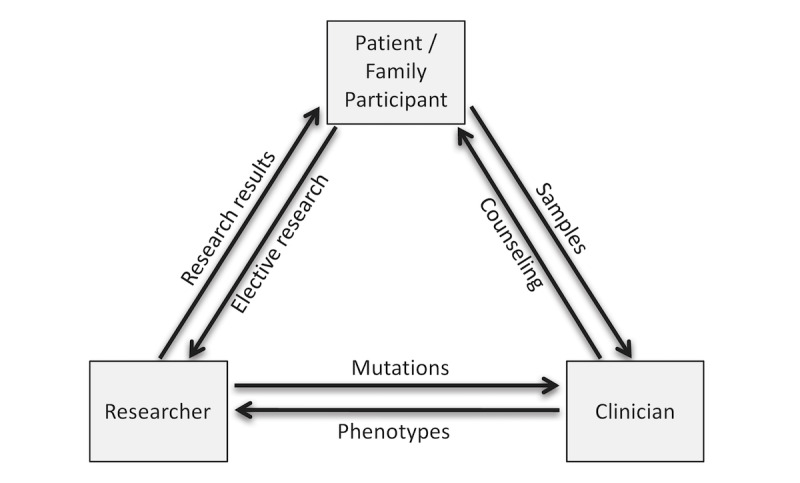
At enrollment, we offered participants options in the consent form for receiving potentially clinically relevant research results. We also offered an option of being a "partner" versus a "traditional" participant; partners could be re-contacted for research and study activities. We invited adult partners to complete a pre-exome survey, attend annual family forums, and participate in other inter-family interaction opportunities.
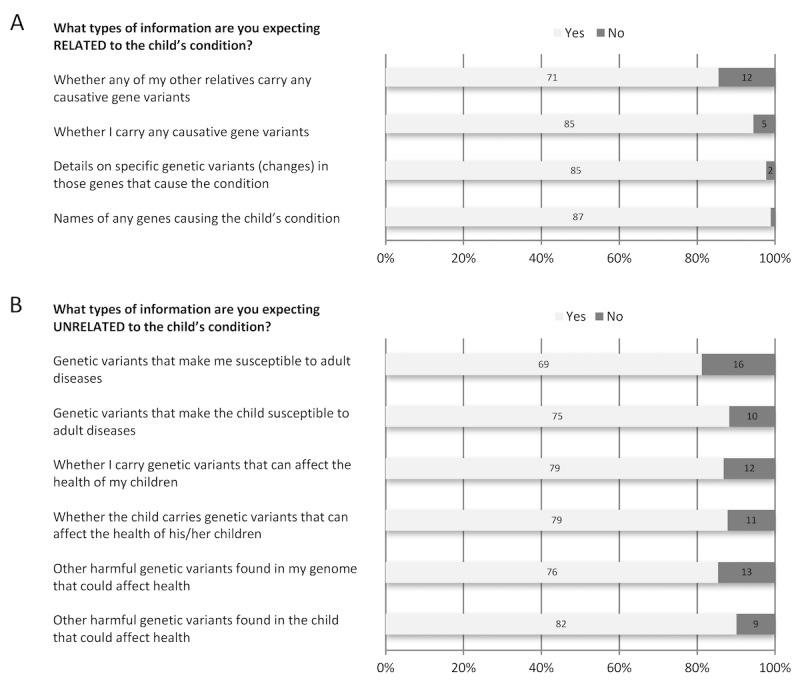
Of the 385 adults enrolled, 79% opted for "partnership" with the research team. Nearly all (99.2%) participants opted to receive research results pertaining to their children's primary conditions. A majority indicated the desire to receive additional clinically relevant outside the scope of their children's conditions (92.7%) and an interest in non-clinically relevant genetic information (82.7%).
Most participants chose partnership, including its rights and potential burdens; however, active engagement in study activities remained the exception. Not surprisingly, the overwhelming majority of participants-both partners and traditional-expected to receive all genetic information resulting from the research study.
与针对患有特定疾病的参与者群体进行的总体研究不同,对离散家庭的罕见病症进行基因组研究可能会产生对家庭及其医疗保健有用的数据,同时也能生成有关人类基因组的知识。
在一项通过外显子组测序帮助家庭确定其子女医疗状况的遗传原因的研究中,我们征求了他们对基因组信息重要性的看法。我们的目的是了解父母寻求基因组研究数据的兴趣,并评估他们对研究团队的响应度和参与度。
在入组时,我们在知情同意书中为参与者提供了接收可能具有临床相关性的研究结果的选项。我们还提供了成为“合作伙伴”与“传统”参与者的选项;合作伙伴可能会被再次联系以参与研究和学习活动。我们邀请成年合作伙伴完成外显子组测序前的调查、参加年度家庭论坛,并参与其他家庭间互动机会。
在385名入组的成年人中,79%选择与研究团队建立“合作关系”。几乎所有(99.2%)参与者都选择接收与其子女主要病症相关的研究结果。大多数人表示希望接收超出其子女病症范围的其他具有临床相关性的结果(92.7%),并对非临床相关的遗传信息感兴趣(82.7%)。
大多数参与者选择了合作关系,包括其权利和潜在负担;然而,积极参与研究活动的情况仍然是个例外。不出所料,绝大多数参与者——无论是合作伙伴还是传统参与者——都期望收到研究产生的所有遗传信息。