Dong Samantha Yimeng, Nguyen Linda, Cross Andrea, Doherty-Kirby Amanda, Geboers Jessica, McCauley Dayle, Soper Alice Kelen, St Dennis Amanda, Steeves Danny, Trehan Natasha, Gorter Jan Willem
Bachelor of Health Sciences Program, McMaster University, Hamilton, ON, Canada.
CanChild Centre for Childhood Disability Research, McMaster University, Hamilton, ON, Canada.
Res Involv Engagem. 2023 Jul 10;9(1):50. doi: 10.1186/s40900-023-00452-3.
Authentic researcher-youth partnerships in patient-oriented research (POR) where the research responds to the needs expressed by youth themselves are essential to make research meaningful. While patient-oriented research (POR) is increasingly practiced, few training programs exist in Canada and none, to our knowledge, are tailored for youth with neurodevelopmental disabilities (NDD). Our primary objective was to explore the training needs of youth (ages 18-25) with NDD to enhance their knowledge, confidence, and skills as research partners. Our secondary objective was to identify the benefits and challenges of engaging youth with NDD in a POR approach.
Our team of four youth and one parent with lived experience [Youth Engagement in Research (YER) partners] and six researchers engaged in POR to investigate the primary objective via two phases: (1) individual interviews with youth living with NDD and (2) a two-day virtual symposium with focus groups with youth and researchers. Collaborative qualitative content analysis was employed to synthesize the data. Our secondary objective was assessed by asking our YER partners to complete the Public and Patient Engagement Evaluation Tool (PPEET) survey and participate in reflective discussions.
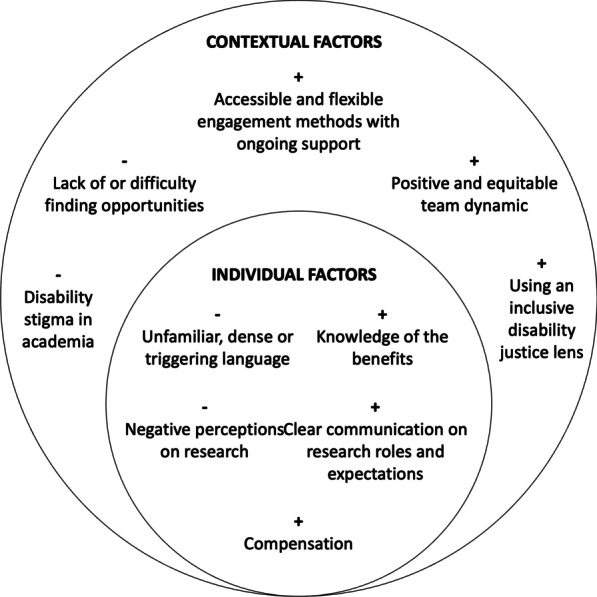
Phase 1 participants (n = 7) identified various barriers and facilitators to their engagement in research and offered suggestions to meet their needs through minimizing barriers and integrating facilitators, which would subsequently enhance their knowledge, confidence, and skills as research partners. Informed by phase 1, phase 2 participants (n = 17) prioritized the following POR training needs: researcher-youth communication, research roles and responsibilities, and finding partnership opportunities. For delivery methods, participants stated the importance of youth representation, using Universal Design for Learning, and co-learning between youth and researchers. Based on the PPEET data and subsequent discussions, YER partners agreed that they were able to express views freely, feel that their views were heard, and that their participation made a meaningful difference. Challenges included scheduling difficulties, ensuring multiple methods for engagement, and working under short timelines.
This study identified important training needs for youth with NDD and for researchers to engage in meaningful POR, which can subsequently inform the co-production of accessible training opportunities with and for youth.
在以患者为导向的研究(POR)中,真正的研究者与青年建立伙伴关系,使研究能够回应青年自身表达的需求,这对于让研究具有意义至关重要。虽然以患者为导向的研究(POR)越来越普遍,但加拿大的培训项目很少,而且据我们所知,没有专门为患有神经发育障碍(NDD)的青年量身定制的项目。我们的主要目标是探索患有神经发育障碍(NDD)的青年(18至25岁)的培训需求,以增强他们作为研究伙伴的知识、信心和技能。我们的次要目标是确定让患有神经发育障碍的青年参与以患者为导向的研究方法的益处和挑战。
我们由四名青年和一名有实际经验的家长组成的团队[青年参与研究(YER)伙伴]以及六名从事以患者为导向研究的研究人员,通过两个阶段来调查主要目标:(1)对患有神经发育障碍的青年进行个人访谈;(2)举行为期两天的虚拟研讨会,包括与青年和研究人员的焦点小组讨论。采用协作定性内容分析法对数据进行综合分析。我们通过要求我们的青年参与研究伙伴(YER)完成公众和患者参与评估工具(PPEET)调查并参与反思性讨论来评估次要目标。
第一阶段的参与者(n = 7)确定了他们参与研究的各种障碍和促进因素,并提出了通过减少障碍和整合促进因素来满足他们需求的建议,这将进而增强他们作为研究伙伴的知识、信心和技能。在第一阶段的基础上,第二阶段的参与者(n = 17)将以下以患者为导向的研究培训需求列为优先事项:研究者与青年的沟通、研究角色和职责以及寻找合作机会。对于授课方式,参与者指出了青年代表性、采用通用学习设计以及青年与研究人员之间共同学习的重要性。根据公众和患者参与评估工具(PPEET)的数据以及随后的讨论,青年参与研究伙伴(YER)一致认为他们能够自由表达观点,感觉自己的观点被听取,并且他们的参与产生了有意义的影响。挑战包括日程安排困难、确保多种参与方式以及在短时间内开展工作。
本研究确定了患有神经发育障碍的青年以及研究人员参与有意义的以患者为导向的研究的重要培训需求,这随后可为与青年共同制作以及为青年制作无障碍培训机会提供参考。