FROM Research Foundation, Papa Giovanni XXIII Hospital, Bergamo, Italy.
Center Research and Innovation of Myeloproliferative Neoplasms (CRIMM), Department of Experimental and Clinical Medicine, Azienda Ospedaliera Universitaria Careggi, University of Florence, Florence, Italy.
Blood Cancer J. 2020 Oct 14;10(10):100. doi: 10.1038/s41408-020-00368-1.
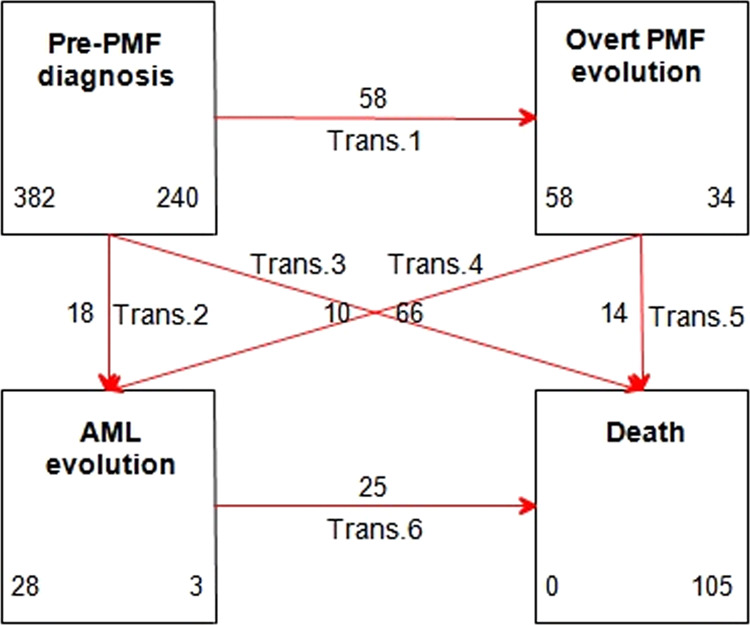
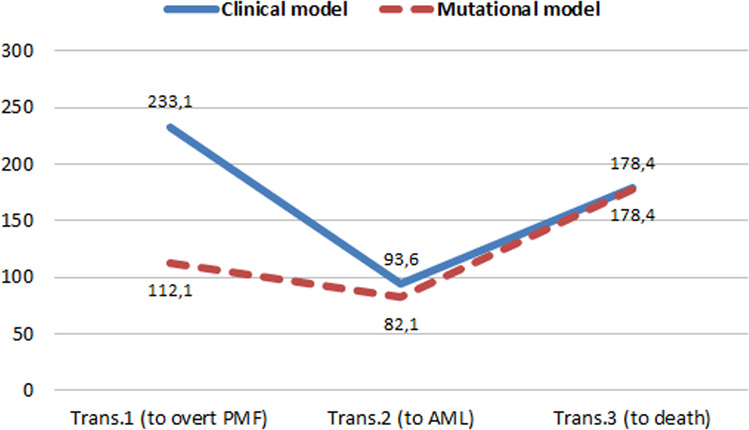
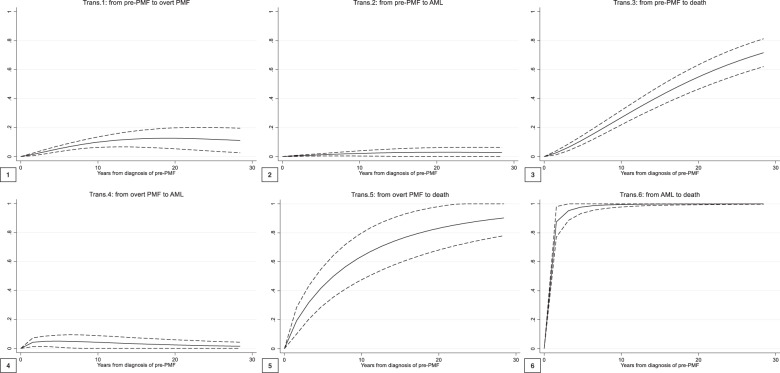
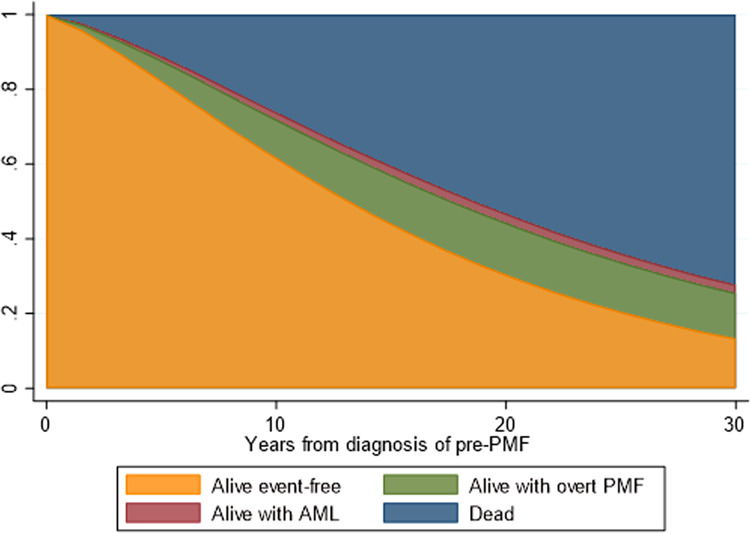
Among 382 patients with WHO-defined prefibrotic myelofibrosis (pre-PMF) followed for a median of 6.9 years, fibrotic or leukemic transformation or death accounts for 15, 7, and 27% of cases, respectively. A multistate model was applied to analyze survival data taking into account intermediate states that are part of the clinical course of pre-PMF, including overt PMF and acute myeloid leukemia (AML). Within this multistate framework, multivariable models disclosed older age (>65 years) and leukocytosis (>15 × 10/L) as predictors of death and leukemic transformation. The risk factors for fibrotic progression included anemia and grade 1 bone marrow fibrosis. The outcome was further affected by high molecular risk (HMR) but not driver mutations. Direct transition to overt PMF, AML, or death occurred in 15.2, 4.7, and 17.3% of patients, respectively. The risk of AML was the highest in the first 5 years (7%), but leveled off thereafter. Conversely, the probability of death from overt PMF or AML increased more rapidly over time, especially when compared to death in the pre-PMF state without disease progression. The probability of being alive with pre-PMF status decreased to 70 and 30% at 10 and 20 years, respectively. This study highlights the aspects of the clinical course and estimates of disease progression in pre-PMF.
在中位随访时间为 6.9 年的 382 例世界卫生组织(WHO)定义的纤维化前期骨髓纤维化(pre-PMF)患者中,纤维化或白血病转化或死亡分别占 15%、7%和 27%。应用多状态模型分析生存数据,同时考虑了纤维化前期 PMF 的临床过程中的中间状态,包括明显的 PMF 和急性髓系白血病(AML)。在这个多状态框架内,多变量模型揭示了年龄较大(>65 岁)和白细胞增多(>15×10/L)是死亡和白血病转化的预测因素。纤维化进展的危险因素包括贫血和 1 级骨髓纤维化。高风险分子(HMR)而非驱动突变进一步影响预后。直接转化为明显的 PMF、AML 或死亡分别发生在 15.2%、4.7%和 17.3%的患者中。AML 的风险在前 5 年最高(7%),但此后趋于平稳。相反,从纤维化前期 PMF 或 AML 死亡的概率随着时间的推移更快地增加,尤其是与纤维化前期无疾病进展的死亡相比。在 10 年和 20 年时,处于纤维化前期 PMF 状态的患者生存概率分别下降至 70%和 30%。这项研究突出了纤维化前期 PMF 的临床过程和疾病进展的评估方面。