
生存预测全景:关于活动、方法、工具、疾病和数据库的深入系统文献综述
Survival prediction landscape: an in-depth systematic literature review on activities, methods, tools, diseases, and databases.
作者信息
Abbasi Ahtisham Fazeel, Asim Muhammad Nabeel, Ahmed Sheraz, Vollmer Sebastian, Dengel Andreas
机构信息
Department of Computer Science, Rhineland-Palatinate Technical University of Kaiserslautern-Landau, Kaiserslautern, Germany.
Smart Data & Knowledge Services, Deutsches Forschungszentrum für Künstliche Intelligenz (DFKI), Kaiserslautern, Germany.
出版信息
Front Artif Intell. 2024 Jul 3;7:1428501. doi: 10.3389/frai.2024.1428501. eCollection 2024.
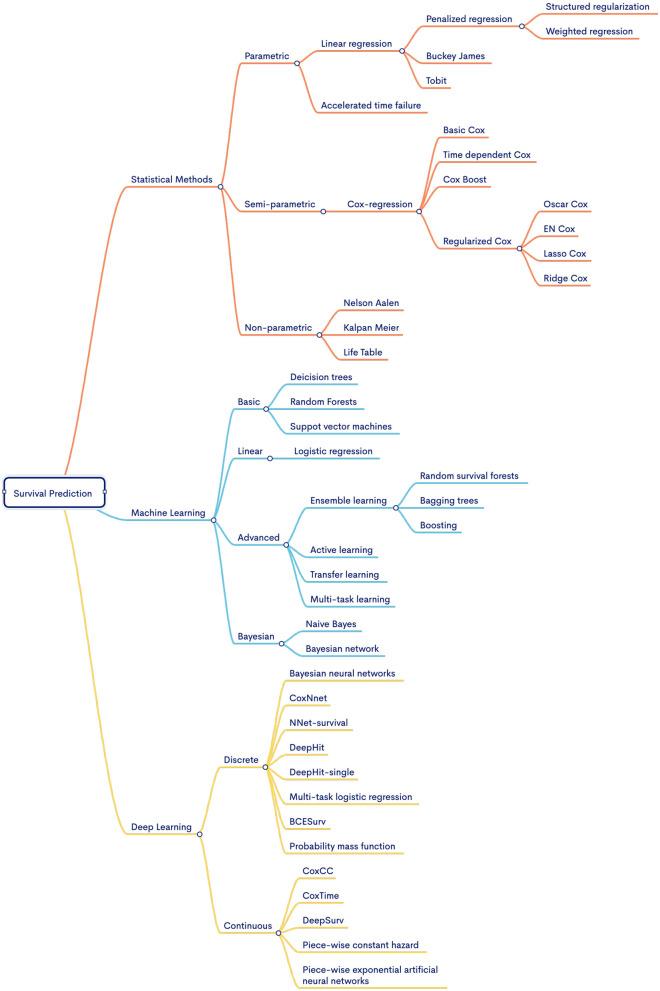
Survival prediction integrates patient-specific molecular information and clinical signatures to forecast the anticipated time of an event, such as recurrence, death, or disease progression. Survival prediction proves valuable in guiding treatment decisions, optimizing resource allocation, and interventions of precision medicine. The wide range of diseases, the existence of various variants within the same disease, and the reliance on available data necessitate disease-specific computational survival predictors. The widespread adoption of artificial intelligence (AI) methods in crafting survival predictors has undoubtedly revolutionized this field. However, the ever-increasing demand for more sophisticated and effective prediction models necessitates the continued creation of innovative advancements. To catalyze these advancements, it is crucial to bring existing survival predictors knowledge and insights into a centralized platform. The paper in hand thoroughly examines 23 existing review studies and provides a concise overview of their scope and limitations. Focusing on a comprehensive set of 90 most recent survival predictors across 44 diverse diseases, it delves into insights of diverse types of methods that are used in the development of disease-specific predictors. This exhaustive analysis encompasses the utilized data modalities along with a detailed analysis of subsets of clinical features, feature engineering methods, and the specific statistical, machine or deep learning approaches that have been employed. It also provides insights about survival prediction data sources, open-source predictors, and survival prediction frameworks.
生存预测整合患者特定的分子信息和临床特征,以预测事件的预期时间,如复发、死亡或疾病进展。生存预测在指导治疗决策、优化资源分配和精准医学干预方面具有重要价值。疾病种类繁多、同一疾病存在多种变体以及对可用数据的依赖,都需要针对特定疾病的计算生存预测模型。人工智能(AI)方法在构建生存预测模型中的广泛应用无疑给该领域带来了变革。然而,对更复杂、更有效的预测模型的需求不断增加,这就需要持续进行创新。为推动这些进展,将现有生存预测模型的知识和见解整合到一个集中平台至关重要。手头的这篇论文全面审视了23项现有综述研究,并简要概述了它们的范围和局限性。该论文聚焦于44种不同疾病的90个最新生存预测模型,深入探讨了用于开发特定疾病预测模型的各种方法。这种详尽的分析涵盖了所使用的数据模式,以及对临床特征子集、特征工程方法,以及所采用的特定统计、机器学习或深度学习方法的详细分析。它还提供了有关生存预测数据源、开源预测模型和生存预测框架的见解。
 Zotero 插件