Biomedical Engineering and Biomechanics Research Centre, School of Engineering, College of Science and Engineering, National University of Ireland Galway, Galway, Ireland.
Sci Rep. 2020 Oct 14;10(1):17321. doi: 10.1038/s41598-020-73141-w.
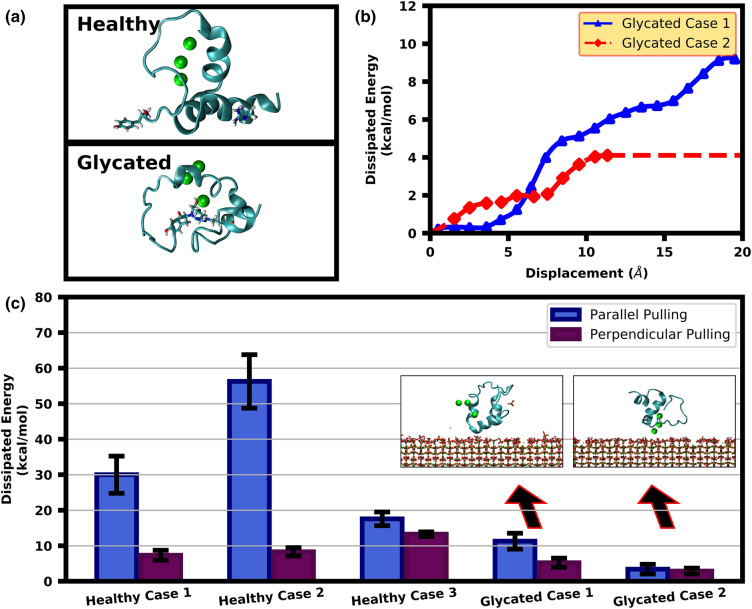
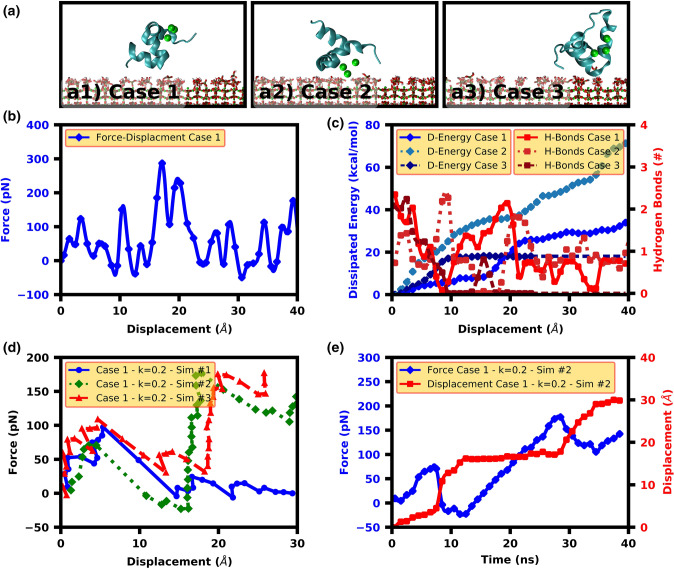
This study presents an investigation into the role of Osteocalcin (OC) on bone biomechanics, with the results demonstrating that the protein's α-helix structures play a critical role in energy dissipation behavior in healthy conditions. In the first instance, α-helix structures have high affinity with the Hydroxyapatite (HAp) mineral surface and provide favorable conditions for adsorption of OC proteins onto the mineral surface. Using steered molecular dynamics simulation, several key energy dissipation mechanisms associated with α-helix structures were observed, which included stick-slip behavior, a sacrificial bond mechanism and a favorable binding feature provided by the Ca motif on the OC protein. In the case of Type-2 Diabetes, this study demonstrated that possible glycation of the OC protein can occur through covalent crosslinking between Arginine and N-terminus regions, causing disruption of α-helices leading to a lower protein affinity to the HAp surface. Furthermore, the loss of α-helix structures allowed protein deformation to occur more easily during pulling and key energy dissipation mechanisms observed in the healthy configuration were no longer present. This study has significant implications for our understanding of bone biomechanics, revealing several novel mechanisms in OC's involvement in energy dissipation. Furthermore, these mechanisms can be disrupted following the onset of Type-2 Diabetes, implying that glycation of OC could have a substantial contribution to the increased bone fragility observed during this disease state.
本研究探讨了骨钙素(OC)在骨生物力学中的作用,结果表明该蛋白的α-螺旋结构在健康条件下对能量耗散行为起着关键作用。首先,α-螺旋结构与羟基磷灰石(HAp)矿物表面具有高亲和力,并为 OC 蛋白吸附到矿物表面提供了有利条件。通过定向分子动力学模拟,观察到与α-螺旋结构相关的几个关键能量耗散机制,包括粘滑行为、牺牲键机制以及 OC 蛋白上 Ca 基序提供的有利结合特征。在 2 型糖尿病的情况下,本研究表明 OC 蛋白可能发生糖化,通过精氨酸和 N-末端区域之间的共价交联,导致α-螺旋的破坏,从而降低蛋白对 HAp 表面的亲和力。此外,α-螺旋结构的丧失使得蛋白在拉伸过程中更容易发生变形,并且在健康构象中观察到的关键能量耗散机制不再存在。本研究对我们理解骨生物力学具有重要意义,揭示了 OC 在能量耗散中的几个新机制。此外,这些机制可能在 2 型糖尿病发作后被破坏,这意味着 OC 的糖化可能对该疾病状态下观察到的骨脆性增加有实质性贡献。