United Graduate School of Agricultural Sciences, Tottori University, Tottori, 680-8553, Japan.
Arid Land Research Center, Tottori University, Tottori, 6800001, Japan.
Sci Rep. 2020 Oct 14;10(1):17189. doi: 10.1038/s41598-020-74303-6.
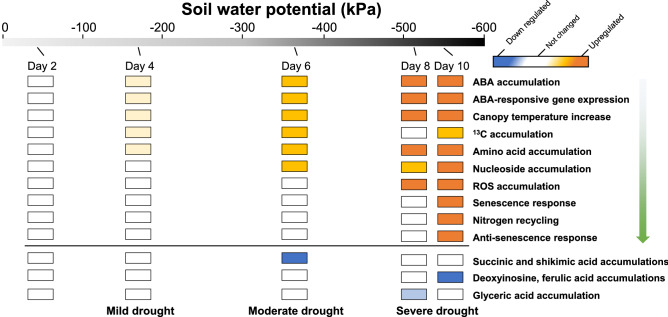
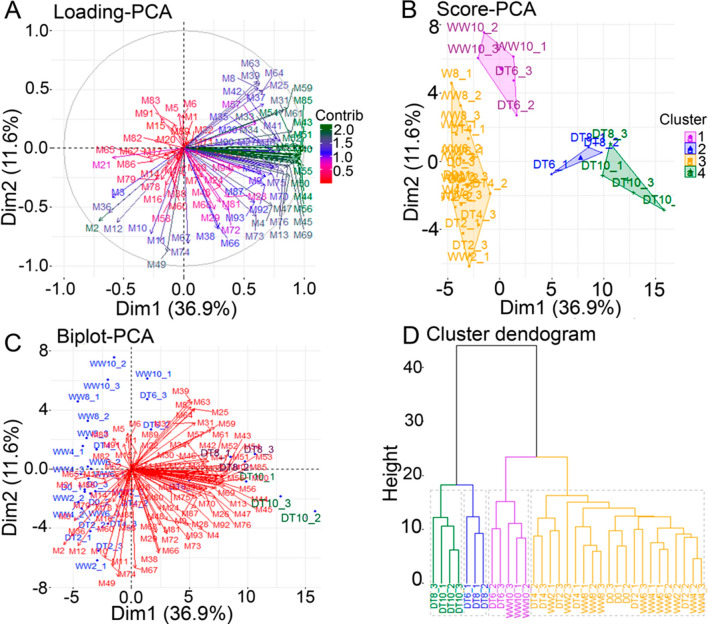
Wheat (Tritium aestivum) is vulnerable to future climate change because it is predominantly grown under rain-fed conditions in drought-prone areas. Thus, in-depth understanding of drought effect on wheat metabolism is essential for developing drought-tolerant wheat varieties. Here, we exposed wheat 'Norin 61' plants to progressive drought stress [0 (before drought), 2, 4, 6, 8, and 10 days after withholding water] during the flowering stage to investigate physiological and metabolomic responses. Transcriptional analyses of key abscisic acid-responsive genes indicated that abscisic acid signalling played a major role in the adaptation of wheat to water deficit. Carbon isotope composition had a higher value than the control while canopy temperature (CT) increased under drought stress. The CT depression was tightly correlated with soil water potential (SWP). Additionally, SWP at - 517 kPa was identified as the critical point for increasing CT and inducing reactive oxygen species. Metabolome analysis identified four potential drought-responsive biomarkers, the enhancement of nitrogen recycling through purine and pyrimidine metabolism, drought-induced senescence based on 1-aminocyclopropane-1-carboxylic acid and Asn accumulation, and an anti-senescence response through serotonin accumulation under severe drought stress. Our findings provide in-depth insight into molecular, physiological and metabolite changes involved in drought response which are useful for wheat breeding programs to develop drought-tolerant wheat varieties.
小麦(Tritium aestivum)易受未来气候变化的影响,因为它主要在干旱易发生地区的雨养条件下种植。因此,深入了解干旱对小麦代谢的影响对于培育耐旱小麦品种至关重要。在这里,我们在开花期将小麦 'Norin 61' 植株暴露于渐进的干旱胁迫下[0(干旱前)、2、4、6、8 和 10 天后停水],以研究其生理和代谢组响应。关键脱落酸响应基因的转录分析表明,脱落酸信号在小麦适应水分亏缺中起主要作用。在干旱胁迫下,碳同位素组成的数值高于对照,冠层温度(CT)升高。CT 下降与土壤水势(SWP)密切相关。此外,SWP 为-517 kPa 时被确定为增加 CT 和诱导活性氧的临界点。代谢组分析确定了四个潜在的干旱响应生物标志物,即嘌呤和嘧啶代谢增强氮循环,基于 1-氨基环丙烷-1-羧酸和 Asn 积累的干旱诱导衰老,以及在严重干旱胁迫下通过血清素积累的抗衰老反应。我们的研究结果深入了解了干旱响应中涉及的分子、生理和代谢变化,这对于小麦育种计划培育耐旱小麦品种非常有用。