International Rice Research Institute (IRRI), South Asia Hub, ICRISAT, Hyderabad, India.
South Asia Regional Centre (ISARC), International Rice Research Institute, Varanasi, India.
PLoS One. 2020 Oct 15;15(10):e0240591. doi: 10.1371/journal.pone.0240591. eCollection 2020.
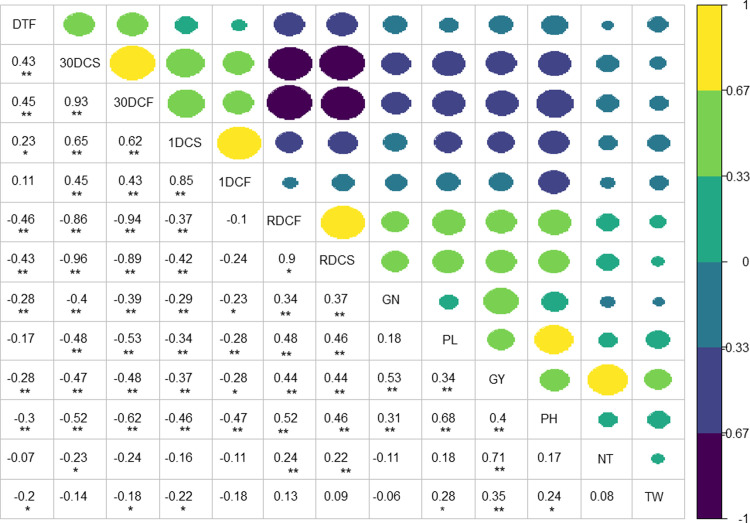
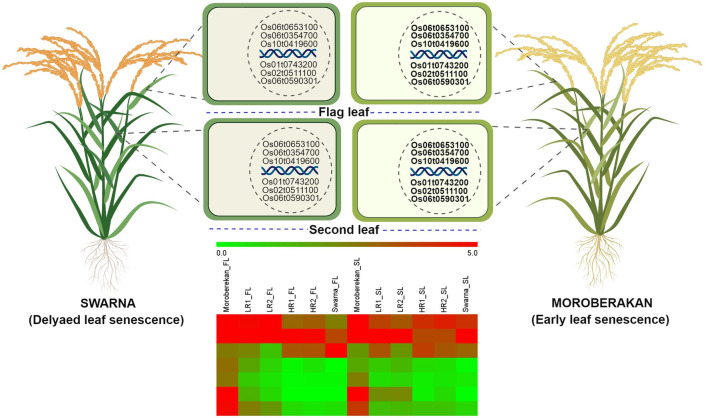
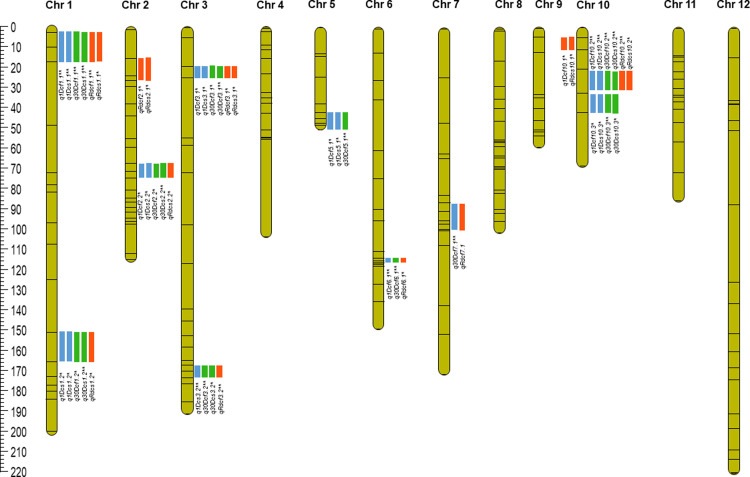
Photosynthates generated after heading contributes to 60% - 80% of grain yield in rice. Delay in leaf senescence can contribute to a long grain-filling period and thereby increased yield. The objective of this study was to identify genomic region(s) responsible for delayed leaf senescence (DLS) and validate the role of underlying candidate genes in controlling target traits. 302 BC2F4 backcross-derived lines (BILs) developed from a cross between Swarna and Moroberekan were phenotyped for two seasons (DS2016 and WS2017) for chlorophyll content and yield parameters. KASPar-SNP assays based genotyping data with 193 SNPs of mapping population was used to identify the targeted genomic region(s). Significant positive correlation was observed between the two most important determinants of DLS traits viz., RDCF (reduced decline degree of chlorophyll content of flag leaf) and RDCS (reduced decline degree of chlorophyll content of second leaf) with plant height (PH), grain number per panicle (GPN), panicle length (PL), number of tiller (NT) and grain yield (GY). A total of 41 and 29 QTLs with phenotypic variance (PVE) ranging from 8.2 to 25.1% were detected for six DLS traits during DS2016 and WS2017, respectively. Out of these identified QTLs, 19 were considered as stable QTLs detected across seasons. 17 of the identified stable QTLs were found to be novel. In-silico analysis revealed five key genes regulating chlorophyll metabolism. Expression analysis of these genes confirmed their strong association with the senescence pattern in leaf tissue of parents as well as selected phenotypically extreme lines. The identified stable QTLs regulating DLS traits and validation of potential candidate genes provides insight into genetic basis of delayed senescence and is expected to contribute in enhancing grain yield through genomics-assisted breeding (GAB).
抽穗后生成的同化物对水稻产量的贡献率为 60%-80%。叶片衰老的延迟可以导致较长的灌浆期,从而提高产量。本研究的目的是鉴定与延迟叶片衰老(DLS)相关的基因组区域,并验证潜在候选基因在控制目标性状中的作用。利用 Swarna 和 Moroberekan 杂交衍生的 302 个 BC2F4 回交系(BILs),在两个季节(DS2016 和 WS2017)对叶绿素含量和产量参数进行表型分析。利用基于 KASPar-SNP 的标记群体基因型数据和 193 个 SNP 鉴定目标基因组区域。观察到 DLS 性状的两个最重要决定因素,即 RDCF(旗叶叶绿素含量下降程度)和 RDCS(第二叶叶绿素含量下降程度)与株高(PH)、每穗粒数(GPN)、穗长(PL)、分蘖数(NT)和产量(GY)之间存在显著正相关。在 DS2016 和 WS2017 期间,共检测到 6 个 DLS 性状的 41 个和 29 个 QTL,表型方差(PVE)范围分别为 8.2%至 25.1%。在所鉴定的 QTL 中,有 19 个被认为是跨季节稳定 QTL。鉴定出的 19 个稳定 QTL 中有 17 个是新的。计算机分析揭示了五个调节叶绿素代谢的关键基因。这些基因的表达分析证实了它们与亲本叶片组织衰老模式以及所选表型极端系之间的强烈关联。鉴定出的调节 DLS 性状的稳定 QTL 和潜在候选基因的验证为延迟衰老的遗传基础提供了深入了解,并有望通过基因组辅助育种(GAB)提高产量。