• 文献检索
  • 文档翻译
  • 深度研究
  • 学术资讯
  • Suppr Zotero 插件Zotero 插件
  • 邀请有礼
  • 套餐&价格
  • 历史记录
应用&插件
Suppr Zotero 插件Zotero 插件浏览器插件Mac 客户端Windows 客户端微信小程序
定价
高级版会员购买积分包购买API积分包
服务
文献检索文档翻译深度研究API 文档MCP 服务
关于我们
关于 Suppr公司介绍联系我们用户协议隐私条款
关注我们

Suppr 超能文献

核心技术专利:CN118964589B侵权必究
粤ICP备2023148730 号-1Suppr @ 2026

文献检索

告别复杂PubMed语法,用中文像聊天一样搜索,搜遍4000万医学文献。AI智能推荐,让科研检索更轻松。

立即免费搜索

文件翻译

保留排版,准确专业,支持PDF/Word/PPT等文件格式,支持 12+语言互译。

免费翻译文档

深度研究

AI帮你快速写综述,25分钟生成高质量综述,智能提取关键信息,辅助科研写作。

立即免费体验

院前输注血浆与创伤性脑损伤患者生存的相关性:PAMPer 集群随机临床试验的二次分析。

Association of Prehospital Plasma With Survival in Patients With Traumatic Brain Injury: A Secondary Analysis of the PAMPer Cluster Randomized Clinical Trial.

机构信息

Department of Surgery and Critical Care Medicine, University of Pittsburgh, Pittsburgh, Pennsylvania.

Pittsburgh Trauma Research Center, Pittsburgh, Pennsylvania.

出版信息

JAMA Netw Open. 2020 Oct 1;3(10):e2016869. doi: 10.1001/jamanetworkopen.2020.16869.

DOI:10.1001/jamanetworkopen.2020.16869
PMID:33057642
原文链接:https://pmc.ncbi.nlm.nih.gov/articles/PMC7563075/
Abstract

IMPORTANCE

Prehospital plasma administration improves survival in injured patients at risk for hemorrhagic shock and transported by air ambulance. Traumatic brain injury (TBI) is a leading cause of death following trauma, but few early interventions improve outcomes.

OBJECTIVE

To assess the association between prehospital plasma and survival in patients with TBI.

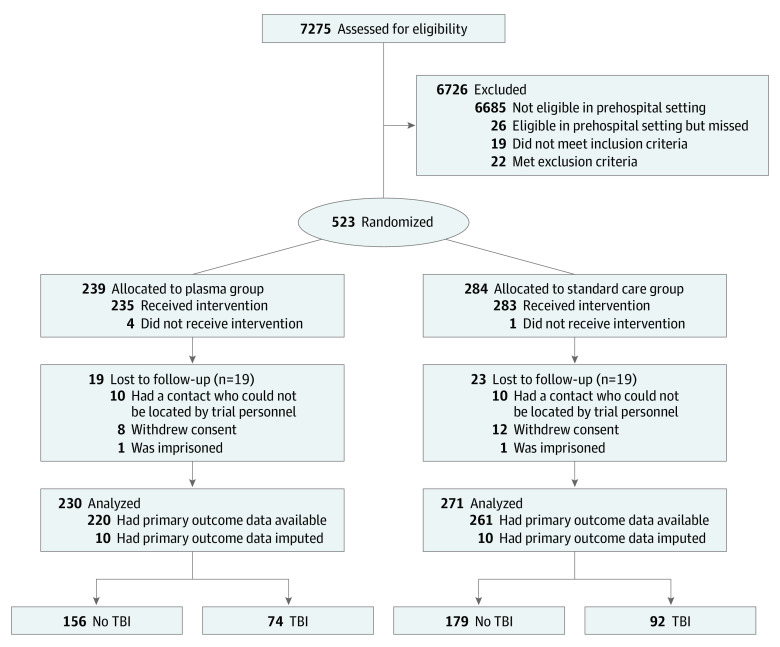
DESIGN, SETTING, AND PARTICIPANTS: The Prehospital Air Medical Plasma (PAMPer) trial was a pragmatic, multicenter, phase 3, cluster randomized clinical trial involving injured patients who were at risk for hemorrhagic shock during air medical transport to a trauma center. The trial was conducted at 6 US sites with 9 level-I trauma centers (comprising 27 helicopter emergency services bases). The original trial analyzed 501 patients, including 230 patients who were randomized to receive plasma and 271 randomized to standard care resuscitation. This secondary analysis of a predefined subgroup included patients with TBI. Data analysis was performed from October 2019 to February 2020.

INTERVENTIONS

Patients were randomized to receive standard care fluid resuscitation or 2 units of thawed plasma.

MAIN OUTCOMES AND MEASURES

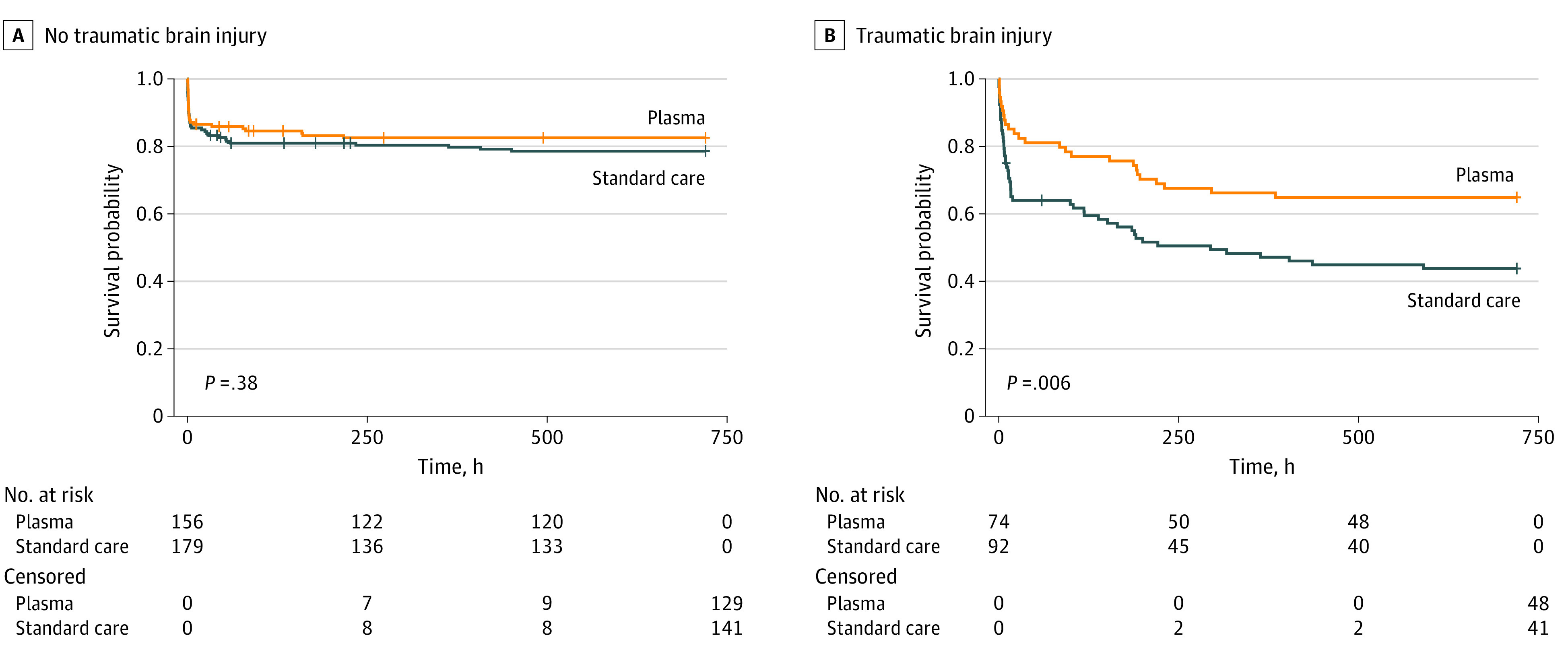
The primary outcome was mortality at 30 days. Patients with TBI were prespecified as a subgroup for secondary analysis and for measurement of markers of brain injury. The 30-day survival benefit of prehospital plasma in subgroups with and without TBI as diagnosed by computed tomography was characterized using Kaplan-Meier survival analysis and Cox proportional hazard regression.

RESULTS

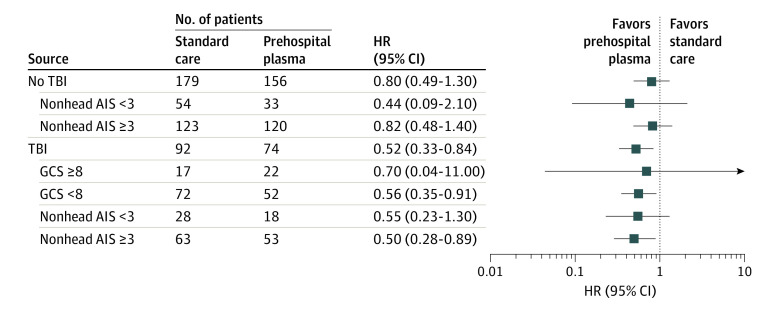
In total, 166 patients had TBI (median [interquartile range] age, 43.00 [25.00-59.75] years; 125 men [75.3%]). When compared with the 92 patients who received standard care, the 74 patients with TBI who received prehospital plasma had improved 30-day survival even after adjustment for multiple confounders and assessment of the degree of brain injury with clinical variables and biomarkers (hazard ratio [HR], 0.55; 95% CI, 0.33-0.94; P = .03). Receipt of prehospital plasma was associated with improved survival among patients with TBI with a prehospital Glasgow Coma Scale score of less than 8 (HR, 0.56; 95% CI, 0.35-0.91) and those with polytrauma (HR, 0.50; 95% CI, 0.28-0.89). Patients with TBI transported from the scene of injury had improved survival following prehospital plasma administration (HR, 0.45; 95% CI, 0.26-0.80; P = .005), whereas patients who were transferred from an outside hospital showed no difference in survival for the plasma intervention (HR, 1.00; 95% CI, 0.33-3.00; P = .99).

CONCLUSIONS AND RELEVANCE

These findings are exploratory, but they suggest that receipt of prehospital plasma is associated with improved survival in patients with computed tomography-positive TBI. The prehospital setting may be a critical period to intervene in the care of patients with TBI. Future studies are needed to confirm the clinical benefits of early plasma resuscitation following TBI and concomitant polytrauma.

TRIAL REGISTRATION

ClinicalTrials.gov Identifier: NCT01818427.

摘要

重要性

在因出血性休克有风险并通过空中救护转运的受伤患者中,院前输注血浆可提高生存率。创伤性脑损伤(TBI)是创伤后死亡的主要原因,但很少有早期干预措施能改善预后。

目的

评估院前输注血浆与 TBI 患者生存之间的关联。

设计、地点和参与者:Prehospital Air Medical Plasma(PAMPer)试验是一项实用的、多中心、3 期、集群随机临床试验,涉及有在转运到创伤中心途中发生出血性休克风险的受伤患者。该试验在 6 个美国地点的 9 个一级创伤中心进行(包括 27 个直升机紧急医疗服务基地)。最初的试验分析了 501 名患者,其中 230 名患者被随机分配接受血浆治疗,271 名随机接受标准复苏治疗。本二次分析纳入了 TBI 患者,作为一个预先设定的亚组进行分析。数据分析于 2019 年 10 月至 2020 年 2 月进行。

干预措施

患者被随机分配接受标准液体复苏或 2 单位解冻血浆。

主要结局和测量指标

主要结局为 30 天死亡率。TBI 患者被指定为二次分析和测量脑损伤标志物的亚组。使用 Kaplan-Meier 生存分析和 Cox 比例风险回归,描述亚组中有无 CT 诊断的 TBI 的患者中,院前输注血浆在 30 天的生存获益。

结果

共有 166 名患者患有 TBI(中位数[四分位数范围]年龄,43.00[25.00-59.75]岁;125 名男性[75.3%])。与接受标准护理的 92 名患者相比,74 名 TBI 患者接受了院前血浆治疗,甚至在调整了多种混杂因素后,在评估了临床变量和生物标志物的脑损伤程度后,30 天的生存率仍有所改善(风险比[HR],0.55;95%CI,0.33-0.94;P=0.03)。在院前格拉斯哥昏迷量表评分低于 8 的 TBI 患者(HR,0.56;95%CI,0.35-0.91)和多发伤患者(HR,0.50;95%CI,0.28-0.89)中,接受院前血浆治疗与生存率的提高相关。接受院前血浆治疗的创伤现场转运患者的生存率有所提高(HR,0.45;95%CI,0.26-0.80;P=0.005),而从其他医院转来的患者在血浆干预方面的生存率没有差异(HR,1.00;95%CI,0.33-3.00;P=0.99)。

结论和相关性

这些发现是探索性的,但它们表明,院前输注血浆与 CT 阳性 TBI 患者的生存率提高有关。院前阶段可能是干预 TBI 患者治疗的关键时期。需要进一步的研究来证实 TBI 后早期血浆复苏和同时多发伤的临床获益。

试验注册

ClinicalTrials.gov 标识符:NCT01818427。
https://cdn.ncbi.nlm.nih.gov/pmc/blobs/6404/7563075/d19580be0e29/jamanetwopen-e2016869-g003.jpg
https://cdn.ncbi.nlm.nih.gov/pmc/blobs/6404/7563075/2229a8d2919d/jamanetwopen-e2016869-g001.jpg
https://cdn.ncbi.nlm.nih.gov/pmc/blobs/6404/7563075/2e91d60f9107/jamanetwopen-e2016869-g002.jpg
https://cdn.ncbi.nlm.nih.gov/pmc/blobs/6404/7563075/d19580be0e29/jamanetwopen-e2016869-g003.jpg
https://cdn.ncbi.nlm.nih.gov/pmc/blobs/6404/7563075/2229a8d2919d/jamanetwopen-e2016869-g001.jpg
https://cdn.ncbi.nlm.nih.gov/pmc/blobs/6404/7563075/2e91d60f9107/jamanetwopen-e2016869-g002.jpg
https://cdn.ncbi.nlm.nih.gov/pmc/blobs/6404/7563075/d19580be0e29/jamanetwopen-e2016869-g003.jpg

相似文献

1
Association of Prehospital Plasma With Survival in Patients With Traumatic Brain Injury: A Secondary Analysis of the PAMPer Cluster Randomized Clinical Trial.院前输注血浆与创伤性脑损伤患者生存的相关性:PAMPer 集群随机临床试验的二次分析。
JAMA Netw Open. 2020 Oct 1;3(10):e2016869. doi: 10.1001/jamanetworkopen.2020.16869.
2
Association of Prehospital Plasma Transfusion With Survival in Trauma Patients With Hemorrhagic Shock When Transport Times Are Longer Than 20 Minutes: A Post Hoc Analysis of the PAMPer and COMBAT Clinical Trials.创伤伴出血性休克患者院前输注血浆与生存的相关性:当转运时间超过 20 分钟时——对 PAMPer 和 COMBAT 临床试验的事后分析。
JAMA Surg. 2020 Feb 1;155(2):e195085. doi: 10.1001/jamasurg.2019.5085. Epub 2020 Feb 19.
3
Prehospital Plasma during Air Medical Transport in Trauma Patients at Risk for Hemorrhagic Shock.创伤患者在航空医疗转运中发生出血性休克风险时的院前血浆治疗。
N Engl J Med. 2018 Jul 26;379(4):315-326. doi: 10.1056/NEJMoa1802345.
4
Association of Statewide Implementation of the Prehospital Traumatic Brain Injury Treatment Guidelines With Patient Survival Following Traumatic Brain Injury: The Excellence in Prehospital Injury Care (EPIC) Study.全美创伤性脑损伤院前治疗指南实施情况与创伤性脑损伤患者生存率的相关性:卓越院前创伤护理(EPIC)研究。
JAMA Surg. 2019 Jul 1;154(7):e191152. doi: 10.1001/jamasurg.2019.1152. Epub 2019 Jul 17.
5
Prehospital Blood Product and Crystalloid Resuscitation in the Severely Injured Patient: A Secondary Analysis of the Prehospital Air Medical Plasma Trial.创伤患者的院前血液制品和晶体液复苏:院前航空医疗血浆试验的二次分析。
Ann Surg. 2021 Feb 1;273(2):358-364. doi: 10.1097/SLA.0000000000003324.
6
Prehospital on-scene anaesthetist treating severe traumatic brain injury patients is associated with lower mortality and better neurological outcome.现场预诊麻醉师治疗严重创伤性脑损伤患者与较低的死亡率和更好的神经预后相关。
Scand J Trauma Resusc Emerg Med. 2019 Jan 28;27(1):9. doi: 10.1186/s13049-019-0590-x.
7
Association Between Prehospital Tranexamic Acid Administration and Outcomes of Severe Traumatic Brain Injury.院前氨甲环酸给药与严重创伤性脑损伤结局的关系。
JAMA Neurol. 2021 Mar 1;78(3):338-345. doi: 10.1001/jamaneurol.2020.4596.
8
Prehospital plasma is associated with survival principally in patients transferred from the scene of injury: A secondary analysis of the PAMPer trial.创伤现场转运患者的院前血浆治疗与生存结局显著相关:PAMPer 试验的二次分析。
Surgery. 2022 Oct;172(4):1278-1284. doi: 10.1016/j.surg.2022.04.039. Epub 2022 Jul 19.
9
Prehospital Intubation is Associated with Favorable Outcomes and Lower Mortality in ProTECT III.在ProTECT III研究中,院外气管插管与良好预后及较低死亡率相关。
Prehosp Emerg Care. 2017 Sep-Oct;21(5):539-544. doi: 10.1080/10903127.2017.1315201. Epub 2017 May 10.
10
Effect of Out-of-Hospital Tranexamic Acid vs Placebo on 6-Month Functional Neurologic Outcomes in Patients With Moderate or Severe Traumatic Brain Injury.院外使用氨甲环酸与安慰剂对中重度创伤性脑损伤患者 6 个月神经功能结局的影响。
JAMA. 2020 Sep 8;324(10):961-974. doi: 10.1001/jama.2020.8958.

引用本文的文献

1
Impact of early plasma resuscitation in pediatric severe traumatic brain injury.早期血浆复苏对小儿重度创伤性脑损伤的影响。
J Pediatr Surg. 2025 Aug 5;60(10):162500. doi: 10.1016/j.jpedsurg.2025.162500.
2
Time-limited association between plasma transfusion and mortality in pediatric traumatic brain injury.小儿创伤性脑损伤中血浆输注与死亡率的限时关联。
J Trauma Acute Care Surg. 2025 Jun 6. doi: 10.1097/TA.0000000000004694.
3
Association between whole blood versus balanced component therapy and survival in isolated severe traumatic brain injury.

本文引用的文献

1
Characterization of unexpected survivors following a prehospital plasma randomized trial.对院前血浆随机试验中意外幸存者的特征描述。
J Trauma Acute Care Surg. 2020 Nov;89(5):908-914. doi: 10.1097/TA.0000000000002816.
2
Prehospital plasma is associated with distinct biomarker expression following injury.创伤后,院前血浆与独特的生物标志物表达相关。
JCI Insight. 2020 Apr 23;5(8):135350. doi: 10.1172/jci.insight.135350.
3
Association of Prehospital Plasma Transfusion With Survival in Trauma Patients With Hemorrhagic Shock When Transport Times Are Longer Than 20 Minutes: A Post Hoc Analysis of the PAMPer and COMBAT Clinical Trials.
全血与平衡成分治疗对单纯严重创伤性脑损伤患者生存率的影响
Trauma Surg Acute Care Open. 2025 May 22;10(2):e001312. doi: 10.1136/tsaco-2023-001312. eCollection 2025.
4
Hemostatic disturbances in traumatic brain injury: from mechanism to management.创伤性脑损伤中的止血障碍:从机制到管理
Acta Neurochir (Wien). 2025 May 19;167(1):146. doi: 10.1007/s00701-025-06549-w.
5
Results of therapy in children diagnosed with severe traumatic brain injury.重度创伤性脑损伤患儿的治疗结果。
Neurol Sci. 2025 Apr 25. doi: 10.1007/s10072-025-08191-x.
6
Blood transfusion strategies for major bleeding in trauma.创伤大出血的输血策略
Cochrane Database Syst Rev. 2025 Apr 24;4(4):CD012635. doi: 10.1002/14651858.CD012635.pub2.
7
Recent Advances in Prehospital and In-Hospital Management of Patients with Severe Trauma.严重创伤患者院前及院内管理的最新进展
J Clin Med. 2025 Mar 24;14(7):2208. doi: 10.3390/jcm14072208.
8
Rethinking Balanced Resuscitation in Trauma.重新思考创伤中的平衡复苏
J Clin Med. 2025 Mar 19;14(6):2111. doi: 10.3390/jcm14062111.
9
High-dimensional analysis of injured patients reveals distinct circulating proteomic profiles in plasma vs. whole blood resuscitation.对受伤患者的高维分析揭示了血浆复苏与全血复苏中不同的循环蛋白质组学特征。
Cell Rep Med. 2025 Mar 18;6(3):102022. doi: 10.1016/j.xcrm.2025.102022.
10
Early achievement of hemostasis defined by transfusion velocity: A possible mechanism for whole blood survival benefit.通过输血速度定义的早期止血实现:全血生存获益的一种可能机制。
J Trauma Acute Care Surg. 2025 Mar 1;98(3):393-401. doi: 10.1097/TA.0000000000004507. Epub 2025 Jan 27.
创伤伴出血性休克患者院前输注血浆与生存的相关性:当转运时间超过 20 分钟时——对 PAMPer 和 COMBAT 临床试验的事后分析。
JAMA Surg. 2020 Feb 1;155(2):e195085. doi: 10.1001/jamasurg.2019.5085. Epub 2020 Feb 19.
4
Severity of hemorrhage and the survival benefit associated with plasma: Results from a randomized prehospital plasma trial.出血严重程度和与血浆相关的生存获益:一项随机院前血浆试验的结果。
J Trauma Acute Care Surg. 2020 Jan;88(1):141-147. doi: 10.1097/TA.0000000000002530.
5
Effects of tranexamic acid on death, disability, vascular occlusive events and other morbidities in patients with acute traumatic brain injury (CRASH-3): a randomised, placebo-controlled trial.氨甲环酸对急性创伤性脑损伤患者死亡、残疾、血管阻塞事件和其他并发症的影响(CRASH-3):一项随机、安慰剂对照试验。
Lancet. 2019 Nov 9;394(10210):1713-1723. doi: 10.1016/S0140-6736(19)32233-0. Epub 2019 Oct 14.
6
Prehospital plasma in injured patients is associated with survival principally in blunt injury: Results from two randomized prehospital plasma trials.创伤患者的院前血浆治疗与生存相关,主要与钝性损伤相关:两项随机院前血浆治疗试验的结果。
J Trauma Acute Care Surg. 2020 Jan;88(1):33-41. doi: 10.1097/TA.0000000000002485.
7
Association between plasma GFAP concentrations and MRI abnormalities in patients with CT-negative traumatic brain injury in the TRACK-TBI cohort: a prospective multicentre study.在 TRACK-TBI 队列中,CT 阴性创伤性脑损伤患者的血浆 GFAP 浓度与 MRI 异常之间的关联:一项前瞻性多中心研究。
Lancet Neurol. 2019 Oct;18(10):953-961. doi: 10.1016/S1474-4422(19)30282-0. Epub 2019 Aug 23.
8
Association of Statewide Implementation of the Prehospital Traumatic Brain Injury Treatment Guidelines With Patient Survival Following Traumatic Brain Injury: The Excellence in Prehospital Injury Care (EPIC) Study.全美创伤性脑损伤院前治疗指南实施情况与创伤性脑损伤患者生存率的相关性:卓越院前创伤护理(EPIC)研究。
JAMA Surg. 2019 Jul 1;154(7):e191152. doi: 10.1001/jamasurg.2019.1152. Epub 2019 Jul 17.
9
Prehospital Blood Product and Crystalloid Resuscitation in the Severely Injured Patient: A Secondary Analysis of the Prehospital Air Medical Plasma Trial.创伤患者的院前血液制品和晶体液复苏:院前航空医疗血浆试验的二次分析。
Ann Surg. 2021 Feb 1;273(2):358-364. doi: 10.1097/SLA.0000000000003324.
10
Plasma for burn shock resuscitation: is it time to go back to the future?用于烧伤休克复苏的血浆:是时候回归未来了吗?
Transfusion. 2019 Apr;59(S2):1578-1586. doi: 10.1111/trf.15243.