Crop Science, Institute of Agricultural Sciences, ETH Zürich, Zurich, Switzerland.
Molecular Plant Breeding, Institute of Agricultural Sciences, ETH Zürich, Zurich, Switzerland.
J Exp Bot. 2021 Feb 2;72(2):700-717. doi: 10.1093/jxb/eraa471.
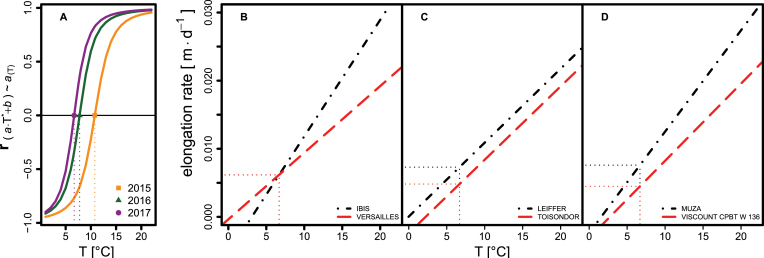
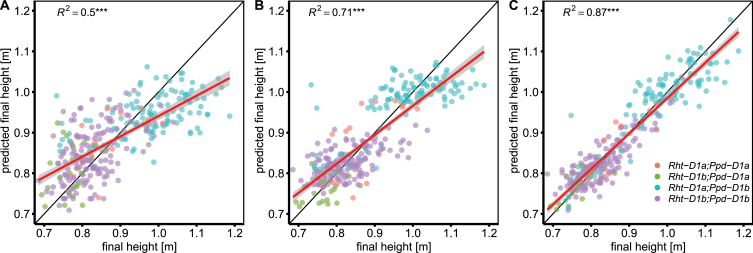
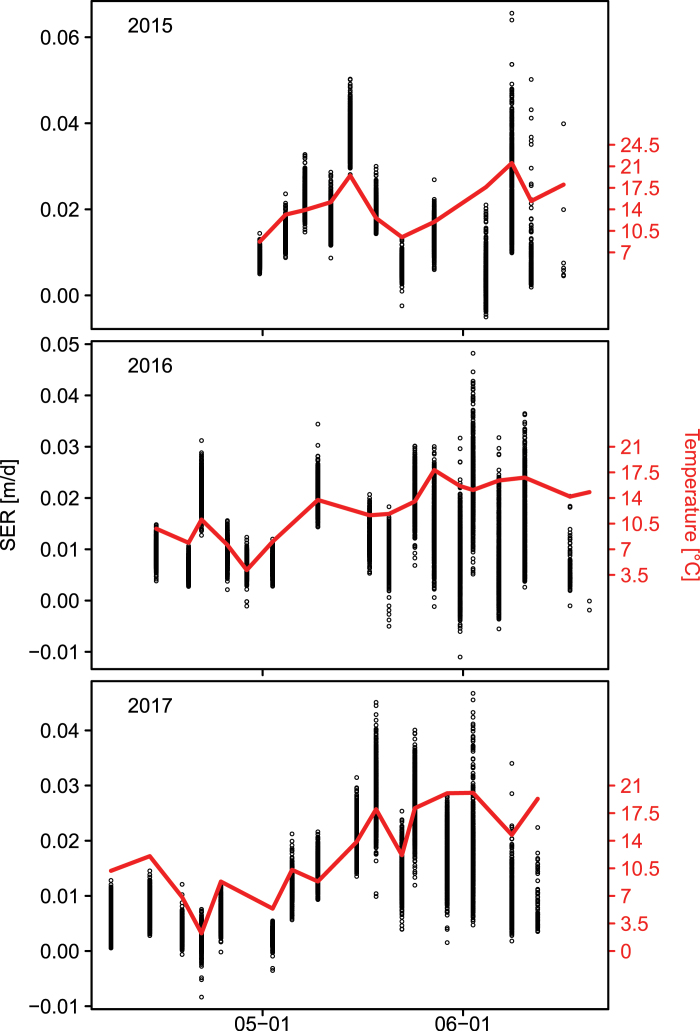
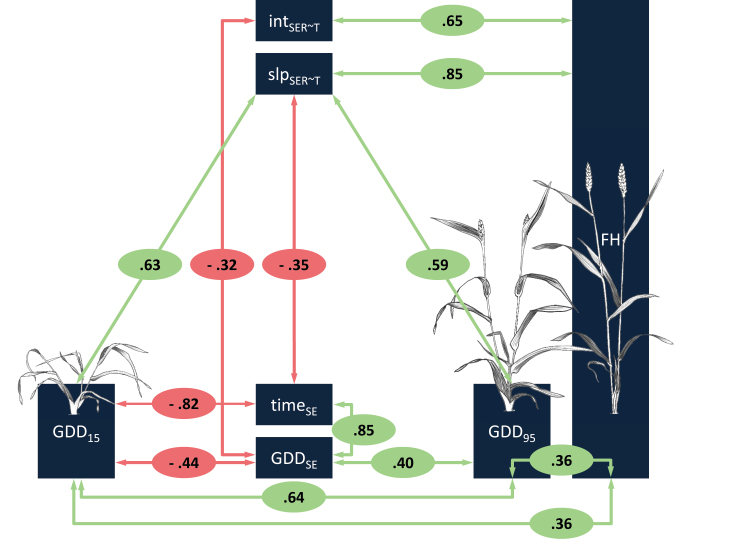
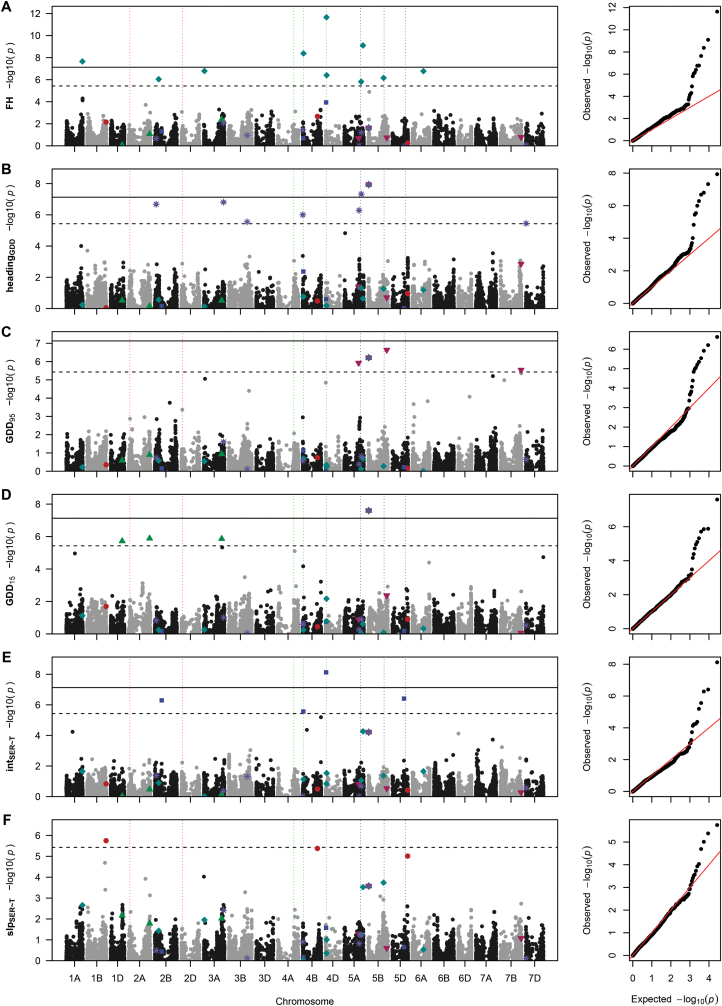
In wheat, temperature affects the timing and intensity of stem elongation. Genetic variation for this process is therefore important for adaptation. This study investigates the genetic response to temperature fluctuations during stem elongation and its relationship to phenology and height. Canopy height of 315 wheat genotypes (GABI wheat panel) was scanned twice weekly in the field phenotyping platform (FIP) of ETH Zurich using a LIDAR. Temperature response was modelled using linear regressions between stem elongation and mean temperature in each measurement interval. This led to a temperature-responsive (slope) and a temperature-irresponsive (intercept) component. The temperature response was highly heritable (H2=0.81) and positively related to a later start and end of stem elongation as well as final height. Genome-wide association mapping revealed three temperature-responsive and four temperature-irresponsive quantitative trait loci (QTLs). Furthermore, putative candidate genes for temperature-responsive QTLs were frequently related to the flowering pathway in Arabidopsis thaliana, whereas temperature-irresponsive QTLs corresponded to growth and reduced height genes. In combination with Rht and Ppd alleles, these loci, together with the loci for the timing of stem elongation, accounted for 71% of the variability in height. This demonstrates how high-throughput field phenotyping combined with environmental covariates can contribute to a smarter selection of climate-resilient crops.
在小麦中,温度会影响茎伸长的时间和强度。因此,该过程的遗传变异对于适应很重要。本研究调查了茎伸长过程中对温度波动的遗传响应及其与物候和高度的关系。通过使用激光雷达在苏黎世联邦理工学院(ETH Zurich)的田间表型平台(FIP)中每周两次扫描 315 个小麦基因型(GABI 小麦面板)的冠层高度。在每个测量间隔中,使用线性回归模型来模拟茎伸长与平均温度之间的温度响应。这导致了一个对温度敏感(斜率)和对温度不敏感(截距)的组件。温度响应具有高度的遗传性(H2=0.81),与茎伸长的起始和结束时间以及最终高度较晚呈正相关。全基因组关联图谱显示了三个对温度敏感和四个对温度不敏感的数量性状基因座(QTL)。此外,对温度敏感 QTL 的候选基因经常与拟南芥开花途径有关,而对温度不敏感 QTL 则与生长和降低高度的基因有关。与 Rht 和 Ppd 等位基因相结合,这些基因座以及茎伸长时间的基因座,共解释了高度变异性的 71%。这表明,高通量田间表型与环境协变量相结合如何有助于更智能地选择抗气候作物。