Department of Botany, University of Sargodha, Sargodha, Punjab, Pakistan.
Atta-ur-Rehman School of Applied Biosciences (ASAB), National University of Science and Technology (NUST), Islamabad, Pakistan.
BMC Plant Biol. 2019 Apr 17;19(1):149. doi: 10.1186/s12870-019-1754-6.
Wheat is a cool seasoned crop requiring low temperature during grain filling duration and therefore increased temperature causes significant yield reduction. A set of 125 spring wheat genotypes from International Maize and Wheat Improvement Centre (CIMMYT-Mexico) was evaluated for phenological and yield related traits at three locations in Pakistan under normal sowing time and late sowing time for expose to prolonged high temperature. With the help of genome-wide association study using genotyping-by-sequencing, marker trait associations (MTAs) were observed separately for the traits under normal and late sown conditions.
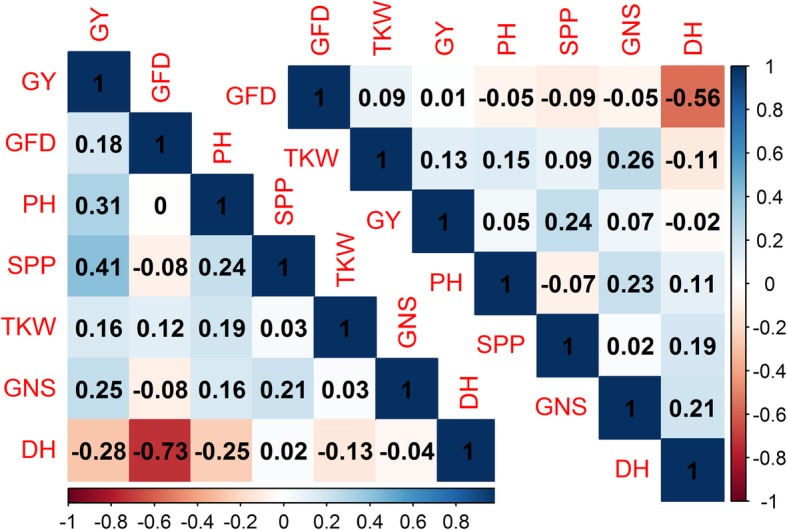
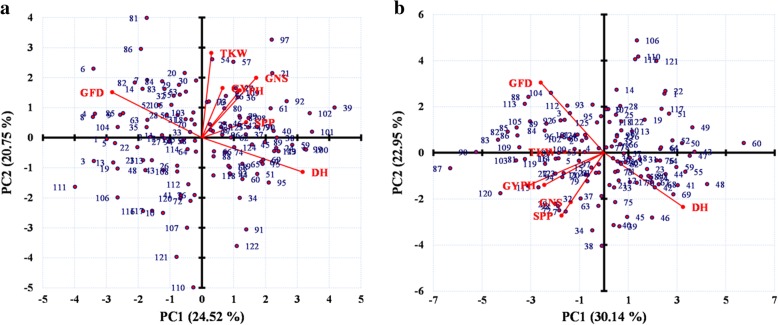
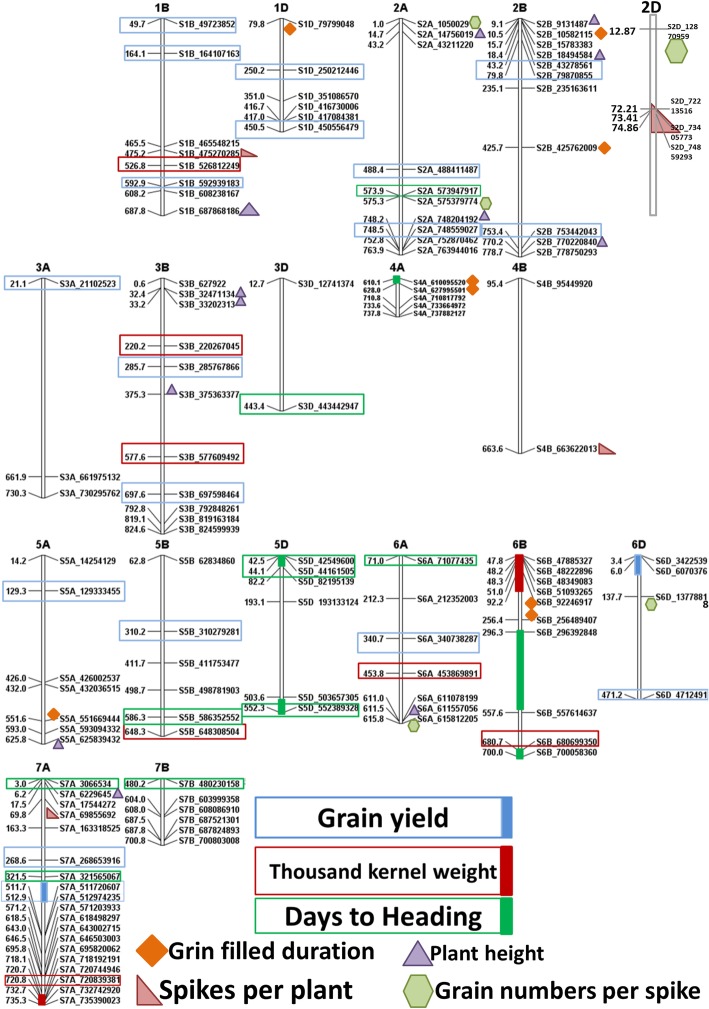
Significant reduction ranging from 9 to 74% was observed in all traits under high temperature. Especially 30, 25, 41 and 66% reduction was observed for days to heading (DH), plant height (PH), spikes per plant (SPP) and yield respectively. We identified 55,954 single nucleotide polymorphisms (SNPs) using genotyping by sequencing of these 125 hexaploid spring wheat genotypes and conducted genome-wide association studies (GWAS) for days to heading (DH), grain filled duration (GFD), plant height (PH), spikes per plant (SPP), grain number per spike (GNS), thousand kernel weight (TKW) and grain yield per plot (GY). Genomic regions identified through GWAS explained up to 13% of the phenotypic variance, on average. A total of 139 marker-trait associations (MTAs) across three wheat genomes (56 on genome A, 55 on B and 28 on D) were identified for all the seven traits studied. For days to heading, 20; grain filled duration, 21; plant height, 23; spikes per plant, 13; grain numbers per spike, 8; thousand kernel weight, 21 and for grain yield, 33 MTAs were detected under normal and late sown conditions.
This study identifies the essential resource of genetics research and underpins the chromosomal regions of seven agronomic traits under normal and high temperature. Significant relationship was observed between the number of favored alleles and trait observations. Fourteen protein coding genes with their respective annotations have been searched with the sequence of seven MTAs which were identified in this study. These findings will be helpful in the development of a breeder friendly platform for the selection of high yielding wheat lines at high temperature areas.
小麦是一种喜凉作物,在灌浆期需要低温,因此高温会导致显著减产。从国际玉米和小麦改良中心(CIMMYT-墨西哥)收集了 125 份春小麦基因型,在巴基斯坦三个地点评估了正常播种时间和晚播时间下的物候和产量相关性状,以暴露于长时间的高温下。利用全基因组关联研究,通过测序基因分型,分别观察了正常播种和晚播条件下性状的标记-性状关联(MTAs)。
在高温下,所有性状都观察到 9%至 74%的显著减少。特别是抽穗期(DH)、株高(PH)、每株穗数(SPP)和产量分别减少了 30%、25%、41%和 66%。我们使用这些六倍体春小麦基因型的测序基因分型鉴定了 55954 个单核苷酸多态性(SNP),并对抽穗期(DH)、灌浆持续时间(GFD)、株高(PH)、每株穗数(SPP)、每穗粒数(GNS)、千粒重(TKW)和每块地产量(GY)进行了全基因组关联研究(GWAS)。通过 GWAS 鉴定的基因组区域平均解释了 13%的表型方差。总共在三个小麦基因组(A 染色体上 56 个,B 染色体上 55 个,D 染色体上 28 个)上鉴定了 139 个标记-性状关联(MTAs),用于研究的所有七个性状。在正常和晚播条件下,抽穗期有 20 个,灌浆持续时间有 21 个,株高有 23 个,每株穗数有 13 个,每穗粒数有 8 个,千粒重有 21 个,产量有 33 个 MTAs。
本研究确定了遗传研究的重要资源,并为正常和高温下七个农艺性状的染色体区域提供了基础。观察到有利等位基因数量与性状之间存在显著关系。在本研究中鉴定的七个 MTAs 与各自的注释的 14 个蛋白编码基因进行了搜索。这些发现将有助于开发一个适合育种者的平台,以便在高温地区选择高产小麦品系。