"Chantal Biya" International Reference Centre (CIRCB) for research on HIV/AIDS prevention and management, P.O. Box 3077, Yaoundé, Cameroon.
University of Ngaoundéré, Faculty of Sciences, Ngaoundéré, Cameroon.
BMC Infect Dis. 2020 Oct 15;20(1):758. doi: 10.1186/s12879-020-05477-7.
HIV infection exacerbates the prognosis of HCV infection, with a faster progression of hepatitis. Hepatic fibrosis is the major disruption of the hepatic tissue architecture characterized by anarchic deposition and excess of the extracellular matrix. The objective of this study was to evaluate hepatic fibrosis in HIV/HCV co-infected individuals as compared to HCV mono-infected.
A total of 97 participants (mean age 60.2 ± 14.3 years and 0.76 male/female sex ratio) was enrolled in a study conducted in Yaoundé, Cameroon from November 2018 to January 2019. Liver fibrosis was assessed by the APRI score (Aspartate Aminotransferase or AST/Platelet Ratio Index) which identifies the stage of fibrosis as classified by the Metavir system (F0 to F4). CD4 counts and plasmatic HIV viral load of HIV/HCV co-infected individuals were determined and the correlation between hepatic fibrosis and immuno-virological status established. Statistical analysis was done using Microsoft Excel 2016 and EpiInfo7 software.
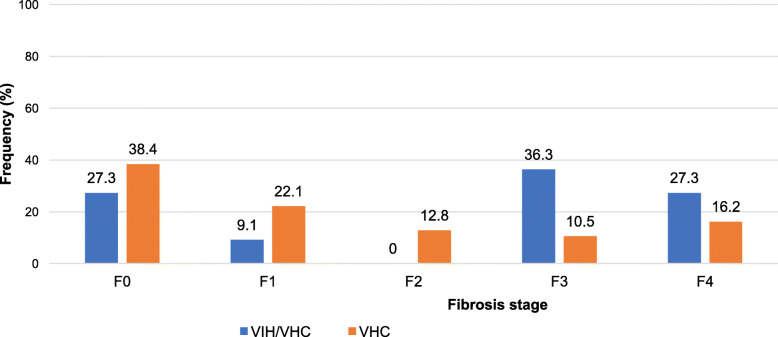
A high proportion (63.6%) of HIV/HCV co-infected participants had an abnormal AST level: 73.6 ± 45.8 IU/L as compared to 58.5 ± 39.3 IU/L (59.3%) among HCV mono-infected participants. The frequency of thrombocytopenia was 63.6% with a mean platelet count of 137 ± 50 × 10 IU/L in HIV/HCV co-infected participants as compared to 176 ± 67 × 10 IU/L in HCV mono-infected participants (38.4%). The progression of hepatic fibrosis in participants with clinically significant fibrosis: F2, F3 and F4 was higher among HIV/HCV co-infected and the mean APRI score was 1.7 ± 1.4 versus 1 ± 0.8 among HCV mono-infected (26.7%). All participants (100%) with detectable HIV viral load had clinically significant fibrosis compared to 33.4% in those with undetectable HIV viral load (p = 0.55). Only 42.9% participants with CD4 > 500 cells/μL had clinically significant fibrosis (p = 0.72) while 100% participants with CD4 < 200 cells/μL had clinically significant fibrosis (p = 0.58).
A high level of AST combined with thrombocytopenia (APRI score > 1.5) is an indicator of hepatic fibrosis in HIV/HCV co-infected individuals. Because of its non-invasive and less costly nature, the APRI score can be a suitable biomarker to monitor hepatic fibrosis in HIV/HCV co-infected individuals in resource constrained settings.
HIV 感染会加重 HCV 感染的预后,导致肝炎更快进展。肝纤维化是肝组织结构的主要破坏,其特征为细胞外基质的无序沉积和过度堆积。本研究的目的是评估 HIV/HCV 合并感染与 HCV 单感染个体的肝纤维化情况。
2018 年 11 月至 2019 年 1 月,在喀麦隆雅温得进行了一项研究,共纳入 97 名参与者(平均年龄 60.2±14.3 岁,男女比例为 0.76)。使用 APRI 评分(天门冬氨酸氨基转移酶或 AST/血小板比值指数)评估肝纤维化,该评分根据 Metavir 系统(F0 至 F4)将纤维化阶段分类。确定了 HIV/HCV 合并感染个体的 CD4 计数和血浆 HIV 病毒载量,并确定了肝纤维化与免疫病毒学状态之间的相关性。统计分析使用 Microsoft Excel 2016 和 EpiInfo7 软件进行。
HIV/HCV 合并感染的参与者中有相当高的比例(63.6%)AST 水平异常:73.6±45.8IU/L,而 HCV 单感染参与者的 AST 水平为 58.5±39.3IU/L(59.3%)。血小板减少的频率为 63.6%,HIV/HCV 合并感染的平均血小板计数为 137±50×10IU/L,而 HCV 单感染的平均血小板计数为 176±67×10IU/L(38.4%)。在有临床显著纤维化的参与者中,肝纤维化的进展:F2、F3 和 F4 在 HIV/HCV 合并感染中更高,平均 APRI 评分为 1.7±1.4,而 HCV 单感染为 1.0±0.8(26.7%)。所有(100%)可检测到 HIV 病毒载量的参与者均有临床显著纤维化,而不可检测到 HIV 病毒载量的参与者中仅有 33.4%有临床显著纤维化(p=0.55)。只有 42.9%的 CD4>500 个细胞/μL 的参与者有临床显著纤维化(p=0.72),而 100%的 CD4<200 个细胞/μL 的参与者有临床显著纤维化(p=0.58)。
AST 水平升高伴血小板减少(APRI 评分>1.5)是 HIV/HCV 合并感染个体肝纤维化的一个指标。由于其非侵入性和成本较低,APRI 评分可以作为监测资源有限环境中 HIV/HCV 合并感染个体肝纤维化的合适生物标志物。