Institute of Occupational, Social, and Environmental Medicine, Centre for Health and Society, Medical Faculty, University of Düsseldorf, Moorenstraße 5, 40225, Düsseldorf, Germany.
Institute of Health Services Research and Health Economics, Centre for Health and Society, Medical Faculty, University of Düsseldorf, Moorenstraße 5, 40225, Düsseldorf, Germany.
BMC Pulm Med. 2020 Oct 15;20(1):267. doi: 10.1186/s12890-020-01301-9.
Pulmonary rehabilitation offers potential benefits to people with asthma. It is however unknown if rehabilitation favourably affects patients' health care needs. We therefore examined if rehabilitation reduced needs and, in addition, if it improved asthma control.
One hundred fifty patients with asthma were surveyed in three rehabilitation clinics at admission and at discharge. Additionally, we surveyed 78 participants with asthma twice 4 weeks apart. The latter sample (i.e. the control group) was recruited through other pathways than rehabilitation clinics. The Patient Needs in Asthma Treatment (NEAT) questionnaire and the Asthma Control Test (ACT) were completed at baseline and follow-up. Differences between baseline and follow-up and between rehabilitation and control group were examined by t-tests and chi-squared-tests. Univariate ANCOVAS were used to examine if NEAT and ACT follow-up scores differed significantly between groups. Within the rehabilitation group, linear regressions were used to examine if self-reported utilization of more interventions that addressed needs were associated with NEAT scores at follow-up.
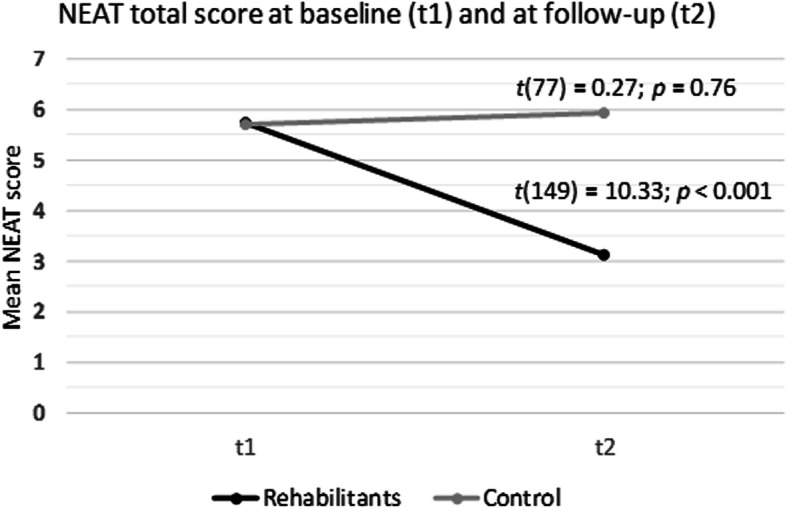
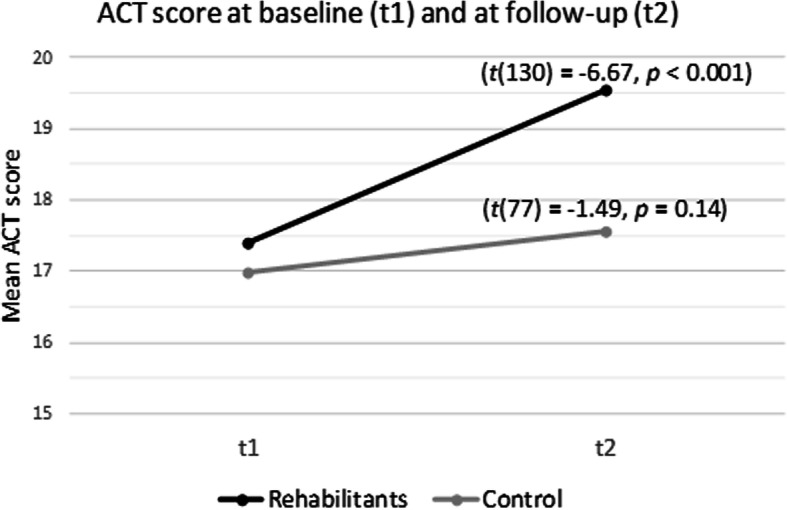
At baseline, there were no differences between the rehabilitation and the control group regarding needs and asthma control. At follow-up, the rehabilitation group showed reduced needs (t(149) = 10.33, p < 0.01) and increased asthma control (t(130) = -6.67, p < 0.01), whereas members of the control group exhibited no changes. Univariate ANCOVAS showed that unmet follow-up needs (F(1, 212) = 36.46, p < 0.001) and follow-up asthma control (F(1, 195) = 6.97, p = 0.009) differed significantly between groups. In the rehabilitation group, self-reported utilization of more interventions was associated with reduced needs (β = 0.21; p = 0.03).
This study provides preliminary evidence suggestion that pulmonary rehabilitation in adults with asthma may reduce asthma-related needs and confirms previous findings that rehabilitation may improve asthma control.
肺康复为哮喘患者带来了潜在的益处。然而,目前尚不清楚康复是否会对患者的医疗需求产生有利影响。因此,我们研究了康复是否会降低需求,以及是否会改善哮喘控制。
在三个康复诊所中,150 名哮喘患者在入院时和出院时接受了调查。此外,我们还对 78 名哮喘患者进行了两次间隔 4 周的调查。后者(即对照组)通过康复诊所以外的途径招募。在基线和随访时,使用哮喘患者治疗需求问卷(NEAT)和哮喘控制测试(ACT)进行评估。通过 t 检验和卡方检验比较基线和随访以及康复组和对照组之间的差异。使用单因素方差分析(ANCOVA)比较两组间的 NEAT 和 ACT 随访评分是否存在显著差异。在康复组内,使用线性回归分析评估自我报告的使用更多针对需求的干预措施是否与随访时的 NEAT 评分相关。
在基线时,康复组和对照组在需求和哮喘控制方面没有差异。在随访时,康复组的需求减少(t(149)=10.33,p<0.01),哮喘控制增加(t(130)=-6.67,p<0.01),而对照组的成员则没有变化。单因素方差分析显示,未满足的随访需求(F(1, 212)=36.46,p<0.001)和随访哮喘控制(F(1, 195)=6.97,p=0.009)在两组之间存在显著差异。在康复组内,自我报告的使用更多干预措施与需求减少相关(β=0.21;p=0.03)。
这项研究提供了初步证据,表明成人哮喘的肺康复可能会降低与哮喘相关的需求,并证实了之前的研究结果,即康复可能会改善哮喘控制。