Computational and Systems Biology, MIT, Cambridge, MA, USA.
Computer Science and Artificial Intelligence Laboratory, MIT, Cambridge, MA, USA.
Nat Commun. 2020 Oct 15;11(1):5208. doi: 10.1038/s41467-020-18952-1.
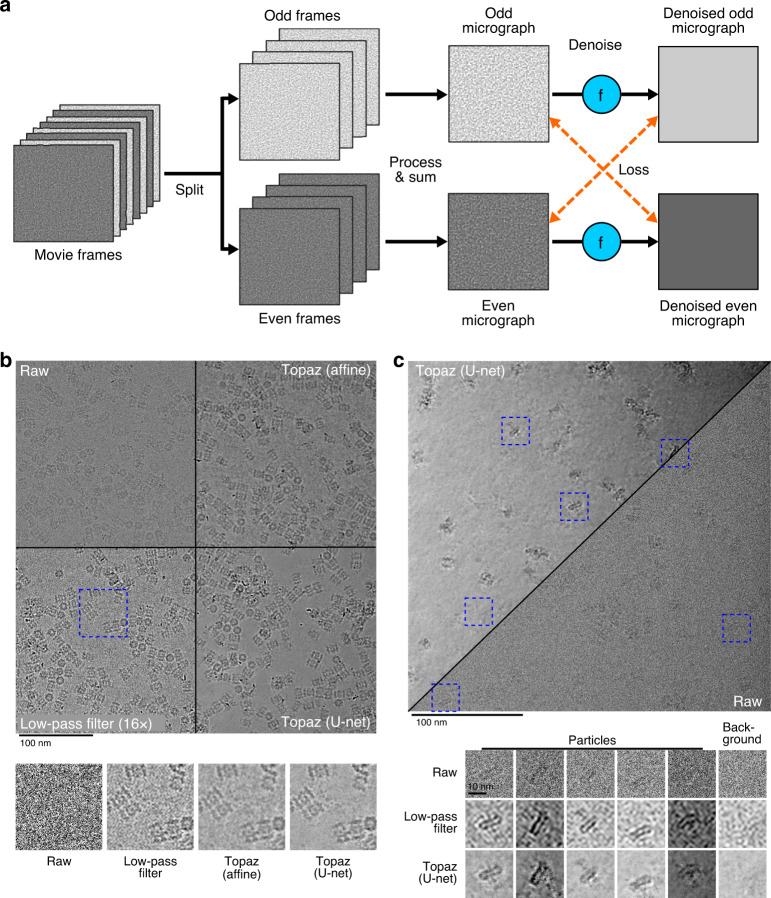
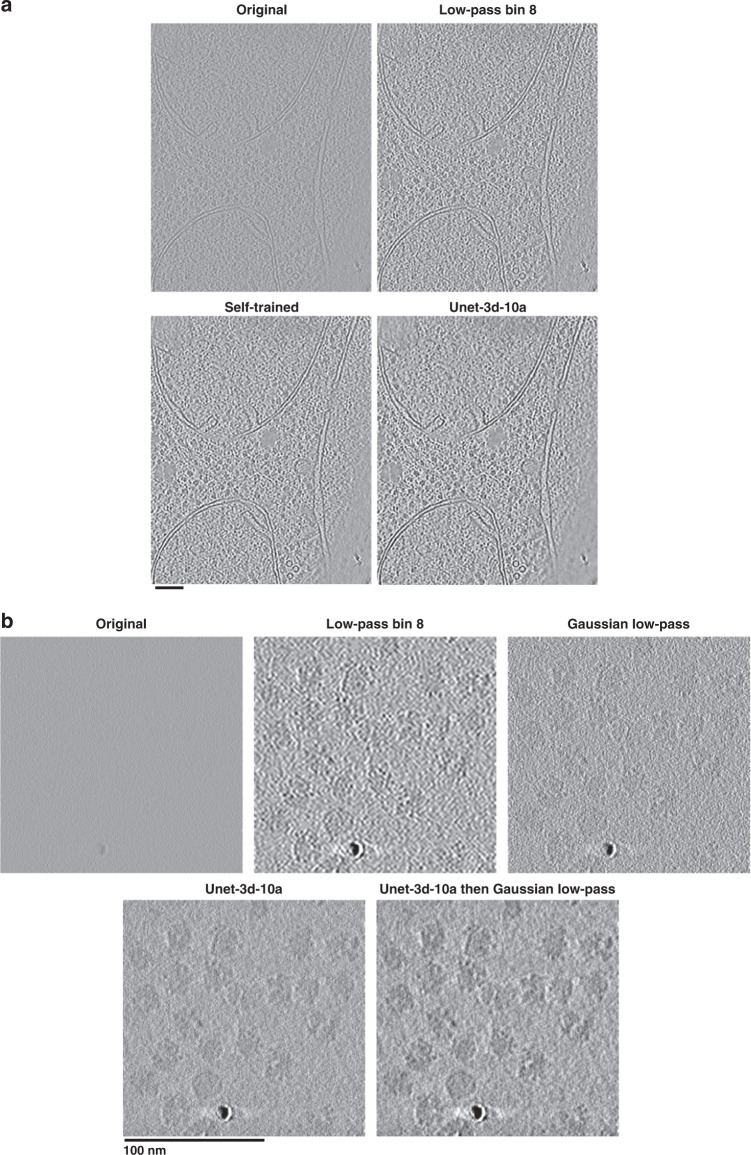
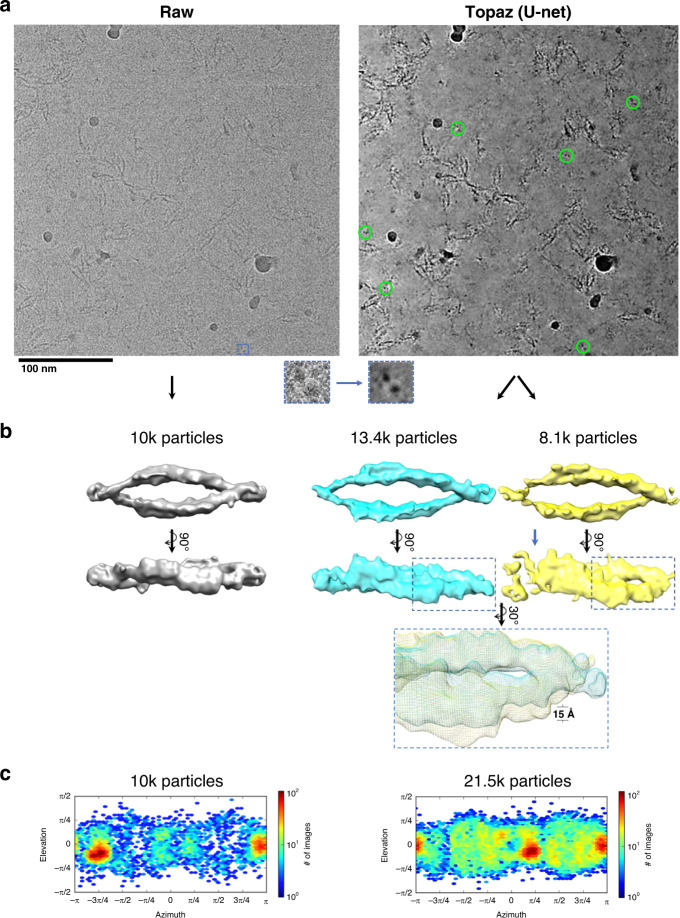
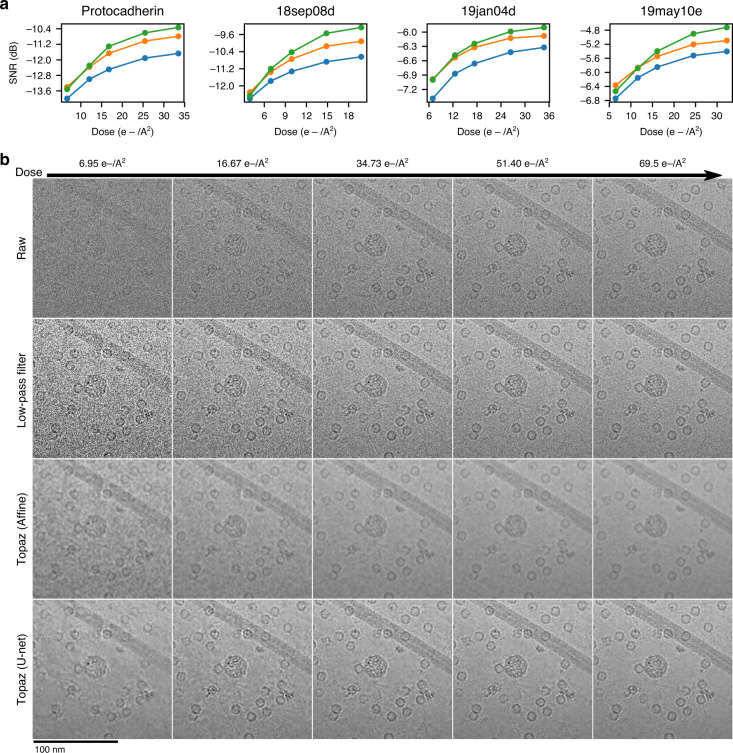
Cryo-electron microscopy (cryoEM) is becoming the preferred method for resolving protein structures. Low signal-to-noise ratio (SNR) in cryoEM images reduces the confidence and throughput of structure determination during several steps of data processing, resulting in impediments such as missing particle orientations. Denoising cryoEM images can not only improve downstream analysis but also accelerate the time-consuming data collection process by allowing lower electron dose micrographs to be used for analysis. Here, we present Topaz-Denoise, a deep learning method for reliably and rapidly increasing the SNR of cryoEM images and cryoET tomograms. By training on a dataset composed of thousands of micrographs collected across a wide range of imaging conditions, we are able to learn models capturing the complexity of the cryoEM image formation process. The general model we present is able to denoise new datasets without additional training. Denoising with this model improves micrograph interpretability and allows us to solve 3D single particle structures of clustered protocadherin, an elongated particle with previously elusive views. We then show that low dose collection, enabled by Topaz-Denoise, improves downstream analysis in addition to reducing data collection time. We also present a general 3D denoising model for cryoET. Topaz-Denoise and pre-trained general models are now included in Topaz. We expect that Topaz-Denoise will be of broad utility to the cryoEM community for improving micrograph and tomogram interpretability and accelerating analysis.
低温电子显微镜(cryoEM)正在成为解析蛋白质结构的首选方法。低温电子显微镜图像中的低信噪比(SNR)降低了数据处理过程中几个步骤确定结构的置信度和速度,导致出现诸如缺少粒子方向等障碍。对低温电子显微镜图像进行去噪不仅可以改善下游分析,还可以通过允许使用低电子剂量的显微照片进行分析来加速耗时的数据收集过程。在这里,我们提出了 Topaz-Denoise,这是一种用于可靠且快速提高低温电子显微镜图像和低温电子断层扫描(cryoET)断层图 SNR 的深度学习方法。通过在由数千张在广泛成像条件下收集的显微照片组成的数据集上进行训练,我们能够学习捕捉低温电子显微镜图像形成过程复杂性的模型。我们提出的通用模型能够对新数据集进行去噪而无需额外的训练。使用该模型进行去噪可以提高显微照片的可解释性,并使我们能够解决原来看似难以捉摸的聚类原钙黏蛋白的 3D 单颗粒结构。然后,我们表明,除了减少数据收集时间外,通过 Topaz-Denoise 实现的低剂量采集还可以改善下游分析。我们还展示了用于 cryoET 的通用 3D 去噪模型。Topaz-Denoise 和预训练的通用模型现在已包含在 Topaz 中。我们预计,Topaz-Denoise 将广泛应用于低温电子显微镜领域,以改善显微照片和断层图的可解释性并加速分析。