Guo Linghong, Ren Honghong, Pu Lutong, Zhu Xingyu, Liu Yin, Ma Xuelei
Department of Biotherapy, Cancer Center, West China Hospital, Sichuan University, Chengdu, Sichuan, People's Republic of China.
West China School of Medicine, Sichuan University, Chengdu, People's Republic of China.
Cancer Manag Res. 2020 Aug 13;12:7173-7188. doi: 10.2147/CMAR.S257934. eCollection 2020.
Hepatic artery interventional therapy has been recognized as the first choice for advanced liver cancer. However, reliable prognostic markers are still lacking. In the present study, we aimed to evaluate the prognostic value of inflammation factors including neutrophil to lymphocyte ratio (NLR), platelet to lymphocyte ratio (PLR) and monocyte to lymphocyte ratio (MLR) in hepatocellular carcinoma (HCC) patients with hepatic artery interventional treatments.
Patients undergoing hepatic artery interventional therapy after being diagnosed with HCC between 2007 and 2014 were enrolled. Pre-treatment NLR, PLR and MLR were calculated, and all factors including gender, age, TNM stage, BCLC staging, inflammation factors, LDH, ALP, CEA, AFP, hepatitis, liver cirrhosis, portal vein involvement, surgical history and hepatic artery interventional treatment on overall survival (OS) were evaluated by the univariate and multivariate Cox proportional hazards analyses.
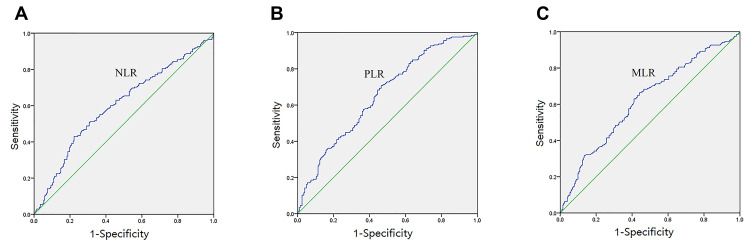
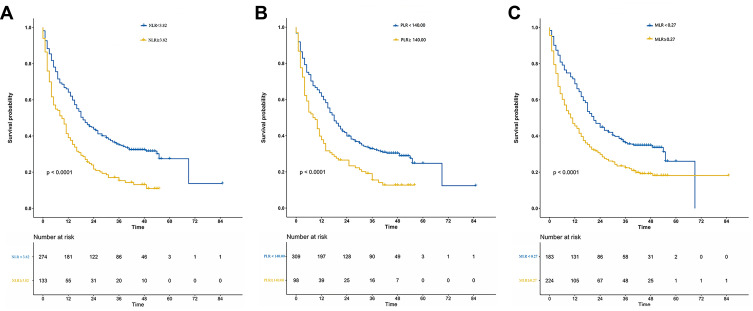
Overall, 407 patients were included. The optimal cutoff values determined by receiver operating characteristic (ROC) curve analyses for NLR, PLR and MLR were 3.82, 140.00 and 0.27, respectively. High NLR was associated with worse OS (median survival time: high NLR group 9 vs low NLR group 19 months, HR 1.842, 95% CI: 1.457-2.329, P<0.001). Elevated PLR was negatively correlated with OS (8 vs 18 months, HR 1.677, 95% CI: 1.302-2.161, P<0.001). Patients in high MLR group had a worse OS (10 vs 21 months, HR 1.626, 95% CI: 1.291-2.048, P<0.001). In multivariate analysis, NLR, LDH, ALP and portal vein involvement were independent prognostic factors for OS of HCC patients after hepatic artery interventional therapy. In addition, for patients in BCLC stage A and B, higher NLR, PLR and MLR were all significantly negatively correlated to median survival time (NLR: 17 vs 26 months, HR: 1.739 (95% CI: 1.279-2.365), P<0.001; PLR: 18 vs 26 months, HR: 1.681 (95% CI: 1.245-2.271), P=0.001; MLR: 20 vs 26 months, HR: 1.589 (95% CI: 1.185-2.129), P=0.002).
Elevated pre-treatment NLR, PLR and MLR were associated with worse survival time in HCC patients after hepatic artery interventional therapy. Among them, NLR was an independent prognostic factor for OS.
肝动脉介入治疗已被公认为晚期肝癌的首选治疗方法。然而,目前仍缺乏可靠的预后标志物。在本研究中,我们旨在评估中性粒细胞与淋巴细胞比值(NLR)、血小板与淋巴细胞比值(PLR)和单核细胞与淋巴细胞比值(MLR)等炎症因子在接受肝动脉介入治疗的肝细胞癌(HCC)患者中的预后价值。
纳入2007年至2014年间确诊为HCC后接受肝动脉介入治疗的患者。计算治疗前的NLR、PLR和MLR,并通过单因素和多因素Cox比例风险分析评估包括性别、年龄、TNM分期、BCLC分期、炎症因子、乳酸脱氢酶(LDH)、碱性磷酸酶(ALP)、癌胚抗原(CEA)、甲胎蛋白(AFP)、肝炎、肝硬化、门静脉受累情况、手术史以及肝动脉介入治疗等所有因素对总生存期(OS)的影响。
共纳入407例患者。通过受试者工作特征(ROC)曲线分析确定的NLR、PLR和MLR的最佳临界值分别为3.82、140.00和0.27。高NLR与较差的OS相关(中位生存时间:高NLR组9个月,低NLR组19个月,风险比[HR] 1.842,95%置信区间[CI]:1.457 - 2.329,P < 0.001)。PLR升高与OS呈负相关(8个月对18个月,HR 1.677,95% CI:1.302 - 2.161,P < 0.001)。高MLR组患者的OS较差(10个月对21个月,HR 1.626,95% CI:1.291 - 2.048,P < 0.001)。多因素分析显示,NLR、LDH、ALP和门静脉受累情况是肝动脉介入治疗后HCC患者OS的独立预后因素。此外,对于BCLC A期和B期患者,较高的NLR、PLR和MLR均与中位生存时间显著负相关(NLR:17个月对26个月,HR:1.739(95% CI:1.279 - 2.365),P < 0.001;PLR:18个月对26个月,HR:1.681(95% CI:1.245 - 2.271),P = 0.001;MLR:20个月对26个月,HR:1.589(95% CI:1.185 - 2.129),P = 0.002)。
治疗前NLR、PLR和MLR升高与肝动脉介入治疗后HCC患者较差的生存时间相关。其中,NLR是OS的独立预后因素。