Ye Jia-Hui, Shi Jia-Jun, Yin Xi, Wu Hong-Yan, Xu Xin-Yun, Yao Yong-Zhong, Zhang Wei-Jie
General Surgery, Nanjing Drum Tower Hospital, The Affiliated Hospital of Nanjing University Medical School, Nanjing, Jiangsu, People's Republic of China.
Pathology Department, Nanjing Drum Tower Hospital, The Affiliated Hospital of Nanjing University Medical School, Nanjing, Jiangsu, People's Republic of China.
Cancer Manag Res. 2020 Sep 22;12:8887-8892. doi: 10.2147/CMAR.S264673. eCollection 2020.
Neoadjuvant chemotherapy (NACT), which is standard treatment for locally advanced breast cancer, improves the resectability of patients with early breast cancer and reduces the extent of breast and axillary surgery. Caveolin-1 (CAV1) is implicated in human cancers, although its utility for cancer prognosis is unknown. Here, we investigated the expression of CAV1 in breast cancer tissues to evaluate its prognostic significance on patients with breast cancer administered NACT.
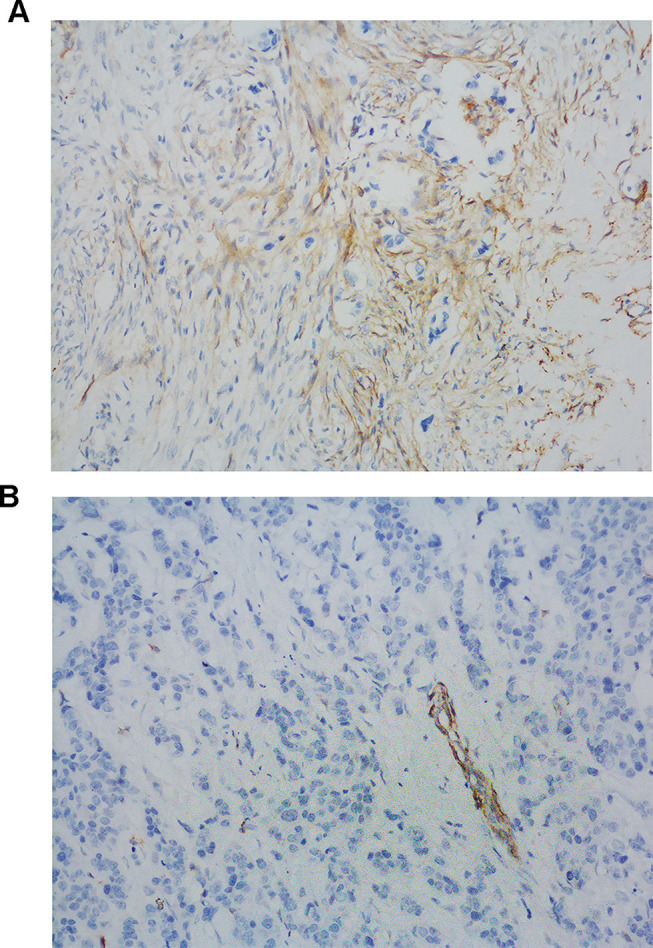
CAV1 expression in 80 breast cancer tissue samples was evaluated using immunohistochemistry (IHC). The association between CAV1 levels and clinical factors was analyzed using the chi-square test and that between CAV1 and prognosis was evaluated using multivariate Cox regression and Kaplan-Meier analyses.
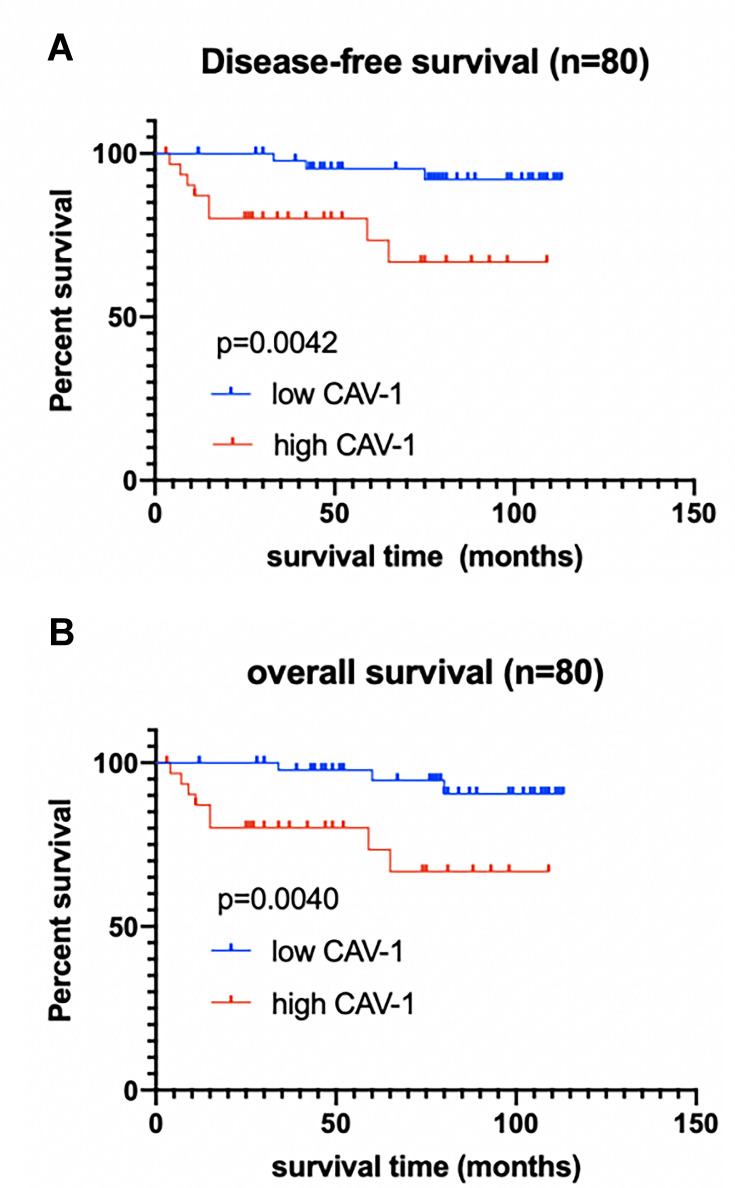
High levels of CAV1 were significantly associated with survival, and patients with overexpression of CAV1 had a poor prognosis. Adjusted multivariate Cox regression analyses revealed that a high level of CAV1 expression was an independent, significant prognostic factor for patients with breast cancer treated with NACT.
Overexpression of CAV1 in patients with breast cancer administered NACT was associated with shorter disease-free survival and overall survival. Therefore, high levels of CAV1 may serve as a prognostic biomarker for such patients.
新辅助化疗(NACT)是局部晚期乳腺癌的标准治疗方法,可提高早期乳腺癌患者的可切除性,并减少乳房和腋窝手术的范围。小窝蛋白-1(CAV1)与人类癌症有关,但其对癌症预后的作用尚不清楚。在此,我们研究了CAV1在乳腺癌组织中的表达,以评估其对接受NACT治疗的乳腺癌患者的预后意义。
使用免疫组织化学(IHC)评估80例乳腺癌组织样本中CAV1的表达。使用卡方检验分析CAV1水平与临床因素之间的关联,并使用多变量Cox回归和Kaplan-Meier分析评估CAV1与预后之间的关联。
高水平的CAV1与生存率显著相关,CAV1过表达的患者预后较差。调整后的多变量Cox回归分析显示,高水平的CAV1表达是接受NACT治疗的乳腺癌患者的独立、显著预后因素。
接受NACT治疗的乳腺癌患者中CAV1的过表达与无病生存期和总生存期缩短有关。因此,高水平的CAV1可能作为此类患者的预后生物标志物。