Ma Zhifeng, Wang Yaoqin, He Binjun, Cui Jian, Zhang Chu, Wang Haiyong, Feng Weizhong, Wang Bin, Wei Desheng, Wu Yuanlin, Zeng Yong, Yu Guangmao
Department of Cardiothoracic Surgery, Shaoxing People's Hospital, Shaoxing, Zhejiang 312000, P.R. China.
Department of Laboratory, Shaoxing People's Hospital, Shaoxing, Zhejiang 312000, P.R. China.
Oncol Lett. 2018 Feb;15(2):1753-1757. doi: 10.3892/ol.2017.7497. Epub 2017 Nov 28.
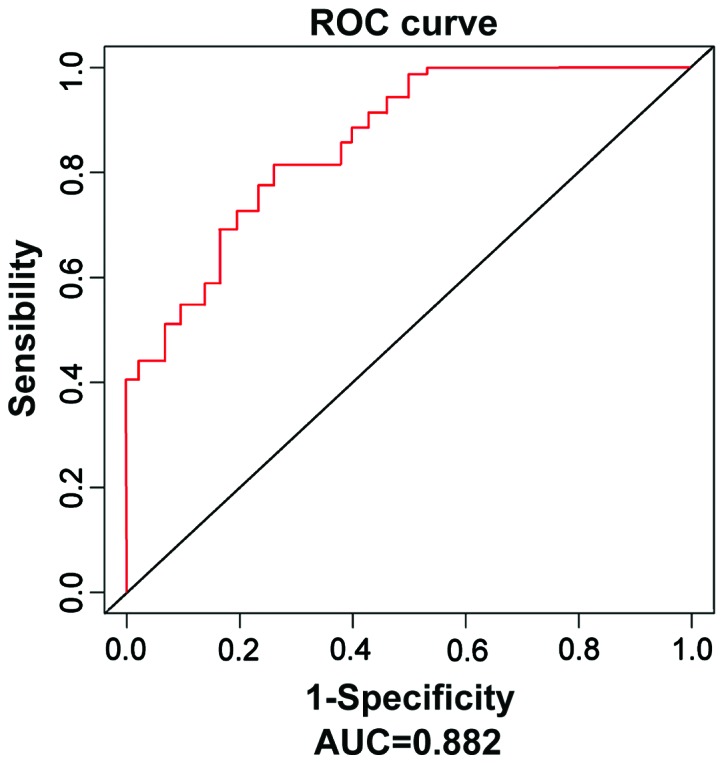
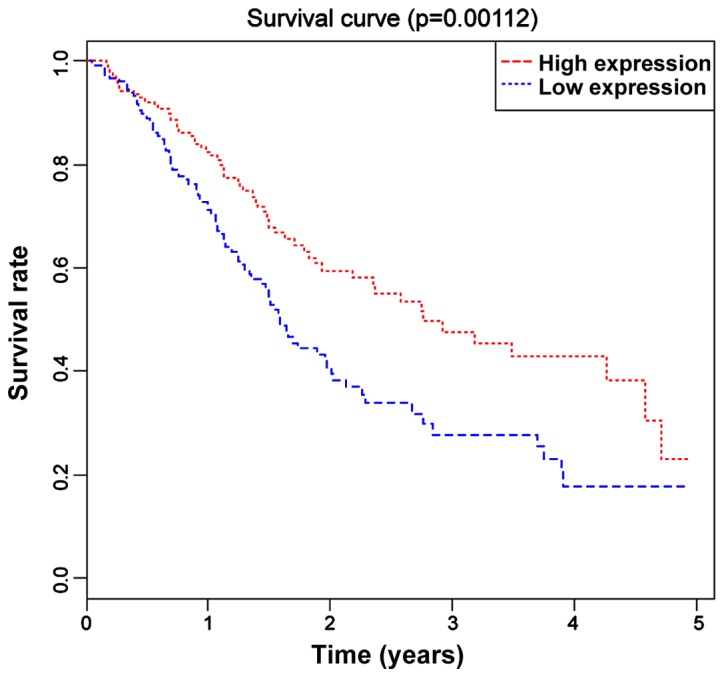
The study aim was to evaluate the association of the expression of serum microribonucleic acid-590 (miR-590) with the risk of lung squamous cell carcinoma (LUSC), clinicopathological staging and prognosis. A total of 237 patients with LUSC and 100 healthy volunteers (control group) were included in the study. Total RNA was extracted from the peripheral blood serum of the subjects, and the expression level of miR-590 was detected by reverse transcription real-time quantitative polymerase chain reaction. The baseline clinicopathological information of LUSC patients was evaluated, and the patients were followed up with the median follow-up of 47 months. Compared with that in the control group, the expression level of serum miR-590 in LUSC patients was significantly decreased [0.532 (0.367- 0.821) vs. 1.63 (0.893-1.347), P<0.001]. The receiver operating characteristic (ROC) curve showed that the value of predicting LUSC risk using miR-590 was high, the area under curve (AUC) was 0.883, and 95% confidence interval (CI) was 0.829-0.934. In addition, the expression level of serum miR-590 was correlated with pathological staging (P=0.022), lymph node metastasis (P=0.012), distant metastasis (P<0.001) and tumor, node and metastasis (TNM) staging (P=0.044). The overall survival (OS) of patients in the serum miR-590 low expression group was significantly lower than that of the serum miR-590 high expression group (P=0.012), and the low expression of miR-590 was an independent risk factor for the prognosis of patients [hazard ratio (HR)=2.152, 95% CI=1.285-3.233, P=0.004]. The results suggested that the expression level of miR-590 can be used as a biomarker for the risk of disease, disease staging and prognosis of LUSC patients.
本研究旨在评估血清微小核糖核酸-590(miR-590)表达与肺鳞状细胞癌(LUSC)风险、临床病理分期及预后的相关性。本研究共纳入237例LUSC患者和100名健康志愿者(对照组)。从受试者外周血血清中提取总RNA,采用逆转录实时定量聚合酶链反应检测miR-590的表达水平。评估LUSC患者的基线临床病理信息,并对患者进行随访,中位随访时间为47个月。与对照组相比,LUSC患者血清miR-590表达水平显著降低[0.532(0.367 - 0.821)对1.63(0.893 - 1.347),P<0.001]。受试者工作特征(ROC)曲线显示,使用miR-590预测LUSC风险的价值较高,曲线下面积(AUC)为0.883,95%置信区间(CI)为0.829 - 0.934。此外,血清miR-590表达水平与病理分期(P = 0.022)、淋巴结转移(P = 0.012)、远处转移(P<0.001)及肿瘤、淋巴结、转移(TNM)分期(P = 0.044)相关。血清miR-590低表达组患者的总生存期(OS)显著低于血清miR-590高表达组(P = 0.012),miR-590低表达是患者预后的独立危险因素[风险比(HR)= 2.152,95% CI = 1.285 - 3.233,P = 0.004]。结果表明,miR-590表达水平可作为LUSC患者疾病风险、疾病分期及预后的生物标志物。