Heijdra Suasnabar Jan Manuel, Hipple Walters Bethany
Trimbos Institute, Utrecht, The Netherlands.
London School of Hygiene and Tropical Medicine, Public Health for Development, London, UK.
Int J Ment Health Syst. 2020 Oct 8;14:74. doi: 10.1186/s13033-020-00405-3. eCollection 2020.
Mental health and substance use disorders (SUDs) are the world's leading cause of years lived with disability; in low-and-middle income countries (LIMCs), the treatment gap for SUDs is at least 75%. LMICs face significant structural, resource, political, and sociocultural barriers to scale-up SUD services in community settings.
This article aims to identify and describe the different types and characteristics of psychosocial community-based SUD interventions in LMICs, and describe what context-specific factors (policy, resource, sociocultural) may influence such interventions in their design, implementation, and/or outcomes.
A narrative literature review was conducted to identify and discuss community-based SUD intervention studies from LMICs. Articles were identified via a search for abstracts on the MEDLINE, Academic Search Complete, and PsycINFO databases. A preliminary synthesis of findings was developed, which included a description of the study characteristics (such as setting, intervention, population, target SUD, etc.); thereafter, a thematic analysis was conducted to describe the themes related to the aims of this review.
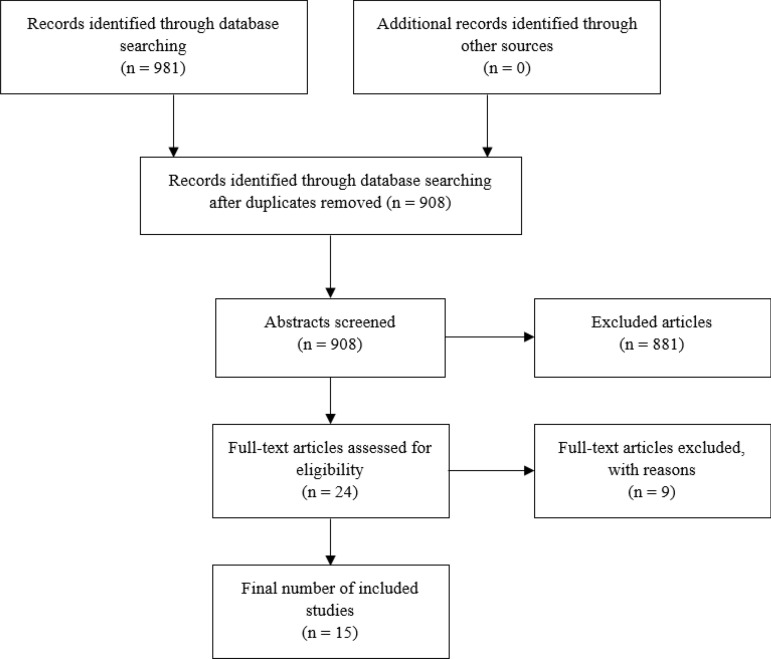
Fifteen intervention studies were included out of 908 abstracts screened. The characteristics of the included interventions varied considerably. Most of the psychosocial interventions were brief interventions. Approximately two thirds of the interventions were delivered by trained lay healthcare workers. Nearly half of the interventions targeted SUDs in addition to other health priorities (HIV, tuberculosis, intimate partner violence). All of the interventions were implemented in middle income countries (i.e. none in low-income countries). The political, resource, and/or sociocultural factors that influenced the interventions are discussed, although findings were significantly limited across studies.
Despite this review's limitations, its findings present relevant considerations for future SUD intervention developers, researchers, and decision-makers with regards to planning, implementing and adapting community-based SUD interventions.
心理健康和物质使用障碍是全球导致残疾生存年数的首要原因;在低收入和中等收入国家(中低收入国家),物质使用障碍的治疗缺口至少为75%。中低收入国家在扩大社区环境中物质使用障碍服务规模方面面临重大的结构、资源、政治和社会文化障碍。
本文旨在识别和描述中低收入国家基于社区的心理社会物质使用障碍干预措施的不同类型和特征,并描述哪些特定背景因素(政策、资源、社会文化)可能在其设计、实施和/或结果方面影响此类干预措施。
进行了一项叙述性文献综述,以识别和讨论来自中低收入国家的基于社区的物质使用障碍干预研究。通过在MEDLINE、学术搜索完整版和PsycINFO数据库中搜索摘要来识别文章。对研究结果进行了初步综合,包括对研究特征(如环境、干预措施、人群、目标物质使用障碍等)的描述;此后,进行了主题分析,以描述与本综述目的相关的主题。
在筛选的908篇摘要中,纳入了15项干预研究。纳入的干预措施的特征差异很大。大多数心理社会干预措施是简短干预。约三分之二的干预措施由经过培训的非专业医护人员提供。近一半的干预措施除了针对其他健康优先事项(艾滋病毒、结核病、亲密伴侣暴力)外,还针对物质使用障碍。所有干预措施均在中等收入国家实施(即低收入国家没有)。讨论了影响干预措施的政治、资源和/或社会文化因素,尽管各研究的结果明显有限。
尽管本综述存在局限性,但其结果为未来物质使用障碍干预措施的开发者、研究人员和决策者在规划、实施和调整基于社区的物质使用障碍干预措施方面提供了相关考虑因素。