Thomas Konstantinos, Lazarini Argiro, Kaltsonoudis Evripidis, Drosos Alexandros, Papalopoulos Ioannis, Sidiropoulos Prodromos, Tsatsani Panagiota, Gazi Sousana, Pantazi Lina, Boki Kyriaki A, Katsimbri Pelagia, Boumpas Dimitrios, Fragkiadaki Kalliopi, Tektonidou Maria, Sfikakis Petros P, Karagianni Konstantina, Sakkas Lazaros I, Grika Eleftheria P, Vlachoyiannopoulos Panagiotis G, Evangelatos Gerasimos, Iliopoulos Alexios, Dimitroulas Theodoros, Garyfallos Alexandros, Melissaropoulos Konstantinos, Georgiou Panagiotis, Areti Maria, Georganas Constantinos, Vounotrypidis Periklis, Kitas George D, Vassilopoulos Dimitrios
Joint Rheumatology Program, School of Medicine, National and Kapodistrian University of Athens, Athens, Greece.
Rheumatology Clinic, University of Ioannina, Ioannina, Greece.
Ther Adv Musculoskelet Dis. 2020 Sep 28;12:1759720X20937132. doi: 10.1177/1759720X20937132. eCollection 2020.
Data regarding the real-life predictors of low disease activity (LDA) in rheumatoid arthritis (RA) patients are limited. Our aim was to evaluate the rate and predictors of LDA and treatment patterns in RA.
This was a multicenter, prospective, RA cohort study where patients were evaluated in two different time points approximately 12 months apart. Statistical analysis was performed in order to identify predictors of LDA while patterns of disease-modifying anti-rheumatic drug [DMARDs; conventional synthetic (csDMARD) or biologic (bDMARD)] and glucocorticoid (GC) use were also recorded.
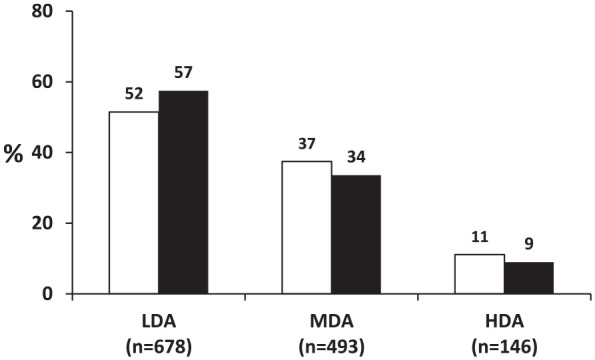
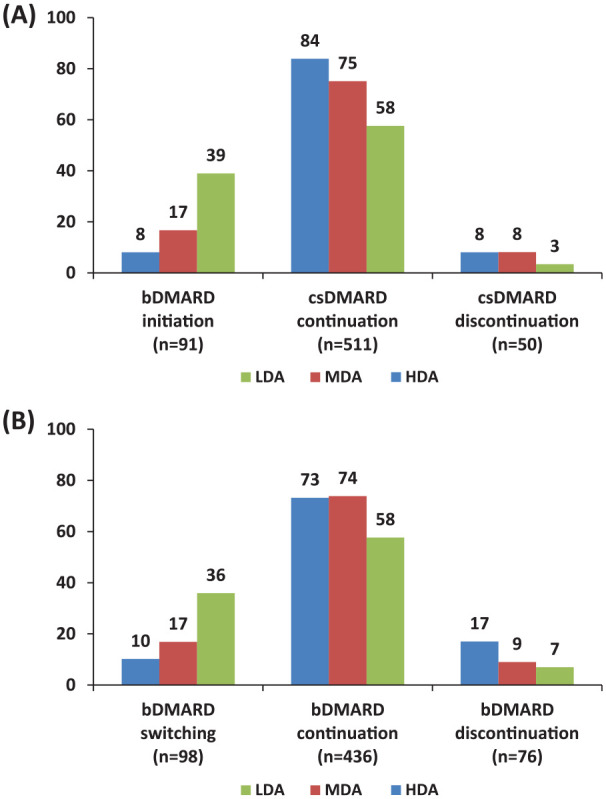
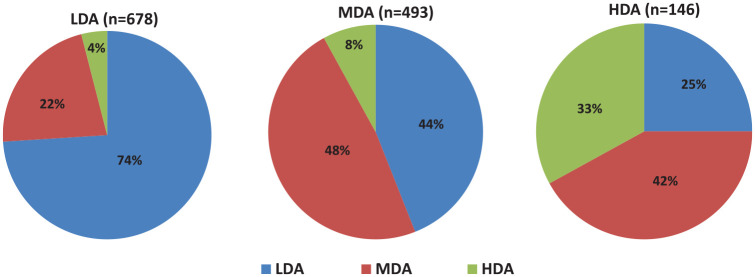
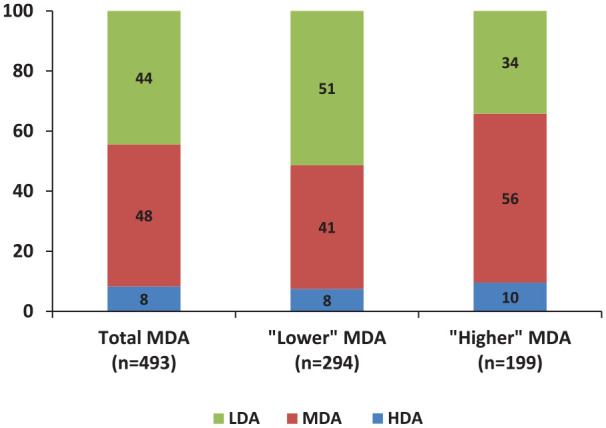
The total number of patients included was 1317 (79% females, mean age: 62.9 years, mean disease duration: 10.3 years). After 1 year, 57% had achieved LDA (DAS28ESR<3.2) while 43% did not (34%: moderate disease activity: DAS28ESR ⩾3.2 to <5.1, 9%: high disease activity, DAS28ESR ⩾5.1). By multivariate analysis, male sex was positively associated with LDA [odds ratio (OR) = 2.29 < 0.001] whereas advanced age (OR = 0.98, = 0.005), high Health Assessment Questionnaire (HAQ) score (OR = 0.57, < 0.001), use of GCs (OR = 0.75, = 0.037) or ⩾2 bDMARDs (OR = 0.61, = 0.002), high co-morbidity index (OR = 0.86, = 0.011) and obesity (OR = 0.62, = 0.002) were negative predictors of LDA. During follow-up, among active patients (DAS28ESR >3.2), 21% initiated (among csDMARDs users) and 22% switched (among bDMARDs users) their bDMARDs.
In a real-life RA cohort, during 1 year of follow-up, 43% of patients do not reach treatment targets while only ~20% of those with active RA started or switched their bDMARDs. Male sex, younger age, lower HAQ, body mass index and co-morbidity index were independent factors associated with LDA while use of GCs or ⩾2 bDMARDs were negative predictors.
关于类风湿关节炎(RA)患者低疾病活动度(LDA)的实际预测因素的数据有限。我们的目的是评估RA患者中LDA的发生率、预测因素及治疗模式。
这是一项多中心、前瞻性的RA队列研究,患者在相隔约12个月的两个不同时间点接受评估。进行统计分析以确定LDA的预测因素,同时记录改善病情抗风湿药物[DMARDs;传统合成(csDMARD)或生物制剂(bDMARD)]和糖皮质激素(GC)的使用模式。
纳入患者总数为1317例(79%为女性,平均年龄:62.9岁,平均病程:10.3年)。1年后,57%的患者达到LDA(DAS28ESR<3.2),而43%的患者未达到(34%:中度疾病活动度:DAS28ESR⩾3.2至<5.1,9%:高度疾病活动度,DAS28ESR⩾5.1)。多因素分析显示,男性与LDA呈正相关[比值比(OR)=2.29 ,P<0.001],而高龄(OR=0.98,P=0.005)、高健康评估问卷(HAQ)评分(OR=0.57,P<0.001)、使用GCs(OR=0.75,P=0.037)或⩾2种bDMARDs(OR=0.61,P=0.00)、高合并症指数(OR=0.86,P=0.011)和肥胖(OR=0.62,P=0.002)是LDA的负性预测因素。在随访期间,在活动期患者(DAS28ESR>3.2)中,21%(在csDMARDs使用者中)开始使用bDMARDs,22%(在bDMARDs使用者中)更换了bDMARDs。
在一个实际的RA队列中,随访1年期间,43%的患者未达到治疗目标,而只有约20%的活动期RA患者开始或更换了bDMARDs。男性、较年轻、较低的HAQ、体重指数和合并症指数是与LDA相关的独立因素,而使用GCs或⩾2种bDMARDs是负性预测因素。