Ahinkorah Bright Opoku, Seidu Abdul-Aziz, Appiah Francis, Budu Eugene, Adu Collins, Aderoju Yaa Boahemaa Gyasi, Adoboi Faustina, Ajayi Anthony Idowu
School of Public Health, Faculty of Health, University of Technology Sydney, Ultimo, Australia.
Department of Population and Health, University of Cape Coast, Cape Coast, Ghana.
Contracept Reprod Med. 2020 Oct 9;5:27. doi: 10.1186/s40834-020-00132-7. eCollection 2020.
Unintended pregnancy constitutes a significant public health challenge in sub-Saharan Africa and particularly among young people, who are more likely to closely space births and experience adverse obstetric outcomes. Studies on modern contraceptive use have mostly focused on women of reproductive age in general with limited attention to factors associated with modern contraceptive use among adolescents and young women (aged 15-24) in Mali. We examined the individual and community-level factors associated with modern contraceptive use among this age cohort using the 2018 Mali demographic and health survey data.
We analyzed data from 2639 adolescent girls and young women, and our outcome of interest was current use of modern contraceptives. We performed descriptive analysis using frequencies and percentages and inferential analysis using mixed-effects multilevel logistic regression. The results of the mixed-effects multilevel logistic regression were presented as adjusted odds ratios with their corresponding 95% confidence intervals.
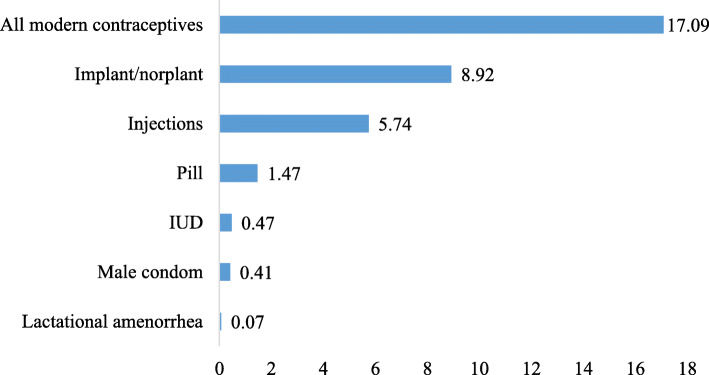
The prevalence of modern contraceptive use among adolescent girls and young women in Mali was 17.1% [95% CI, 15-19%]. Adolescent girls and young women who were married [aOR = 0.20, CI = 0.09-0.41], had no formal education [aOR = 0.43, CI = 0.32-0.59], in the poorest wealth quintile [aOR = 0.38, CI = 0.19-0.79] and had no children [aOR = 0.38, CI = 0.27-0.53] were less likely to use modern contraceptives. Similarly, those who had low knowledge of modern contraception [aOR = 0.60, CI = 0.42-0.85] and whose ideal number of children was six or more [aOR = 0.66, CI = 0.43-0.99] were less likely to use modern contraceptives. However, those with four or more births were more likely to use modern contraceptives [aOR = 1.85, CI = 1.24-2.77].
Modern contraceptive use among adolescent girls and young women in Mali has improved slightly relative to the prevalence of 2012, though the prevalence is still low, compared to the prevalence in other sub-Saharan African countries and the prevalence globally. Individual-level factors such as marital status, educational level, wealth quintile, parity, ethnicity and ideal number of children were associated with the use of modern contraceptive among adolescent girls and young women in Mali. Community knowledge of modern contraceptives was found as a community-level factor associated with modern contraceptive use among adolescent girls and young women. Therefore, Mali's Ministry of Health and Public Hygiene's Health Promotion and Education unit should prioritise and intensify contraceptive education to increase coverage of modern contraceptive use and address disparities in the use of modern contraceptives. Such education should be done, taking into consideration factors at the individual and community-level of the target population.
意外怀孕是撒哈拉以南非洲地区一项重大的公共卫生挑战,在年轻人中尤为突出,他们更有可能生育间隔过短并经历不良产科结局。关于现代避孕方法使用情况的研究大多集中在一般育龄妇女,而对马里青少年和年轻女性(15 - 24岁)中与现代避孕方法使用相关的因素关注有限。我们利用2018年马里人口与健康调查数据,研究了该年龄组中与现代避孕方法使用相关的个人和社区层面因素。
我们分析了2639名青春期女孩和年轻女性的数据,我们感兴趣的结果是现代避孕方法的当前使用情况。我们使用频率和百分比进行描述性分析,并使用混合效应多级逻辑回归进行推断性分析。混合效应多级逻辑回归的结果以调整后的优势比及其相应的95%置信区间呈现。
马里青春期女孩和年轻女性中现代避孕方法的使用率为17.1%[95%置信区间,15 - 19%]。已婚的青春期女孩和年轻女性[aOR = 0.20,置信区间 = 0.09 - 0.41]、未接受正规教育的[aOR = 0.43,置信区间 = 0.32 - 0.59]、处于最贫困财富五分位数的[aOR = 0.38,置信区间 = 0.19 - 0.79]以及没有孩子的[aOR = 0.38,置信区间 = 0.27 - 0.53]使用现代避孕方法的可能性较小。同样,对现代避孕知识了解较少的[aOR = 0.60,置信区间 = 0.42 - 0.85]以及理想子女数为六个或更多的[aOR = 0.66,置信区间 = 0.43 - 0.99]使用现代避孕方法的可能性较小。然而,生育四个或更多子女的人使用现代避孕方法的可能性更大[aOR = 1.85,置信区间 = 1.24 - 2.77]。
与2012年的使用率相比,马里青春期女孩和年轻女性中现代避孕方法的使用情况略有改善,不过与其他撒哈拉以南非洲国家的使用率以及全球使用率相比,该使用率仍然较低。个人层面的因素,如婚姻状况、教育水平、财富五分位数、生育次数、种族和理想子女数,与马里青春期女孩和年轻女性使用现代避孕方法有关。社区对现代避孕方法的了解被发现是与青春期女孩和年轻女性使用现代避孕方法相关的社区层面因素。因此,马里卫生与公共卫生部的健康促进与教育部门应优先并加强避孕教育,以提高现代避孕方法的使用覆盖率,并解决现代避孕方法使用方面的差异。这种教育应在考虑目标人群个人和社区层面因素的情况下进行。
