Solanke Bola Lukman, Oyinlola Funmilola Folasade, Oyeleye Olaoye James, Ilesanmi Benjamin Bukky
1Department of Demography and Social Statistics, Obafemi Awolowo University, Ile-Ife, Nigeria.
Action Against Hunger, ACF-International, Damaturu, Yobe State Nigeria.
Contracept Reprod Med. 2019 Sep 2;4:11. doi: 10.1186/s40834-019-0093-1. eCollection 2019.
Unmet need for modern contraceptive remains a critical reproductive health challenge in Nigeria. Numerous studies in Nigeria and other countries have investigated the patterns, prevalence and associated factors of unmet contraceptive need. In spite of these, the associated factors of unmet contraceptive need in Northern Nigeria have remained insufficiently explored. The few studies that focused on Northern Nigeria have mainly examined maternal individual factors leaving out higher level factors such as community-level factors that may be associated with unmet contraceptive need. This study examines the extent to which maternal and community factors are associated with unmet contraceptive need in Northern Nigeria.
Data was pooled from 2008 to 2013 Nigeria Demographic and Health Surveys. A weighted sample size of 26,730 women was analysed. The outcome variable was unmet contraceptive need, dichotomised into no unmet need and unmet need. The explanatory variables were individual maternal characteristics such as age, education, number of living children, age at marriage, pregnancy termination experience, and death of a child, and selected community characteristics such as community socioeconomic status, community literacy level, community knowledge of modern contraceptive and geo-political zone. The Multilevel Logistic Regression Model (MLRM) was applied.
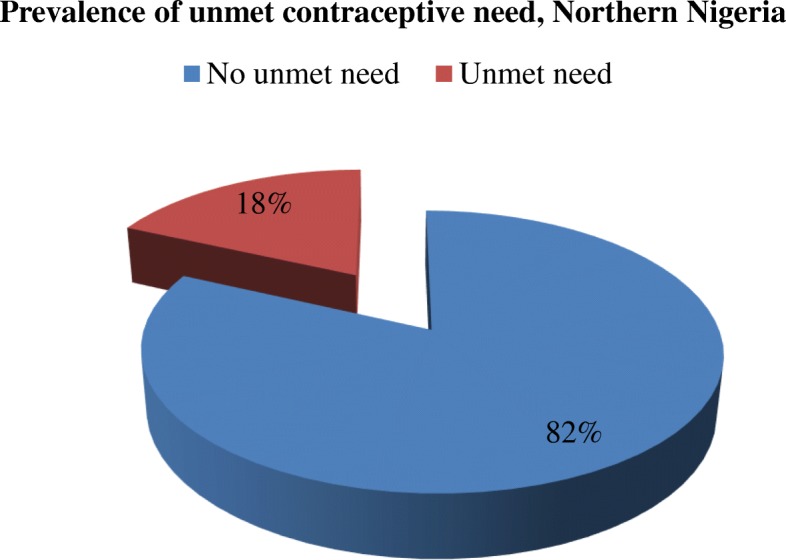
Results showed a prevalence of 18% unmet contraceptive need among Northern women in Nigeria. Maternal age of 35 years or older (AOR = 0.873; < 0.05, CI: 0.780-0.976), having five or more living children (AOR = 1.813; < 0.001, CI: 1.663-1.977), higher maternal education (AOR = 0.787; < 0.05, CI: 0.625-0.993), and never experience death of a child (AOR = 0.866; < 0.001, CI: 0.805-0.933) are the maternal factors significantly associated with unmet contraceptive need, while high community literacy level (AOR = 1.230; < 0.05, CI: 1.041-1.454), moderate (AOR = 0.862; < 0.05, CI: 0.767-0.968) or high (AOR = 0.821; < 0.05, CI: 0.726-0.929) community knowledge of modern contraceptive, and geo-political zone of residence are the community-level characteristics significantly associated with unmet contraceptive need among women in Northern Nigeria.
Maternal and community factors are significantly associated with unmet contraceptive need, but based on the ICC maternal factors have more significance in Northern Nigeria. The expansion of existing family planning delivery points to cover all communities including rural and remote areas in the region is imperative.
现代避孕需求未得到满足仍是尼日利亚面临的一项关键生殖健康挑战。尼日利亚及其他国家的众多研究已对避孕需求未得到满足的模式、患病率及相关因素进行了调查。尽管如此,尼日利亚北部避孕需求未得到满足的相关因素仍未得到充分探究。少数针对尼日利亚北部的研究主要考察了孕产妇个体因素,而忽略了可能与避孕需求未得到满足相关的更高层面因素,如社区层面因素。本研究考察了尼日利亚北部孕产妇因素和社区因素与避孕需求未得到满足之间的关联程度。
数据来自2008年至2013年尼日利亚人口与健康调查。对加权样本量为26730名妇女的数据进行了分析。结果变量为避孕需求未得到满足,分为无未满足需求和有未满足需求。解释变量包括孕产妇个体特征,如年龄、教育程度、存活子女数、结婚年龄、终止妊娠经历和子女死亡情况,以及选定的社区特征,如社区社会经济地位、社区识字水平、社区对现代避孕方法的了解程度和地理政治区域。应用了多水平逻辑回归模型(MLRM)。
结果显示,尼日利亚北部妇女中避孕需求未得到满足的患病率为18%。35岁及以上的孕产妇年龄(比值比[AOR]=0.873;P<0.05,置信区间[CI]:0.780 - 0.976)、有五个或更多存活子女(AOR = 1.813;P<0.001,CI:1.663 - 1.977)、较高的孕产妇教育程度(AOR = 0.78