Lee Nicole S M, Clements Gopalasamy R, Ting Adeline S Y, Wong Zhi H, Yek Sze H
School of Science, Monash University Malaysia, Bandar Sunway, Selangor, Malaysia.
Department of Biological Sciences and Jeffrey Sachs on Sustainable Development, Sunway University, Bandar Sunway, Selangor, Malaysia.
PeerJ. 2020 Oct 1;8:e10033. doi: 10.7717/peerj.10033. eCollection 2020.
Human population growth has led to biodiversity declines in tropical cities. While habitat loss and fragmentation have been the main drivers of urban biodiversity loss, man-made interventions to reduce health risks have also emerged as an unintentional threat. For instance, insecticide fogging to control mosquito populations has become the most common method of preventing the expansion of mosquito-borne diseases such as Dengue. However, the effectiveness of fogging in killing mosquitoes has been called into question. One concern is the unintended effect of insecticide fogging on non-target invertebrates that are crucial for the maintenance of urban ecosystems. Here, we investigate the impacts of fogging on: (1) target invertebrate taxon (Diptera, including mosquitoes); (2) non-target invertebrate taxa; and (3) the foraging behavior of an invertebrate pollinator taxon (Lepidoptera) within an urban tropical forest.
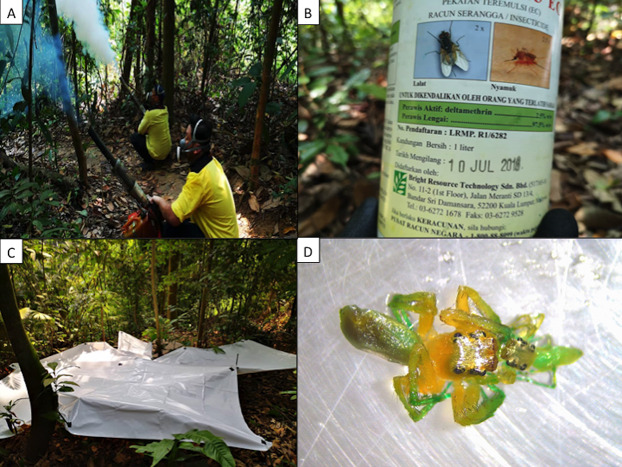
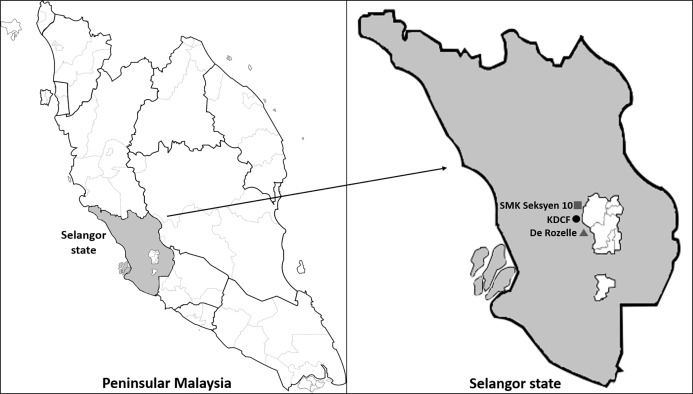
We carried out fogging with Pyrethroid insecticide (Detral 2.5 EC) at 10 different sites in a forest situated in the state of Selangor, Peninsular Malaysia. Across the sites, we counted the numbers of knocked-down invertebrates and identified them based on morphology to different taxa. We constructed Bayesian hierarchical Poisson regression models to investigate the effects of fogging on: (1) a target invertebrate taxon (Diptera) 3-h post-fogging; (2) selected non-target invertebrate taxa 3-h post-fogging; and (3) an invertebrate pollinator taxon (Lepidoptera) 24-h post-fogging.
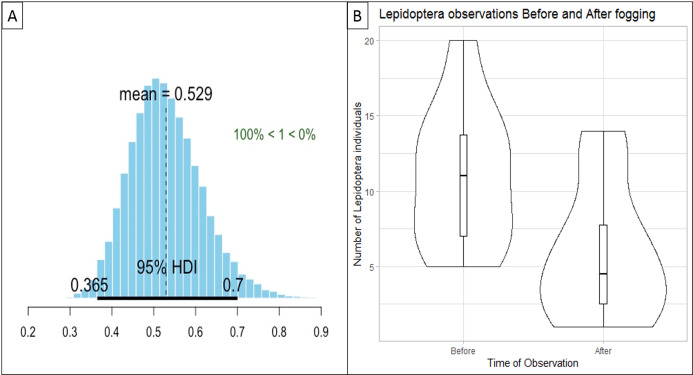
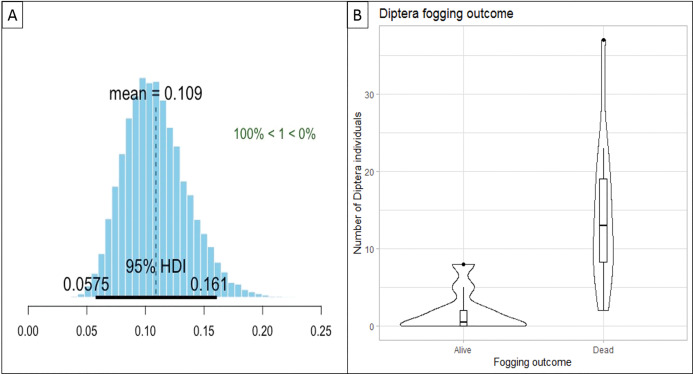
A total of 1,874 invertebrates from 19 invertebrate orders were knocked down by the fogging treatment across the 10 sites. Furthermore, 72.7% of the invertebrates counted 3-h post-fogging was considered dead. Our regression models showed that given the data and prior information, the probability that fogging had a negative effect on invertebrate taxa 3-h post-fogging was 100%, with reductions to 11% of the pre-fogging count of live individuals for the target invertebrate taxon (Diptera), and between 5% and 58% of the pre-fogging count of live individuals for non-target invertebrate taxa. For the invertebrate pollinator, the probability that fogging had a negative effect 24-h post-fogging was also 100%, with reductions to 53% of the pre-fogging count of live individuals.
Our Bayesian models unequivocally demonstrate that fogging has detrimental effects on one pollinator order and non-target invertebrate orders, especially taxa that have comparatively lower levels of chitinisation. While fogging is effective in killing the target order (Diptera), no mosquitos were found dead in our experiment. In order to maintain urban biodiversity, we recommend that health authorities and the private sector move away from persistent insecticide fogging and to explore alternative measures to control adult mosquito populations.
人口增长导致热带城市生物多样性下降。虽然栖息地丧失和破碎化一直是城市生物多样性丧失的主要驱动因素,但为降低健康风险而进行的人为干预也已成为一种无意的威胁。例如,喷洒杀虫剂以控制蚊虫数量已成为预防登革热等蚊媒疾病传播的最常用方法。然而,喷洒杀虫剂灭蚊的效果受到质疑。一个担忧是杀虫剂喷洒对维持城市生态系统至关重要的非目标无脊椎动物产生的意外影响。在此,我们研究喷洒杀虫剂对以下方面的影响:(1)目标无脊椎动物类群(双翅目,包括蚊子);(2)非目标无脊椎动物类群;(3)城市热带森林中一个无脊椎动物传粉类群(鳞翅目)的觅食行为。
我们在马来西亚半岛雪兰莪州的一片森林中的10个不同地点,用拟除虫菊酯杀虫剂(敌杀死2.5乳油)进行喷洒。在各个地点,我们统计被击倒的无脊椎动物数量,并根据形态将它们鉴定到不同类群。我们构建贝叶斯分层泊松回归模型,以研究喷洒杀虫剂对以下方面的影响:(1)喷洒后3小时的目标无脊椎动物类群(双翅目);(2)喷洒后3小时选定的非目标无脊椎动物类群;(3)喷洒后24小时的无脊椎动物传粉类群(鳞翅目)。
在10个地点,喷洒处理共击倒了来自19个无脊椎动物目的1874只无脊椎动物。此外,喷洒后3小时统计的无脊椎动物中有72.7%被认为死亡。我们的回归模型表明,根据数据和先验信息,喷洒杀虫剂在喷洒后3小时对无脊椎动物类群产生负面影响的概率为100%,目标无脊椎动物类群(双翅目)存活个体数量降至喷洒前数量的11%,非目标无脊椎动物类群存活个体数量降至喷洒前数量的5%至58%。对于无脊椎动物传粉者,喷洒后24小时产生负面影响的概率也为100%,存活个体数量降至喷洒前数量的53%。
我们的贝叶斯模型明确表明,喷洒杀虫剂对一个传粉目和非目标无脊椎动物目有有害影响,特别是几丁质化水平相对较低的类群。虽然喷洒杀虫剂对目标目(双翅目)有效,但在我们的实验中未发现有蚊子死亡。为了维持城市生物多样性,我们建议卫生当局和私营部门摒弃持续喷洒杀虫剂的做法,探索控制成年蚊子数量的替代措施。