Marini Danila, Kearton Tellisa, Ouzman Jackie, Llewellyn Rick, Belson Sue, Lee Caroline
School of Environmental and Rural Science, University of New England, Armidale, New South Wales, Australia.
Agriculture and Food, Commonwealth Scientific and Industrial Research Organisation, Armidale, New South Wales, Australia.
PeerJ. 2020 Sep 30;8:e10066. doi: 10.7717/peerj.10066. eCollection 2020.
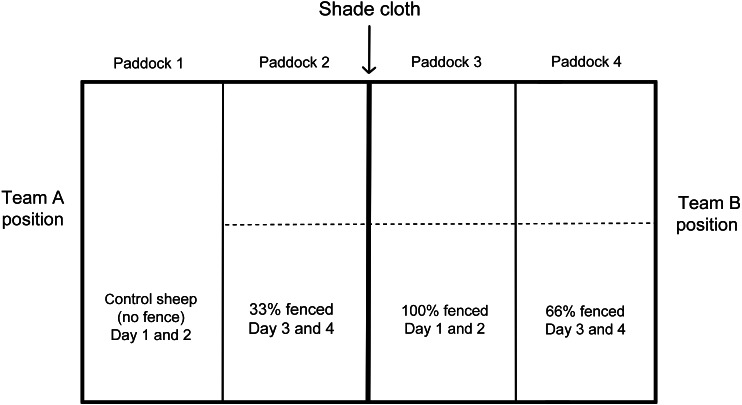
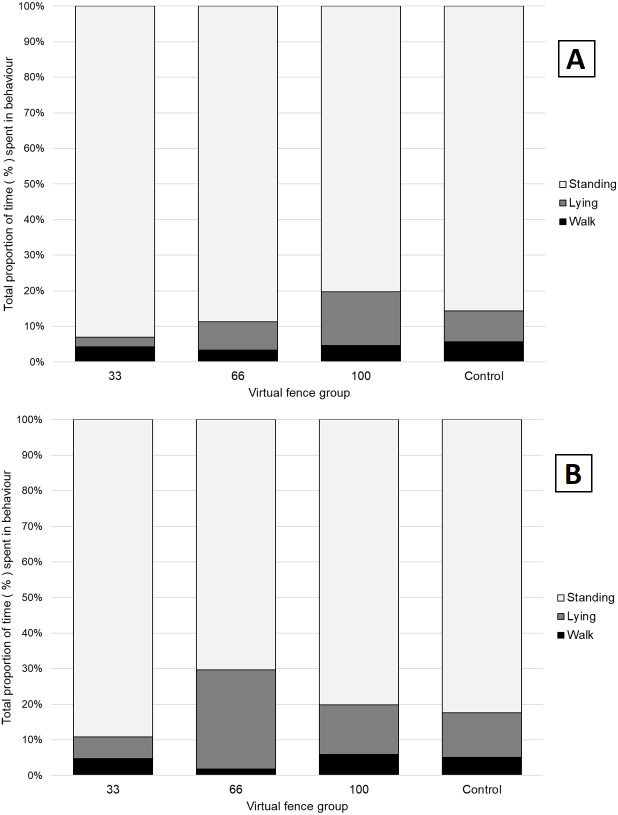
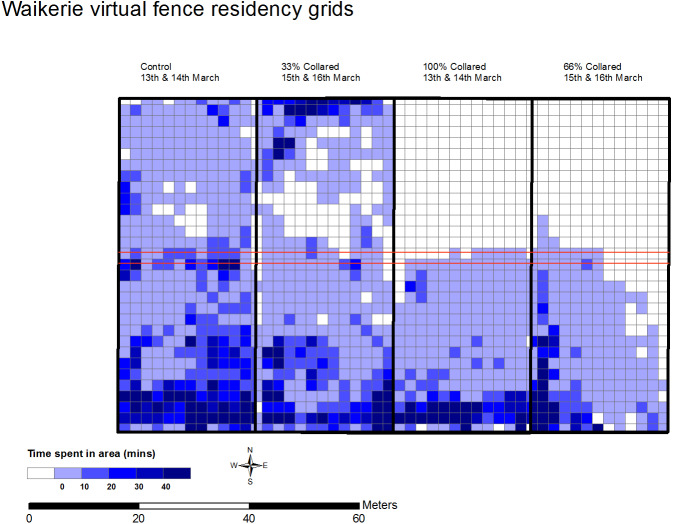
Early virtual fencing trials have effectively contained small groups of sheep within set areas of a paddock when all animals were wearing manual electronic collars. With sheep farming commonly involving large flocks, a potential cost-effective application of virtual fencing would involve applying equipment to only a proportion of the flock. In this study, we tested the ability of virtual fencing to control a small flock of sheep with differing proportions of the group exposed to the virtual fence (VF). Thirty-six Merino sheep were identified as leaders, middle or followers by moving them through a laneway. The sheep were then allocated to groups balanced for order of movement. The groups ( = 9 per group) included applying the VF to the following proportions of animals within each group: (1) 100% ( = 9 VF) (2) 66% ( = 6 VF; = 3 no VF) (3) 33% ( = 3 VF; = 6 no VF) (4) 0% (no VF; free to roam the paddock). The groups were given access to their own paddock (80 × 20 m) for two consecutive days, six hours per day, with the VF groups prevented from entering an exclusion zone that covered 50% of the north side of the paddock. During these hours, VF interactions, behavioural time budgets, and body temperature were recorded as measures of stress, and location was tracked with GPS. Group 100% VF and Control were tested on the first two days and groups 33% VF and 66% VF were tested on the following two days. During VF implementation the 100% VF and 66% VF group were successfully prevented from entering the exclusion zone. Having only 33% of the flock exposed to the virtual fence was not successful, with the sheep pushing forward through the VF to join flock mates in the exclusion zone. For learning to respond to the audio cue, sheep in the 33% group received more electrical stimuli with a 0.51 proportion for the ratio of electrical stimuli to audio cue, compared to 0.22 and 0.28 for the 100% and 66% groups, respectively. There were small differences in behavioural patterns of standing and lying on both days of testing, with the 100% VF and 66% VF groups spending more time lying. Although stress-induced hyperthermia did not occur in any of the VF groups, body temperature differed in the 33% VF group. There were no differences in temperature measures between the control and 100% VF animals. This study demonstrates that for a short period, controlling two-thirds of the flock was equally as effective as virtually fencing all animals, while controlling one-third of a flock with a virtual fence was not effective. For the short term, it appears that implementing the VF to a proportion of the flock can be an effective method of containment. Due to the limitations of this study, these results warrant further testing with larger flocks and for longer periods.
早期的虚拟围栏试验在所有动物都佩戴手动电子项圈时,有效地将一小群绵羊限制在围场的指定区域内。由于养羊通常涉及大量羊群,虚拟围栏一个潜在的具有成本效益的应用是仅对一部分羊群应用设备。在本研究中,我们测试了虚拟围栏控制一小群绵羊的能力,其中不同比例的羊群暴露于虚拟围栏(VF)。通过让36只美利奴绵羊在一条巷道中移动,将它们分为领导者、中间者或跟随者。然后将绵羊分配到按移动顺序平衡的组中。这些组(每组(n = 9)只)包括对每组内以下比例的动物应用虚拟围栏:(1)100%((n = 9)只带VF)(2)66%((n = 6)只带VF;(n = 3)只不带VF)(3)33%((n = 3)只带VF;(n = 6)只不带VF)(4)0%(不带VF;可在围场自由漫游)。这些组连续两天每天有6小时进入它们自己的围场(80×20米),带虚拟围栏的组被阻止进入覆盖围场北侧50%的禁区。在这些时间里,记录虚拟围栏交互、行为时间分配和体温作为应激指标,并用GPS跟踪位置。100% VF组和对照组在前两天进行测试,33% VF组和66% VF组在接下来的两天进行测试。在实施虚拟围栏期间,100% VF组和66% VF组成功被阻止进入禁区。仅让33%的羊群暴露于虚拟围栏并不成功,绵羊会向前推挤通过虚拟围栏去与禁区内的同伴会合。对于学习对音频提示做出反应,33%组的绵羊接受了更多电刺激,电刺激与音频提示的比例为0.51,而100%组和66%组分别为0.22和0.28。在测试的两天中,站立和躺卧的行为模式存在微小差异,100% VF组和66% VF组躺卧的时间更多。虽然任何虚拟围栏组都未出现应激性体温过高,但33% VF组的体温有所不同。对照组和100% VF组动物的体温测量值没有差异。本研究表明,在短时间内,控制三分之二的羊群与对所有动物进行虚拟围栏同样有效,但用虚拟围栏控制三分之一的羊群则无效。短期内,对一部分羊群实施虚拟围栏似乎是一种有效的限制方法。由于本研究的局限性,这些结果需要用更大的羊群和更长的时间进行进一步测试。